
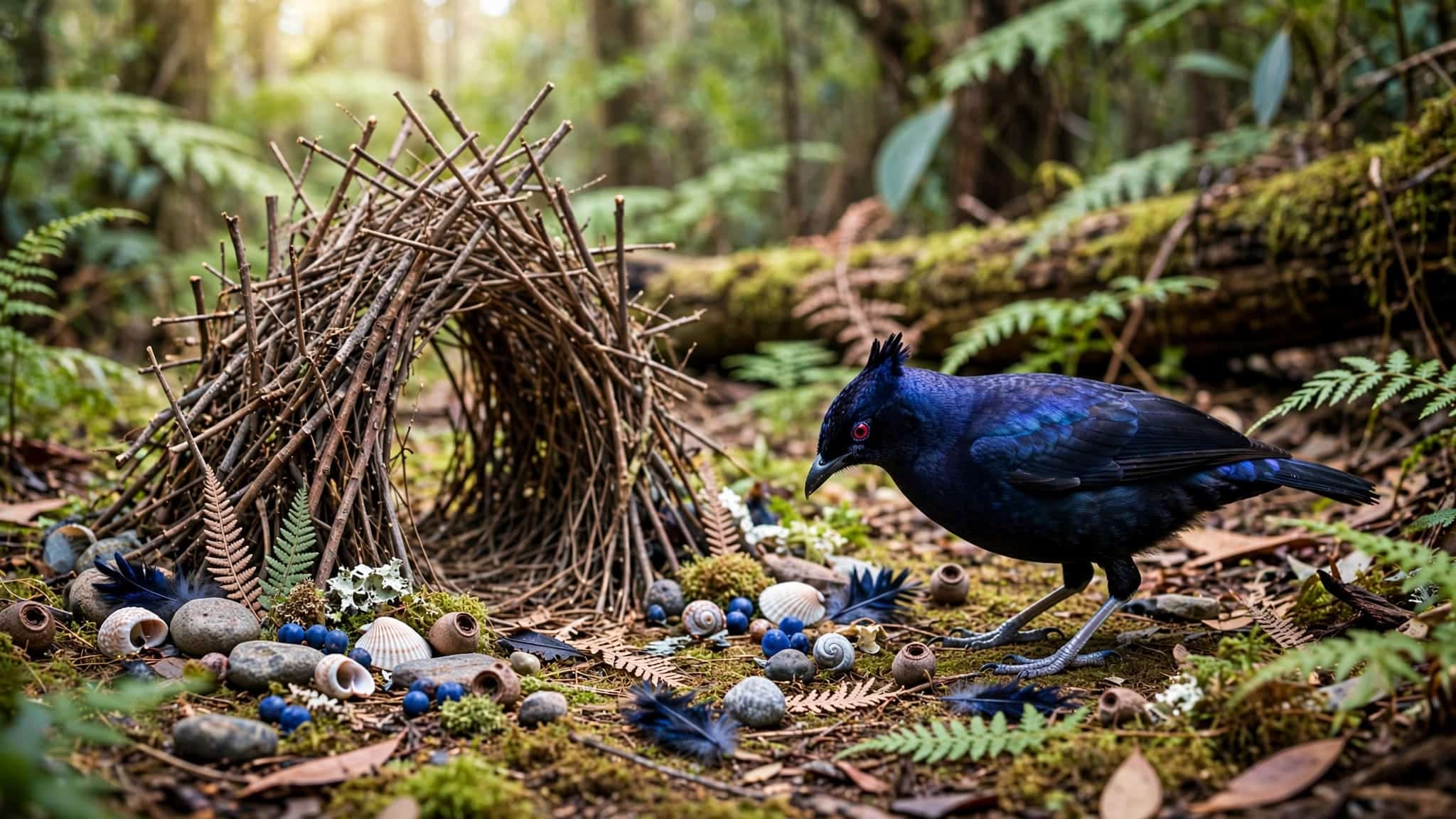
A bowerbird’s “home” is not really a home at all. It is a courtship stage, built and decorated by a male who is trying to persuade a female that he is worth her time.
That is what makes bowerbird mating displays so strange and so impressive. The bird is not relying on feathers, song, or a dramatic dance alone. He is arranging sticks, berries, shells, stones, insect parts, and sometimes bits of human litter with the concentration of someone preparing a very important dinner party.
The result is one of nature’s clearest examples of courtship turning into architecture.
This post may contain affiliate links. If you make a purchase through these links, I may earn a small commission at no extra cost to you.
Why males build a bower instead of a nest
Female bowerbirds build the actual nest and raise the young. The male’s bower is a separate structure, used to attract visitors and conduct courtship. It is less nursery, more showroom.
The exact materials differ by species and habitat. A male may gather leaves, flowers, beetle wings, snail shells, berries, bones, feathers, plastic caps, and anything with the right colour or shine. Other males may steal them, which makes bower ownership a surprisingly demanding job.
A display outside the body
In evolutionary biology, a bower is often described as an extended phenotype. That means it is an outward expression of an animal’s genes and behaviour, even though it sits outside the animal’s body.
A male’s plumage is part of him. His bower is something he makes, repairs, defends, paints, rearranges, and keeps tidy. It gives a female more to judge than his appearance during a brief encounter.
This is one reason animal courtship behaviors can look so wildly different across species. Some animals sing. Some dance. A bowerbird builds a tiny gallery and hopes the visitor likes the curation.
Female mate choice keeps the pressure on
A bower takes time, energy, and attention. It can also attract rivals who want to wreck it or nick the best decorations. A male who can rebuild after a raid, hold a territory, and keep finding desirable objects may be showing that he is healthy, alert, and persistent.
That doesn’t mean females choose only the bird with the biggest pile of blue plastic. Courtship is more complicated than that. The bower, the male’s condition, his display movements, his behaviour around a female, and her own preferences can all affect the outcome.
Not every bowerbird builds the same way
Bowerbirds belong to the family Ptilonorhynchidae. They live in Australia, New Guinea, and nearby islands, but their courtship styles don’t follow one shared blueprint.
The family includes birds that build towering structures, birds that build stick corridors, and true catbirds that skip bowers altogether. These structures serve courtship, not ordinary nesting. For a broader look at how birds fit within larger animal groups, animal classification basics is a useful starting point.
True catbirds take another route
True catbirds are bowerbirds, but they don’t build decorative bowers. They’re socially monogamous, and their courtship doesn’t centre on a purpose-built display structure.
That distinction matters. Calling every member of the family a bower builder is a bit like saying every relative at Christmas is responsible for the pudding. Technically related, wildly different contribution.
Maypole bower and avenue bower
Maypole-builders, including the golden bowerbird (Prionodura newtoniana) and species in the genus Amblyornis, construct tower-like structures around a central sapling or stout twig. The bower rises around that support, often with a decorated court nearby.
Avenue-builders take a different approach. The satin bowerbird (Ptilonorhynchus violaceus), regent bowerbirds, spotted bowerbirds, and the great bowerbird build two parallel walls from upright sticks and grasses. The walls create a narrow passage, called an avenue, where the female can sit while the male performs outside.
The shapes are different because they guide courtship in different ways. One is a tower. The other is a corridor with an audience seat built in.
How bowerbird mating displays play with sight
The great bowerbird (Ptilonorhynchus nuchalis) turns the avenue bower into a set of visual illusions. A female usually looks out from inside the corridor, giving the male a predictable field of view.
That fixed viewing position lets him control what she sees, when she sees it, and how large it appears.
Forced perspective makes objects look more dramatic
Great bowerbirds arrange pale objects in front of their bowers so larger items sit farther away and smaller items sit closer. To a female looking from the avenue, the display court can appear more even in size and depth than it really is.
It is a form of forced perspective, the same basic visual principle that lets a tourist photo make somebody appear to hold up the Leaning Tower of Pisa. The bird is not carrying a camera or directing anyone to move a little to the left. He has built the illusion into the ground.
Research on visual effects in great bowerbird sexual displays found that display quality was linked with mating success. That finding doesn’t show that forced perspective alone determines reproduction. Getting the effect right requires repeated placement, comparison, and adjustment.

Red walls can alter colour perception
A great bowerbird may paint the inside walls of his avenue with a reddish mixture, often made from plant material and saliva. While a female spends time inside that reddish space, her eyes may adapt to the colour.
When the male suddenly presents a vivid object or exposes his pink nuchal crest, the colour can appear more striking against the adjusted visual background. This effect is called chromatic adaptation.
The detail is easy to miss because the bower looks like a heap of sticks from a distance. Yet it is a controlled viewing environment. The California Academy of Sciences explains the optical illusions as courtship strategies shaped around the female’s point of view.
Why bright decorations stay out of sight
A male great bowerbird doesn’t always leave his best objects sitting where a female can admire them all afternoon. He may keep colourful decorations outside her direct view, then lift, flash, move, or reveal them during the display.
That timing matters. A bright red item is less startling after lying in plain sight for ten minutes. A sudden burst of colour, movement, or a raised crest is harder to ignore.
The male also has another problem: females can be wary. A large bird rushing at the bower with a loud display may look impressive, but it may also look alarming. The avenue gives the female a sheltered viewing position while maintaining some distance.
A bowerbird courtship display isn’t simply decoration. Concealment, timing, movement, and the female’s viewing position shape how she perceives the signal, but none guarantees attention or mating.

What a well-kept bower may reveal
A decorated bower can give a female clues about a male’s abilities, but scientists avoid treating one feature as the whole story. A handsome bird can have a messy bower. A diligent builder can lose prized objects to a rival.
What matters is the wider pattern of behaviour over time.
Parasites may leave visible clues
One long-standing idea in sexual selection is that displays may reveal resistance to parasites. In some bowerbird research, plumage reflectance has been associated with internal parasite infection, while bower quality has been linked with external parasites.
The theory is plausible, but it remains a hypothesis that varies across species and studies. An unhealthy male may have less energy for collecting, defending, repairing, and displaying. Still, parasite-related evidence isn’t universal.
A female isn’t running a laboratory test from inside a stick corridor. She’s responding to visible condition and behaviour that may, over many generations, help her choose a capable mate.
Building skill also calls for brainpower
A forced-perspective display can’t happen by accident. The male must place objects in a pattern, maintain it after wind or theft, and make alterations that improve the view from one location.
A 2010 study of the great bowerbird linked variation in illusion quality with female choice. It doesn’t prove that intelligence directly causes mating success. It does suggest that cognitive ability, spatial judgement, problem-solving, memory, and persistence may contribute to a male’s success.
A bower isn’t evidence that a male can build anything useful for a family. It’s evidence that he can sustain a difficult display while rivals keep trying to spoil it.
The point of all that collecting
A satin bowerbird is famous for favouring blue objects. Other species may prefer white, green, red, yellow, or a mix that suits their own display style. An item may be natural or borrowed from human litter, but its placement, visibility, and use during the display can matter as much as its colour.
A bottle cap tossed into the bush is litter. Selected, guarded, repositioned, and shown at the right moment, it becomes part of a male’s courtship signal. Nature is not always subtle, and neither is a bird with a taste for bright objects.
The bower also lets female choice act on several traits at once. She can assess the structure, the objects, the male’s movements and confidence, the bower’s condition, and his response when things go wrong. A rival’s raid can turn an immaculate bower into a disaster before lunch.
Key takeaways
Bowerbirds decorate because females often choose mates partly through the quality of a male’s courtship display. The bower is not a nest, and it is not a cosy bachelor pad. It is a temporary performance space.
Avenue bowers guide the female’s view through a stick corridor. Maypole bowers rise around a central support. Great bowerbirds take visual control further by arranging forced perspective and using colour at carefully chosen moments.
The impressive part is not any single shell, berry, or scrap of plastic. It is the male’s ability to turn a patch of forest floor into a display that a female notices and trusts.
Frequently asked questions
Do female bowerbirds live in the bower?
No. Females visit bowers during courtship, but they build separate nests for laying eggs and raising chicks. The male’s structure is mainly for attracting mates, not for housing a family.
Do bowerbirds steal decorations from one another?
They do. Male bowerbirds may raid nearby bowers and take valuable objects. That theft adds another layer to courtship because a male must find decorations, protect them, and replace them when a rival makes off with the good stuff.
Can people watch bowerbird courtship safely?
Yes, if they give the birds plenty of space and never alter a bower or its decorations. Breeding areas are sensitive, and a close approach can interrupt the behaviour you hoped to see. These ethical bird photography tips help keep observation respectful.
The bower is the message
Bowerbirds decorate because their displays give females a fuller picture of the male behind the feathers. A well-made bower can show persistence, visual judgement, condition, and a talent for making ordinary objects look extraordinary.
The next time you see a photo of one, remember that the sticks are not the home. They are the audition.


