
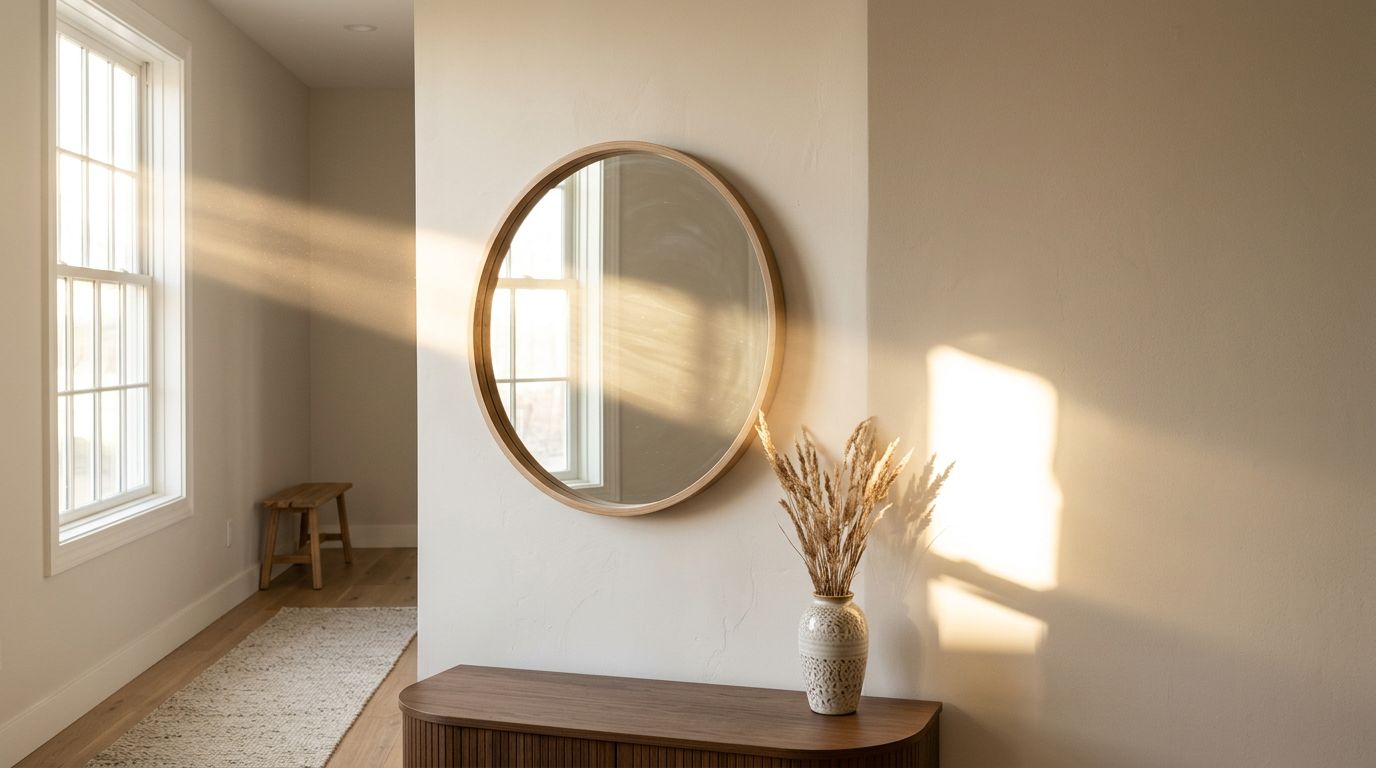
You catch a patch of sunlight in a mirror, and suddenly it appears on the opposite wall. Did the mirror make the room brighter, or did it simply move the light around?
To understand how mirrors reflect light, you need two things: a reflective surface and a way for light to reach it. The interesting part is what happens when that light arrives, and why a mirror gives you an image while a painted wall doesn’t.
This post may contain affiliate links. If you make a purchase through these links, I may earn a small commission at no extra cost to you.
How mirrors reflect light: the short answer
A mirror reflects light because its smooth, usually metallic surface sends incoming light back in an orderly direction. This predictable path is one of the properties of light. Shine a flashlight at a mirror, and the beam leaves at a predictable angle. Move the flashlight, and the reflected beam moves too.
That may sound like something the glass does. In most household mirrors, though, the glass mainly protects a transparent layer of reflective material. Light passes through it, reaches a thin metal coating behind it, and returns through the glass to your eyes.
The surface needs light to work with. A mirror in a completely dark room has nothing to reflect. Give it a lamp, a window, or even faint light from a phone screen, and it can redirect some of that light. It cannot create more.
The same idea explains both the face you see in a bathroom mirror and the bright patch you can steer across a room. One follows the path of light back to your eyes. The other follows it onto a wall.
What the law of reflection tells you

The angles match
Imagine drawing a line straight out from the mirror where light hits it. Physicists call that imaginary line the normal. Measure the incoming beam’s angle against it, then measure the outgoing beam’s angle the same way. This predictable geometry comes from the properties of light and is described by the law of reflection.
The law of reflection says the angle of incidence and the angle of reflection are equal when measured from the normal. A beam arriving at 30 degrees to the normal leaves at 30 degrees on the other side. The rule works whether you’re directing a flashlight across a room or tracing sunlight from a window.
Measure from the mirror itself instead, and the geometry gets muddled. That’s why the normal matters.
Why you see an image behind the glass
Your eyes receive light that bounced off the mirror, but your brain traces it backward in a straight line. Those apparent paths meet behind the mirror. That’s where your reflection seems to stand, although no light is actually gathering there.
In a flat mirror, your image appears as far behind the surface as you are in front of it. Step closer, and it steps closer too. It’s a convincing arrangement for something made entirely of redirected light.
What happens when light reaches the metal
The angle rule describes where light goes. It doesn’t say why metal is so good at sending it there.
Mobile electrons respond to the light
Light is an electromagnetic wave. At the molecular level, its changing electric field pushes on mobile electrons in a metal such as silver or aluminum. Their collective response sends energy away from the surface. On a smooth metal surface, those responses combine to form reflected light waves.
Thinking of light as photons also works, but picturing tiny balls bouncing off individual atoms can be misleading. A clear reflection comes from the coordinated interaction of light with the surface, not a lucky series of miniature collisions.
Metal doesn’t send everything back. Some incoming energy is absorbed or reflected, and reflectivity science examines how the mirror’s construction affects how much returns. For a closer look at the wave picture, the physics of reflection connects this everyday rule with electromagnetic behavior.
Wavelength affects what comes back
The properties of light, including wavelength and frequency, help explain why materials respond differently across the spectrum. Visible light spans roughly 400 to 700 nanometers. The wavelength of light and light frequency are related, so shorter wavelengths correspond to higher frequencies. Silver reflects visible wavelengths broadly, helping a silver-backed mirror show colors without a strong tint. Gold reflects some visible wavelengths better than others, which is why it looks golden.
A surface can behave differently with light beyond what you can see. An ordinary mirror’s performance with infrared or ultraviolet light isn’t settled by how bright it looks to your eyes. Reflective always raises a useful follow-up question: reflective to which wavelengths?
Why a painted wall can’t show your face
Light reflects from many ordinary objects. The difference lies in how the properties of light shape the direction of the reflected rays.
Smoothness keeps the rays organized
A polished mirror produces specular reflection. Nearby incoming rays meet nearly the same surface angle and leave in an orderly pattern. Your eyes can use that pattern to make out an image.
A painted wall is a diffuse reflector. Its tiny bumps point in different directions, sending light widely and scrambling the pattern needed to recognize a face. The difference between specular and diffuse reflection is easier to spot when you compare a mirror with matte paint under the same lamp.
A smooth surface is judged relative to the wavelength of light, not by touch alone. A surface can feel smooth under your fingertip and still have enough tiny irregularities to blur a reflection.
Glass protects the reflective layer
A standard household mirror is often glass with a thin silver or aluminum coating on its back, covered by protective layers. At the molecular level, the metal coating responds to incoming light, while the glass keeps the surface flat and protects the metal.
Plain window glass reflects a little light at its front surface. You can see a faint version of yourself in a dark window when the room behind you is bright. Most light passes through, though, so you can also see what’s on the other side. A mirror’s metal backing returns far more of the incoming visible light.
Flat, concave and convex mirrors change the view
All three shapes follow the same reflection rule. The difference is that a curved surface points in a new direction at each spot where light lands.
Flat mirrors keep familiar proportions
A flat mirror forms an upright image with the same apparent size as the object. It’s the sensible choice when you want to check your collar rather than study an enlarged version of your nose.
Its field of view depends on its size and where you stand. A larger mirror lets you see more, but the reflection still follows the same angle rule at every point.
Concave mirrors bring rays together
A concave mirror curves inward, like the inside of a spoon. Parallel rays striking it can meet at a focus. Depending on how far you stand from the mirror, your image may look enlarged and upright or upside down.
That magnification is useful in some makeup mirrors and optical instruments. It also explains why a concave mirror placed in direct sunlight deserves care: concentrated sunlight can heat what it falls on. A flat decorative mirror doesn’t focus sunlight in that way.
Convex mirrors show more at once
A convex mirror bulges outward. It spreads reflected rays, giving you a wider view with smaller-looking objects. That’s handy for seeing around a corner or watching a shop aisle. It’s less helpful if you’re trying to decide whether a small mark is on your cheek or on the glass.
How to use a mirror to brighten a room

A mirror can move light into a dimmer part of a room and make the space feel more open, creating an illusion of space. It still has to catch light from somewhere. On a dark wall with no useful view, it may reflect another dark wall.
Watch where the daylight travels
Look at the room at the time you most want it to feel brighter. Where does sunlight enter, and which areas stay dim? A mirror beside or opposite a window may reflect the bright window, sky, or sunlit surfaces into the room. Its exact effect depends on the angles.
Try holding a small mirror in a few positions before hanging a large one. Watch what appears in it from the places you normally sit or stand. You can use the same observation when using natural light to highlight architectural features.
Size helps, but placement matters more
A large mirror can show more of a bright window, extending the apparent view and creating an illusion of space. A narrow mirror can still be effective if it catches light and directs it toward a useful spot. A mirrored splashback, for example, may brighten a work area while reflecting whatever you’ve left on the counter. A mirrored splashback can also redirect daylight onto a work surface. Good interior design balances a mirror’s effects on light and space.
Check for glare before fixing a mirror in place. A bright reflection at eye level can be annoying, especially near a television or desk. If the mirror faces direct sun, watch where the reflected light lands as the sun moves. The best spot sends light somewhere you want it, without making someone squint through lunch.
When a mirror loses its shine
Fingerprints, dust, and water spots scatter light at the front surface. They can soften a reflection even when the metal backing is fine. Cleaning the glass gently often restores the clear view; these bathroom mirror cleaning tips are useful when streaks keep getting in the way.
Damage behind the glass is another matter. Dark patches near a mirror’s edges can mean moisture has reached the reflective coating. Wiping the front won’t repair that layer.
This is one reason bathroom mirrors need sound edges and suitable ventilation. A mirror can obey the law of reflection perfectly and still give you a poor image if its surface is dirty or its backing is damaged.
Key Takeaways
A mirror needs incoming light, a smooth reflective surface, and the right angle to send light where you can see it. Its metal coating does most of the reflecting; the glass in front usually protects that coating.
The same physics explains a clear image and a brighter-looking room. In either case, the mirror redirects available light. It doesn’t produce its own.
Questions people often ask
Does a mirror work in complete darkness?
No. With no incoming light, there’s nothing for the mirror to send toward your eyes. Even a tiny amount of light can produce a reflection, but the image may be too faint to make out.
Does a mirror reverse left and right?
A flat mirror reverses the direction perpendicular to its surface: front to back. The familiar left-right puzzle comes from comparing your reflection with a person turned around to face you.
A photo can feel unfamiliar for another reason. You’re used to seeing your face in a mirror, while other people usually see its unreversed appearance. A close phone selfie can add perspective distortion if the camera is held near your face.
Can aluminum foil work like a mirror?
Foil reflects light, and a smooth piece may show a rough image. Its wrinkles and uneven surface scatter rays in slightly different directions, so the result won’t be as crisp as a household mirror. Smoothing it helps, but it won’t give foil the flatness of mirror glass.
The next time you catch your reflection
That face in the glass is light taking an orderly trip: in through the glass, back from the metal, and into your eyes. Turn the mirror, and you change where that light goes.
That is how one makes a mirror reflect light where it’s useful. Give it light to catch, keep its surface clear, and pay attention to the angle.


