
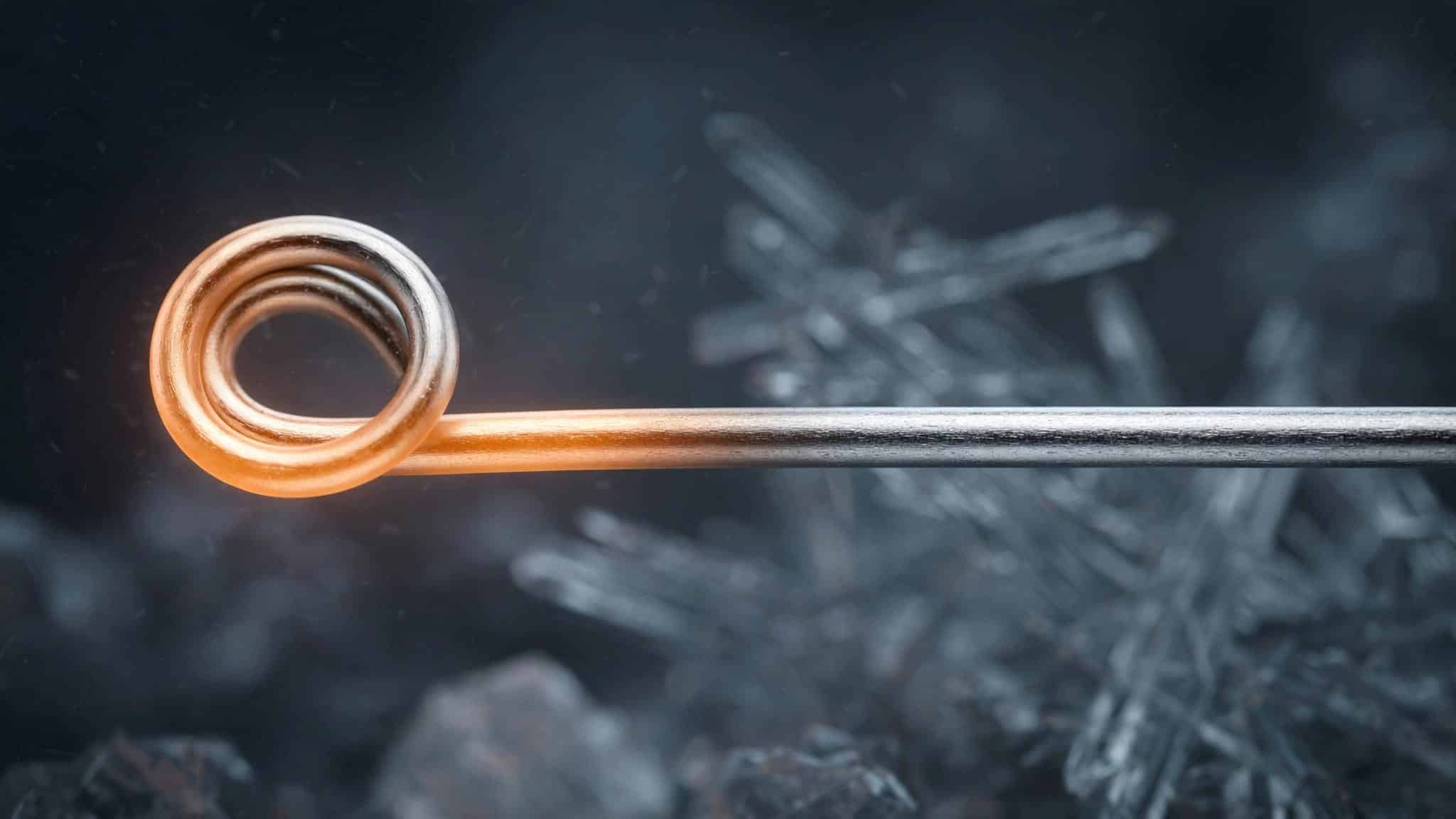
Bend an ordinary metal wire far enough, and it stays bent. Warm the right nickel-titanium wire, and it can curl back to its original shape. That’s the shape memory effect, not memory like a brain.
Shape memory alloys are smart materials that act like structures with two stable arrangements. Heat changes their crystal structure, allowing certain bends to undo themselves. The trick has useful limits, which become clearer once you see what changes inside the metal.
This post may contain affiliate links. If you make a purchase through these links, I may earn a small commission at no extra cost to you.
The short answer: the atoms can rearrange
Shape memory alloys have a shape set during manufacturing. Unlike elastic objects, cooled alloys can hold a temporary bend under mechanical load. Heat one past its transformation temperature, and its atoms rearrange into a different crystal structure, restoring its set shape.
This is a physical change, not memory in the way a brain stores an experience. The metal doesn’t recognize a particular curve. Its internal structure favors the shape it had when it was treated.

There’s an important condition: the bend must stay within the alloy’s recoverable strain limit. Twist it too far, and ordinary permanent damage takes over. Even a talented wire has its limits.
What changes inside shape memory alloys?
Metals contain atoms arranged in repeating patterns called lattices. In a shape memory alloy, heating and cooling drive a reversible phase transformation without requiring atoms to diffuse long distances through the metal. Two phases matter most: the austenite phase and the martensite phase.
Austenite holds the shape set by thermal treatment
Austenite is the high-temperature phase. Imagine a small tile pattern repeated throughout the wire. Thermal treatment establishes the geometry the material returns to when austenite reforms.
Cooling changes the pattern to the martensite phase. It doesn’t leave the metal as an empty slate, the atoms take on a different, more easily rearranged structure. NASA’s guide to shape memory alloys describes the ranges in which cooling and heating transformations begin and finish, rather than one magic transition temperature on a thermometer.
Martensite makes the bend possible
Freshly formed martensite often contains tiny regions arranged in different orientations, known as twins. Push on the wire, and some regions change orientation to accommodate the bend. Researchers call this detwinning.
Heating reverses the phase transformation. The original high-temperature phase forms again, and the piece moves toward its heat-set shape. The atoms follow a reversible route, provided the load and deformation stay within suitable limits.

You can’t watch individual atoms do this with a household magnifier. Studying a material’s crystal structure calls for specialized methods; polarizing microscopy for crystal analysis offers a closer look at one way researchers examine materials.
Why does the metal sometimes spring back without heat?
The familiar demonstration uses heat to straighten a bent wire. Some alloys can also recover from a substantial bend as soon as you release the force. The difference depends on the metal’s starting phase and what drives the phase transformation.
Shape memory needs a temperature change
In the usual one-way shape memory effect, a cooled piece is bent while it’s in the martensite phase. Heating restores its set shape. Cooling it again doesn’t automatically recreate the bend; something must deform it again.
A two-way shape memory effect is possible when repeated training or carefully designed internal stresses make the alloy adopt one shape when warm and another when cool. That sounds convenient, but the motion can be less stable over repeated cycles than a design using a separate spring to provide the return force.
Superelasticity uses force instead
Above the temperature where austenite is stable, a mechanical load can turn some austenite into martensite. Remove the load, and austenite reforms. The piece springs back without needing an extra blast of heat. This is superelasticity, also called pseudoelasticity.
That distinction matters for a dental archwire used in dental braces: it can bend during placement, then keep applying a gentle restoring force at mouth temperature. Its behavior depends on the alloy and how it was processed, not merely on being made of nickel and titanium.
The return trip also follows a different path from the outward one. That difference is called hysteresis, and it affects how precisely a device can move.
Why is Nitinol the alloy people actually use?
Nitinol is a nickel-titanium alloy named for nickel, titanium, and the Naval Ordnance Laboratory. It became the best-known member of the smart materials family because it offers useful shape recovery and superelastic behavior. Engineers can manufacture it as wire, tubes, and other forms.
Its transition temperature can be adjusted through composition and processing. That makes it possible to choose an alloy for room-temperature equipment or a device designed to work near body temperature. Nickel-titanium is also widely used in medical devices, but suitability depends on the finished device and its surface, not the alloy name alone.
There are cheaper material options. Copper-based alloys can show shape memory, while iron-based systems are attractive for larger parts and lower material costs. Their properties and processing needs differ, so neither is a simple substitute for Nitinol. A review of shape memory alloy systems compares nickel-titanium, copper-based, and iron-based approaches.
For a tiny medical part, the price of Nitinol may matter less than reliable performance. For a large actuator, material and manufacturing costs can change the decision.
How do you teach metal a shape?
“Training” sounds as if someone patiently demonstrates a circle until the wire catches on. The real process involves shaping, controlled heating, and testing.
First, set the geometry
A manufacturer forms the alloy into the desired shape and holds it there during a specified thermal treatment. For example, wire can be held around a fixture to set a curve. The required temperature and time depend on the alloy and product, and overheating can give the wire quite different properties.
This process sets the shape associated with austenite. It also affects the temperatures and forces at which the material transforms. A shape that looks right on the bench is only part of the job.
Then, check how it behaves in use
Manufacturers test transformation temperatures, movement under load, and performance over repeated cycles. Cutting, drawing, and surface finishing can affect the finished part. A tiny flaw matters when the same wire bends thousands of times.
If a device needs two-way motion, repeated thermal and mechanical cycling can train the alloy to behave that way. Many designs instead use one-way recovery with a conventional return spring. The spring makes the return motion less dependent on preserving a trained two-way effect.
For assemblies, testing loads and temperatures before manufacturing can help identify problems. Physical cycle tests are still necessary because a model cannot reveal every manufacturing flaw.
Where does a metal with memory earn its keep?
The useful question isn’t “Where could a bending wire go?” It’s “Where does controlled movement solve a problem without adding a bulky mechanism?”
Medical devices use movement and flexibility
In medical applications, Nitinol stents made from nickel-titanium can be compressed for delivery through a catheter and expand after placement. Superelasticity helps them tolerate movement in the body. Dental archwires used with dental braces apply pressure as teeth shift.
These aren’t interchangeable applications. A stent must be assessed for its particular anatomy, loads, surface condition, and lifetime. A 2025 study of strain in real Nitinol medical devices shows why measuring deformation across a finished component matters: strain doesn’t necessarily spread evenly through every bend.
Small actuators turn heat into motion
An actuator is a part that produces movement. Pass electrical current through a suitable shape-memory wire, and electrical resistance heats it. The wire contracts toward its set shape and can pull a latch or move a small mechanism.
Miniature actuators are an appealing match because a thin wire takes little space. Researchers have also developed thin-film nickel-titanium for miniature actuators, including work on microvalves and optical devices. The principle may also suit aerospace applications or consumer electronics, though heat flow and required force become harder to manage in larger equipment.
The awkward part: it has to cool down
A heated alloy can move quickly. Returning it to its starting condition often takes longer because it must lose heat to its surroundings. A thick wire holds more heat than a thin one, and a tightly enclosed device may cool slowly.
Why speed and precision can suffer
Heating doesn’t produce the same motion instantly at every point in a part. Cooling takes time too. Hysteresis means the temperature for the forward transformation differs from the temperature for the reverse one. If a mechanism needs an exact position at an exact moment, its designer must account for those differences.
Thin wires, better airflow, or a suitable heat sink can shorten cooling time. Each choice brings a trade-off: a thinner wire may deliver less force, while active cooling adds equipment.
Compared with hydraulic or pneumatic actuators, a shape-memory wire can make a small mechanism simpler and lighter. Fluid-powered systems may be a better choice when fast, repeated motion and precise control matter more than compactness.
Repeated cycles have a cost
Movement can change after many cycles. Functional fatigue means the transformation behavior drifts; structural fatigue can eventually produce cracks or breakage. Exceeding the alloy’s recoverable strain, high stresses, overheating, and surface damage all deserve attention.
There isn’t one lifetime figure that fits every nitinol product. A medical device and a heated hobby wire experience different loads, temperatures, and surroundings. The sensible question is how the finished part behaves under its actual working conditions.
How do engineers decide if an alloy is worth using?
Start with the job the part must do. Does it need to recover after heating, or spring back immediately when a force is removed? Temperature and mechanical load help narrow the material and processing choices, from nitinol to copper-based alloys.
Next comes the full mechanism. A wire used in actuators that contracts when heated still needs a way to return, room to shed heat, and a power source if electricity provides the heat. Designers also check force, travel, cycle life, and what happens if the part gets hotter than intended.
Cost belongs in that same assessment. Nitinol can be expensive to process, but in compact devices such as some consumer electronics, replacing motors or fluid lines with actuators might justify the expense. For a large, rapidly cycling machine, cooling and control costs may outweigh the advantage of a compact wire.
Key Takeaways
Shape memory alloys recover because their crystal structure can change reversibly. In the shape memory effect, flexible martensite accommodates a bend, then heating restores austenite and the set shape. Superelasticity uses force to trigger the change, allowing recovery without extra heating.
Nitinol is widely used because its properties suit small, flexible parts. Its practical value still depends on processing, temperature, loading, and how often the part must move.
FAQ
Can any metal learn to remember its shape?
No. Ordinary metals usually retain a substantial bend because their internal structure has changed permanently. Shape memory requires an alloy and processing conditions that allow the relevant phase transformation. Even then, the recoverable deformation has a limit.
Does a shape memory alloy remember more than one shape?
A one-way alloy returns to the shape set for its warm phase but generally needs an external force to bend again after cooling. Some specially trained alloys can change between warm and cool shapes. That two-way behavior doesn’t mean the metal can store any new shape you give it.
The shape was there all along
A bent wire seems to remember because its atoms have a reversible route back to a heat-set arrangement. Once you know about austenite and martensite, the trick feels less mysterious, though no less clever.
The next time you see metal spring back or straighten with warmth, look for the condition that made it move. Temperature, force, and crystal structure are doing the remembering.


