
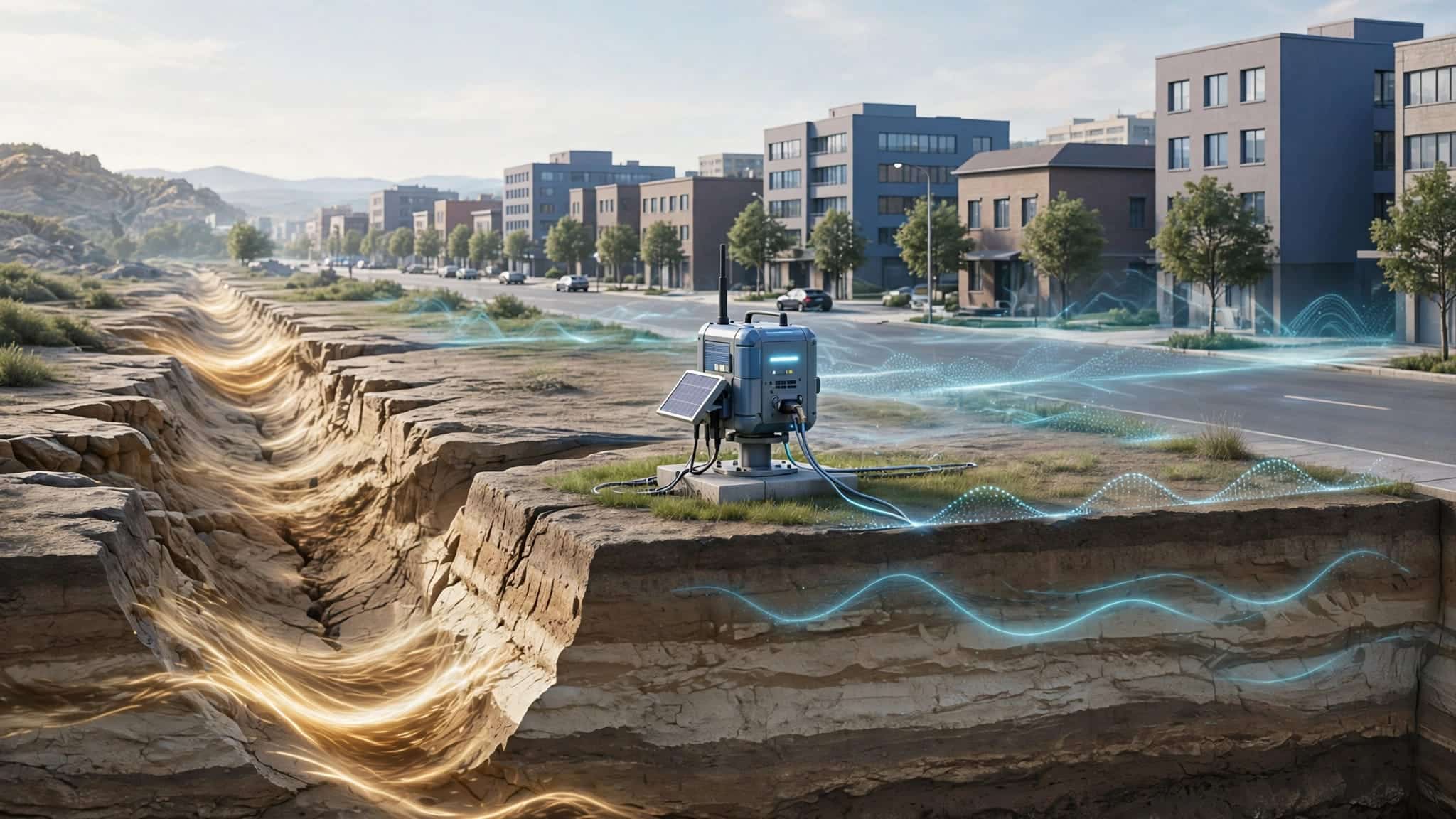
An earthquake can already be happening while the ground beneath you still feels perfectly still. Earthquake early warning works by detecting the first seismic waves, then sending an electronic alert ahead of stronger shaking.
The useful trick is speed: information can travel faster than earthquake waves. That can give you a brief chance to take cover, although people nearest the rupture may receive no advance notice. Understanding how this works begins with the different ways an earthquake moves through the ground.
This post may contain affiliate links. If you make a purchase through these links, I may earn a small commission at no extra cost to you.
What earthquake early warning actually detects
When a fault suddenly slips, it releases energy that travels outward through the Earth. That energy arrives in different forms, and the first arrival gives warning systems their opportunity.
The first waves provide the clue
P waves, short for primary waves, compress and stretch rock in their direction of travel. They move faster than S waves, which shake material perpendicular to their direction of travel.
The USGS explanation of early warning gives approximate speeds of 3.7 miles per second for P waves and 2.5 miles per second for S waves. Actual speeds depend on the material.
P waves generally cause less shaking. S waves and surface waves usually produce the stronger movement that damages buildings and sends objects falling.

Detection starts after the fault moves
The earthquake must already have begun before a seismic warning system can detect it. Sensors record the first waves, and computers rapidly assess what those measurements mean.
This distinction helps explain the apparently mysterious timing. Your phone isn’t receiving news about an earthquake that will begin tomorrow. It’s receiving news about one happening elsewhere, whose stronger waves haven’t reached you yet.
The warning window exists because the earthquake’s effects take time to spread. The electronics are trying to make good use of that interval.
How sensors turn movement into a warning
A sensor can record movement without knowing what caused it. The difficult part is recognizing an earthquake quickly enough to send a useful message.
Several instruments build a clearer picture
Seismometers and other ground-motion instruments continuously measure movement. Computers compare signals across a network, looking for patterns consistent with seismic waves spreading outward.
The arrival times at different stations help estimate where the earthquake began. The signals also help estimate its size. Combining observations reduces the chance of treating a local disturbance, such as nearby machinery, as a regional earthquake.
Much of this happens automatically. Waiting for someone to examine every trace would use up the small amount of time the system is trying to save.
Magnitude and local shaking answer different questions
Magnitude describes an earthquake’s overall size. Shaking intensity describes its effects at a particular place.
That difference matters when deciding who needs an alert. Two communities can experience very different shaking during the same earthquake because of distance, local ground conditions, and the way the fault ruptures.
The USGS describes shaking intensity using the Modified Mercalli scale. At intensity VI, everyone feels the shaking and standing becomes difficult.
Warning systems therefore estimate expected shaking across an area rather than simply sending everyone the same magnitude announcement. Your distance from the source matters, but it isn’t the whole story.
Why some people get seconds and others get none
A warning system can work correctly and still give two people very different experiences. Geography determines how much time the technology has available.
Distance creates an opportunity
Someone farther from the rupture may receive an alert while stronger waves are still traveling toward them. Someone closer may already be shaking.
A larger distance can increase the available warning time, but it doesn’t automatically mean a more useful warning. Shaking generally weakens with distance, although local conditions can complicate that pattern.
The most desirable situation would be plenty of warning before dangerous shaking. Unfortunately, the strongest shaking often occurs close to the rupture, where the available time is shortest.
Every stage uses part of the interval
The system needs time to detect movement, gather enough observations, calculate an estimate, and distribute a message. Delivery to a particular phone adds another delay.
The USGS discussion of warning times in the Pacific Northwest explains that people facing strong shaking should often expect less than ten seconds.
Close to the source, strong shaking may arrive before an alert. This near-source area is often called a warning blind zone. Faster processing can shrink it, but seismic waves don’t wait for the notification sound.
How the warning reaches your phone
Detecting an earthquake and notifying a person are separate jobs. A successful warning depends on both working quickly.
ShakeAlert supplies information to delivery partners
In California, Oregon, and Washington, the USGS operates ShakeAlert. Its sensor network and processing systems estimate earthquake location, magnitude, and expected shaking.
As the USGS description of ShakeAlert explains, partner organizations use that information to deliver alerts or trigger protective actions.
Public delivery routes include supported smartphone services, apps, and Wireless Emergency Alerts. Different delivery services apply different thresholds, so an earthquake doesn’t produce an identical notification on every device. A message generated by the system and an alert received by your phone are separate events.
Some phones also contribute observations
Android phones contain accelerometers, the tiny motion sensors that also help detect changes in orientation. Google’s earthquake-detection approach can combine shaking signals from multiple phones to identify an earthquake.
This phone-based detection is distinct from Android delivering ShakeAlert-powered warnings in the three ShakeAlert states.
An individual phone can move for many ordinary reasons. Agreement across many devices helps distinguish an earthquake from someone dropping a handset. Phone-based detection adds another way to gather observations, although useful results depend on the available devices and connections.
What a few seconds can actually accomplish
A short warning can feel almost unfair. By the time you’ve noticed the sound, there may be little time to think. That’s why its usefulness depends on a simple, familiar response.
For someone indoors, the standard protective action is Drop, Cover, and Hold On. Drop before shaking knocks you down, take cover beneath a sturdy table or desk when available, and hold on. Protect your head and neck.
If sturdy cover isn’t nearby, protect your head and neck where you are, away from windows and objects that could fall. Running outside during shaking exposes you to falling glass and debris.

Those seconds aren’t intended for collecting belongings or reading a detailed earthquake report. Practicing beforehand reduces the decisions you need to make during the warning.
Machines can also use short intervals. Warning messages can trigger automatic actions, such as slowing trains or pausing equipment, without waiting for someone to read a screen.
These actions don’t stop the earthquake. They reduce exposure to particular hazards before the strongest movement arrives.
If you feel shaking before receiving an alert, take protective action immediately. The movement around you is already enough information.
Why the first estimate can change
An earthquake unfolds over time. A large rupture can continue growing after the first waves have reached nearby sensors.
The earliest measurements therefore describe an event that may still be developing. As more stations report, estimates of location, magnitude, and expected shaking can change.
There is a practical tension here. Waiting for a fuller picture improves confidence, but waiting also leaves less time for protection. Sending an early estimate preserves time while accepting some uncertainty.
You might receive a warning and then feel only weak movement. That doesn’t automatically mean the system detected something imaginary. It may have overestimated local shaking, or the actual movement may have been difficult to notice.
Understanding this helps put alerts in perspective. They are rapid estimates built for a short decision window. They can’t provide the same detail as an analysis completed after the earthquake has finished.
Key Takeaways
Earthquake early warning depends on faster seismic waves revealing an earthquake before stronger shaking reaches some locations. Sensor networks, rapid calculations, and electronic delivery all contribute to the result.
The most useful expectation is a brief opportunity to protect yourself, rather than a guaranteed countdown. Distance, earthquake behavior, and delivery delays determine whether that opportunity exists where you are.
Frequently Asked Questions
Can these systems warn us days before an earthquake?
These systems begin working after an earthquake starts. They analyze movement already traveling through the ground.
Long-term earthquake-hazard assessments answer a different question. They estimate the likelihood of earthquakes over extended periods, rather than announcing the exact time and place of the next rupture. A phone alert belongs to the immediate-detection category, with a much shorter timescale.
Does an earthquake alert also mean a tsunami is coming?
An earthquake alert alone doesn’t establish a tsunami threat. An undersea earthquake must displace enough water to generate a tsunami, and many earthquakes don’t.
Our explanation of how tsunami warning systems work follows the next stage: combining earthquake measurements, ocean observations, and wave models. Near a coast, strong or prolonged shaking can itself be a natural tsunami warning. After protecting yourself during shaking, move inland or uphill according to local evacuation guidance.
The warning arrives because the waves haven’t
Detecting an earthquake before shaking reaches you depends on a small but useful difference in travel times. Instruments register the first movement, computers interpret it, and an electronic message may reach you before stronger waves do.
The important limit is distance. People close to the rupture may have no advance warning, even when the system operates correctly.
A familiar protective response makes whatever time is available more useful. The science creates the opportunity; preparation helps you use it.


