
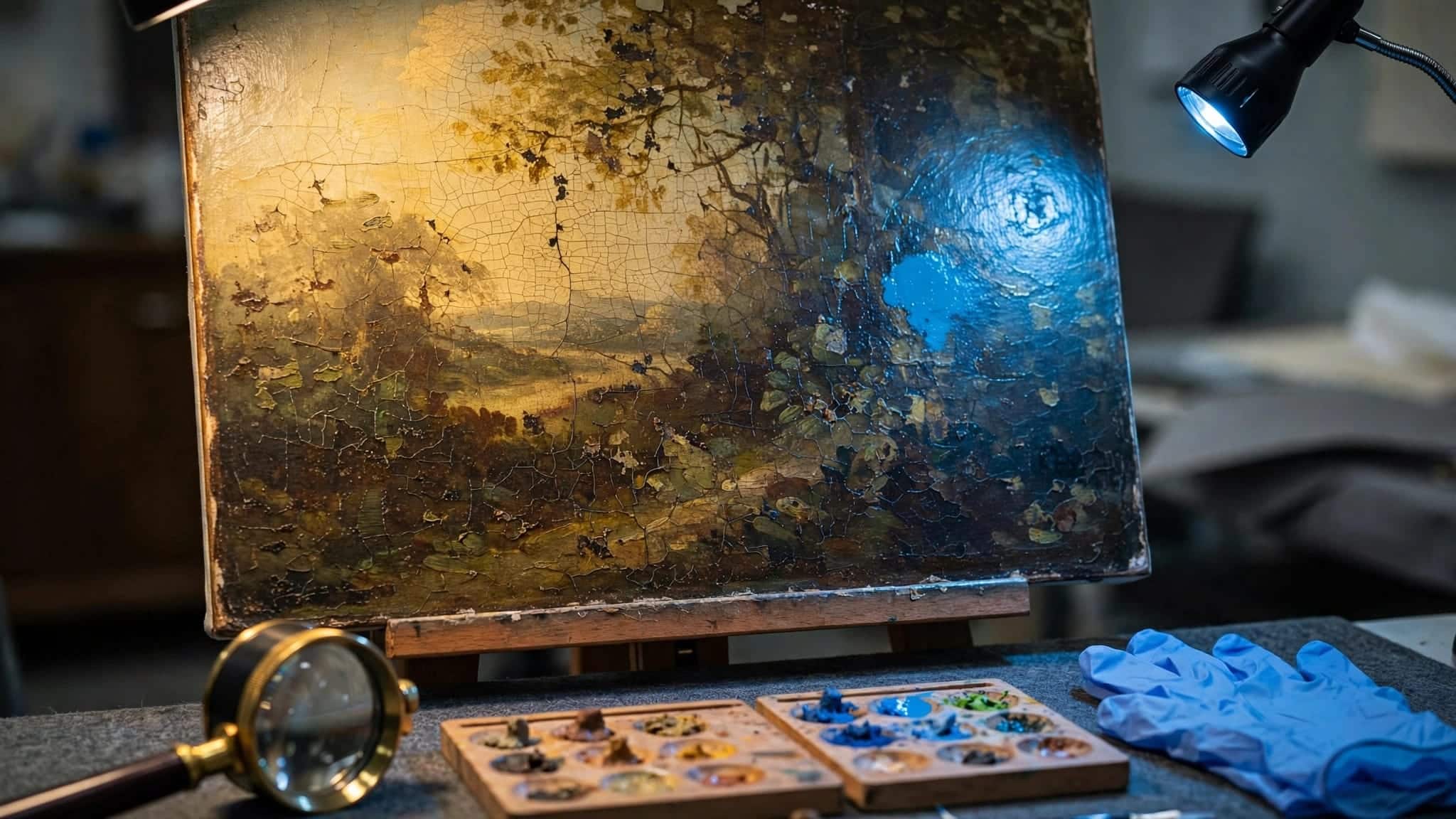
A forged painting can fool the eye, so detecting art forgery requires checking ownership history, artistic technique, and scientific evidence. The most useful clue is often a contradiction between the painting and the story attached to it.
A pigment might be too new, an exhibition record might be invented, or the brushwork might belong to someone else. Understanding how these clues fit together starts with a distinction: looking old and being authentic are separate things. A real painting with a false attribution is sometimes described with the phrase “Genuine Fakes,” though it isn’t a formal category.
This post may contain affiliate links. If you make a purchase through these links, I may earn a small commission at no extra cost to you.
Key Takeaways
- A forgery involves deliberate deception about an artwork’s maker or date. An openly identified copy and a changed attribution aren’t automatically forgeries.
- The strongest authentication comes from provenance, stylistic assessment, and scientific findings that agree. A signature, certificate, old frame, or single test can’t settle every question alone.
- Scientific tests can expose materials that don’t fit a claimed date, but old canvas can be reused and later repairs can contain modern pigments.
- Buyers should check the exact attribution, request ownership records and photographs, and seek independent assessment when a purchase depends on a valuable attribution.
What makes a painting a forgery?
A forgery involves deliberate deception about who made an artwork or when it was created. An openly identified copy isn’t a forgery. Neither is every painting whose attribution changes after further study.
That distinction matters when discussing museum collections. Sleek’s survey of notorious art forgers repeats an estimate, attributed to The Independent, that museum fakes, including fake paintings, may account for around 20% of museum artworks. This isn’t an established worldwide measurement, and uncertain attribution doesn’t automatically mean fraud.
The history is equally easy to oversimplify. Roman sculptors copied Greek works, but those copies weren’t necessarily forgeries; deception about authorship or date is what makes a work a forgery. Renaissance collectors’ appetite for antiquities encouraged deception, while the expanding twentieth-century art market gave forgers more buyers to impress.
Begin with the painting’s history and appearance
Follow the ownership trail
Provenance is the record of a painting’s ownership and movements. Sale receipts, exhibition catalogues, correspondence, photographs, and collection inventories can connect an object to particular people and places.
The useful question is whether those records describe this painting. A title alone may fit several works. Measurements, photographs, inscriptions, and descriptions provide stronger connections.
The Metropolitan Museum’s provenance research resources show the range of historical documents involved. Gaps invite investigation, but they’re common in genuine objects too. An apparently complete history deserves scrutiny when its supporting documents can’t withstand examination.
Compare technique, signatures, and labels
Specialists compare brushwork, composition, surface preparation, and recurring habits with securely attributed paintings. Recognizing characteristics of Romantic art, for example, helps establish context, but identifying a period doesn’t identify an individual painter.
Signatures, canvas stamps, and gallery labels also need to fit the artist’s working life. A supplier’s mark can help establish a date; a famous signature can be copied.
Condition requires similar care. A well-preserved painting isn’t automatically authentic, and damage doesn’t establish age. Repairs may explain apparent inconsistencies that initially look suspicious.
What science reveals about a forged painting

Test whether the materials fit the date
Pigment analysis uses X-ray fluorescence, usually shortened to XRF, to identify elements in pigments. Complementary methods help identify the compounds present.
This can expose materials unavailable at the claimed date. Titanium white, for example, can raise serious questions about an allegedly nineteenth-century painting if it belongs to the original paint layer.
That last detail matters. A modern pigment in a later repair doesn’t make the original painting fraudulent.
Carbon dating can assess organic materials such as canvas fibres. However, dating the support doesn’t automatically date the image. A forger can paint on genuinely old canvas.
Look beneath the visible surface
Infrared imaging can reveal underdrawing beneath some paint layers. X-radiography can show concealed compositions, structural details, and changes made during painting.
These findings help specialists compare working methods. They don’t provide an automatic verdict. Genuine artists sometimes copied compositions, while forgers could imitate preparatory work.
A scientific review of art-imaging methods describes the variety of techniques available. Each answers a different question.
Scientific testing can rule out an impossible date more confidently than it can name the person holding the brush.
The strongest conclusions come when material findings, documentary evidence, and stylistic assessment agree.
How forgers make new paintings look old

Forgers have reused old canvases, attached antique frames, and manipulated paint surfaces to imitate wear. Han van Meegeren used synthetic resin, associated with Bakelite, and heat to produce hardened paint that appeared older.
This is why cracks deserve examination rather than admiration. Their pattern, depth, and relationship to the paint layers can reveal how they formed.
An old frame provides context, but frames move between paintings. Likewise, accumulated dirt can be added deliberately. Ageing effects become meaningful only when they agree with the object’s materials and history.
Four forgers who made history look convincing
Art forgers can rely on a convincing history as well as convincing craftsmanship, so provenance matters alongside the object itself.
1. Michelangelo and the supposedly ancient sculpture
In 1496, Michelangelo made Sleeping Eros, a sculpture subsequently sold as an antiquity. The deception was discovered, and the buyer sought his money back.
Although this wasn’t a forged painting, it illustrates an enduring problem: an impressive object can carry a false identity. Admiring its quality doesn’t establish its age or origin.
2. Reinhold Vasters and the revealing archive
Vasters produced Renaissance-style objects associated with names including Wenzel Jamnitzer, Leone Leoni, and Valerio Belli. His deception emerged through study of drawings held at the V&A around 1970, decades after his death.
The revealing evidence was documentary. The drawings connected supposedly historical treasures with a much later workshop run by Reinhold Vasters. Sometimes the object keeps its secret until an archive supplies the missing explanation.
3. Han van Meegeren and the Vermeers people wanted
Van Meegeren forged paintings attributed to Johannes Vermeer, Pieter de Hooch, and Gerard ter Borch. His invented Vermeers appealed to expectations about a poorly documented period of the painter’s career.
The story of Van Meegeren’s fake Vermeers shows how persuasive scholarship can support wishful thinking. His exposure brought extraordinary publicity; a 1947 Dutch poll ranked him the second most popular Dutchman.
4. Elmyr de Hory and a recognizable style
Elmyr de Hory imitated artists including Picasso, Matisse, and Modigliani. His work illustrates how familiarity can mislead: recognizable stylistic features may persuade viewers before they examine ownership records.
Orson Welles featured him in F for Fake, a film concerned with deception and authorship. Elmyr de Hory’s reputation also encourages caution about forgers’ biographies, since a compelling personal story isn’t independent evidence.
Four schemes that fooled the modern art market
5. Wolfgang Beltracchi and the wrong pigment
Wolfgang Beltracchi invented paintings that appeared to fill gaps in known artists’ careers. He was caught in 2010 and sentenced in 2011.
A supposed Heinrich Campendonk painting contained titanium white inconsistent with its claimed 1914 date. It was a useful reminder that convincing brushwork and an elaborate ownership story can’t overcome a material that arrived too late.
6. Thomas Patrick Keating and deliberate clues
Thomas Patrick Keating imitated painters including Samuel Palmer and claimed to leave clues within his work. These included materials or inscriptions that could expose the deception under examination.
His case complicates the romantic image of the mischievous forger. Hidden warnings don’t protect a buyer who never sees them. Scientific examination can reveal an inconsistency that remains invisible across a gallery room.
7. Ely Sakhai and duplicated identities
Ely Sakhai’s scheme paired genuine paintings with copies, allowing documents associated with an authentic work to support a different object. He received a prison sentence for the fraud.
The important lesson concerns certificates. A genuine document doesn’t authenticate every painting presented beside it. Photographs, dimensions, condition details, and other identifying features must connect the paperwork to the object being sold.
8. John Myatt and John Drewe’s invented history
John Myatt painted imitations while Drewe fabricated provenance as part of an art fraud. Their deception reached major auction houses, including Sotheby’s and Christie’s.
Myatt received a twelve-month sentence and served four months; Drewe received six years. The operation demonstrated that authentication can fail through paperwork as well as paint. A convincing archive entry becomes dangerous when everyone assumes someone else has already established its reliability.
Two famous stories that deserve careful handling
9. Robert Driessen and counterfeit Giacomettis
Driessen made sculptures presented as works by Alberto Giacometti. The medium changes, but the authentication problem remains familiar: recognizable forms can be reproduced, and identifying marks can be imitated.
For sculpture, casting methods, metal composition, foundry records, and edition history become important. The same principles apply to paintings, and Robert Driessen’s case shows why a recognizable artistic style is only a starting point for investigation, not a finished answer.
10. Yves Chaudron and the Mona Lisa legend
Chaudron’s name appears in the story of copies supposedly sold after the Mona Lisa was stolen in 1911. The elaborate account of multiple deceived buyers remains disputed.
The account linked to Yves Chaudron is entertaining, but it shouldn’t carry the same weight as a documented prosecution or laboratory finding. Forgery history contains its own authenticity problems, including stories that become more impressive with each retelling.
What should a buyer do before purchasing?
Begin with the exact attribution in the sales description. “By,” “attributed to,” and “after” express different claims about authorship. A painting described as “after Rembrandt” is presented as following his work, rather than as an original Rembrandt.
Ask for ownership documents, clear photographs of the front and reverse, and condition information. An artist specialist assesses authorship; a conservator examines materials and condition. An appraisal addresses value and doesn’t automatically provide either assessment.
Independent examination is especially useful when the purchase depends on a valuable attribution. The seller’s confidence may be sincere, but confidence isn’t evidence.
Avoid cleaning, scraping, or removing labels yourself. These actions can damage the painting and destroy clues. Preserve the object and its accompanying documents together, including correspondence and photographs that explain where it came from.
Frequently Asked Questions
What makes a painting a forgery?
A forgery involves deliberate deception about who made an artwork or when it was created. An openly identified copy isn’t a forgery, and a changed attribution doesn’t automatically mean fraud.
Can scientific tests prove who painted a work?
Tests can identify materials and reveal whether they fit a claimed date, while imaging can show features beneath the surface. These methods can rule out some claims, but they don’t automatically identify the person who painted the work.
Does an old canvas or frame prove a painting is authentic?
No. Forgers can reuse old canvases and antique frames, and dirt or wear can be added deliberately. The materials, condition, and ownership history need to fit together.
What should a buyer check before purchasing a painting?
Check the exact attribution and ask for ownership documents, clear photographs of the front and reverse, and condition information. An independent specialist can assess authorship, while a conservator can examine materials and condition.
Authenticity comes from evidence that agrees
A forged painting becomes harder to defend when its materials, technique, and history contradict one another. No signature, certificate, crack pattern, or scientific test can settle every question alone.
The most dependable judgment comes from independent evidence pointing in the same direction. You can still enjoy a painting’s beauty while questioning its identity. A real object can carry a false identity, the contradiction behind “Genuine Fakes.”


