
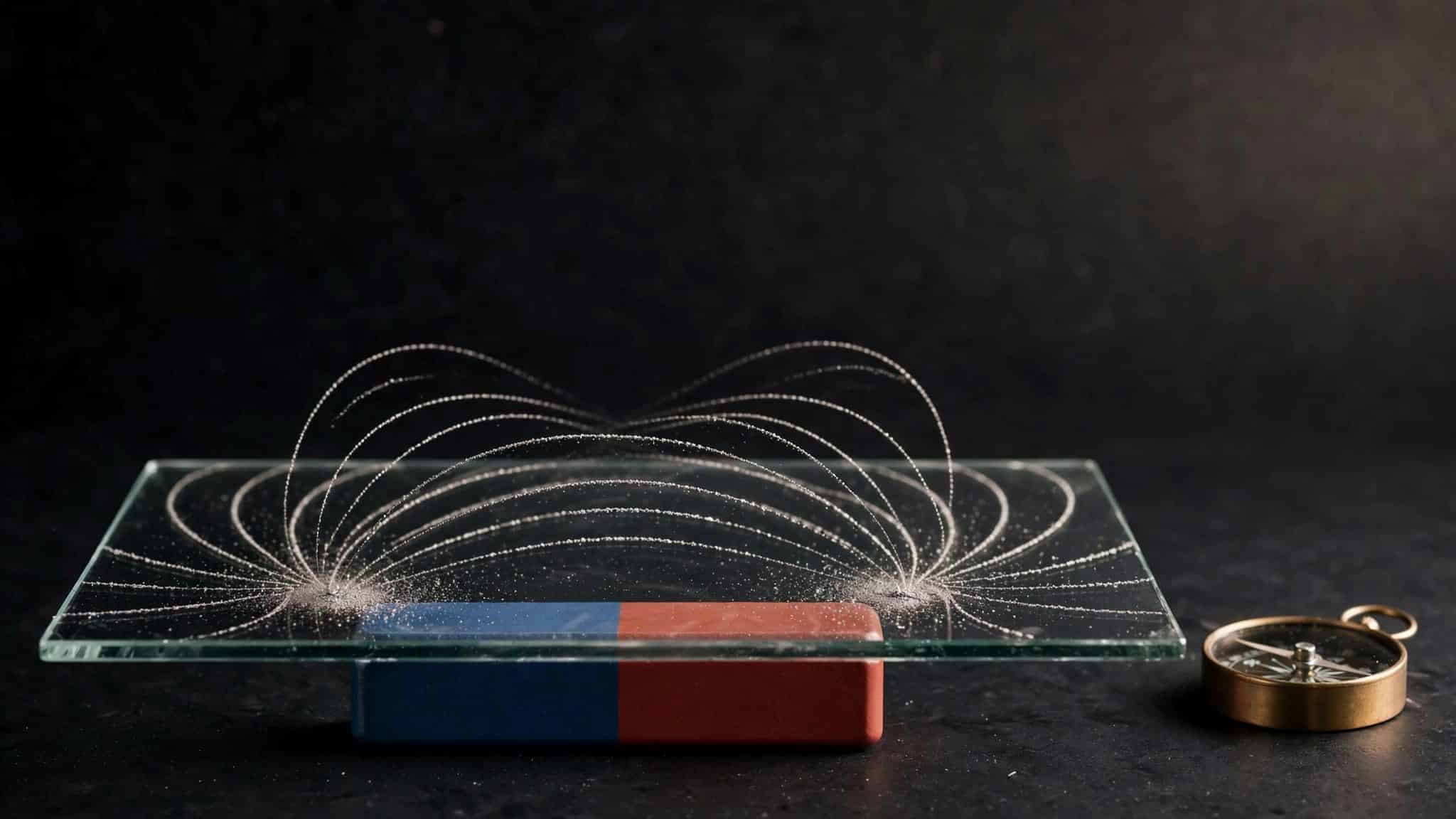
You can make a magnetic field visible by placing materials that respond to magnetism around a magnet. Iron filings, compass needles, and specialty films reveal patterns your eyes can’t detect directly. Magnetic field visualization makes the field’s effects visible, rather than turning magnetism itself into something you can see.
The interesting part is learning what those patterns mean, starting with the curved lines familiar from science classrooms.
This post may contain affiliate links. If you make a purchase through these links, I may earn a small commission at no extra cost to you.
Key Takeaways
- Magnetic field visualization shows how materials respond to a field; it doesn’t make the field itself visible.
- Field lines are models: their direction follows the curve’s tangent, and closer lines indicate a stronger field. The number of lines in a drawing isn’t a measurement.
- Iron filings show a field’s shape, a compass adds direction, and viewing film and ferrofluid reveal other patterns.
- Gauss meters compare measured field strength, while simulation software calculates fields from specified inputs.
What magnetic field visualization shows
Michael Faraday introduced magnetic field lines as a way to describe an invisible influence. These modeled curves, also called magnetic flux lines, help us understand direction and strength. They aren’t physical threads floating around a magnet.
Reading direction and strength
A tangent to a field line shows the magnetic field’s direction at that point. Imagine placing a straight ruler against a curve: the direction along the curve is the local field direction.
Closer lines indicate a stronger field. Around a bar magnet, they crowd together near its poles. The number of lines in a drawing is a choice, however, so counting them doesn’t give a measurement.
Understanding loops and materials
Field lines form continuous, closed loops. Outside a magnet, they run from its north pole to its south pole, then return through its interior.
They never cross because a crossing would give the field two directions at one point. Iron and other magnetic materials bend and concentrate the pattern. Ordinary wood and plastic are not magnetic materials, so they leave it essentially unchanged. These materials are useful supports for demonstrations.
Reveal the pattern with iron filings
Place a bar magnet on a table and cover it with stiff paper or a thin plastic sheet. Sprinkle iron filings lightly across the surface, then tap the sheet gently.
The filings align with the local field and settle into curved chains. TeachEngineering’s magnetic field visualization activity combines this approach with compass observations to connect the pattern with direction.

Start with a light scattering rather than a generous heap. Too many filings hide the spaces that make the pattern readable. Keeping the sheet between the filings and magnet also prevents a frustrating cleanup.
Notice how the chains curve between the ends and gather near the poles. They show the field’s shape, but don’t tell you which way it points.
Keep filings away from eyes and mouths, and don’t blow them off the sheet. A sealed magnetic field viewer keeps suspended iron filings contained while showing their alignment. It’s more suitable for younger children.
Use films and fluids for different views
Iron filings give a familiar picture, but other materials reveal details without loose metal particles. Each method translates magnetic effects into a different visual language.
Magnetic viewing film
Magnetic viewing film is a flexible, translucent sheet containing microcapsules with suspended nickel flakes. Those flakes change orientation in response to a nearby magnetic field.
Regions look dark where the field meets the film perpendicularly, often above poles. Regions look brighter where the field runs parallel to its surface.
This makes film useful for locating pole patterns, including alternating poles that a simple bar-magnet drawing doesn’t capture. A dark patch doesn’t, by itself, identify a north pole rather than a south pole.
Ferrofluid and ferrocells
Ferrofluid contains tiny magnetic particles suspended in liquid. Near a magnet, it can rise into spikes as magnetic forces compete with gravity and surface tension.
The changing spikes reveal field structure and intensity in real time. Their height isn’t a calibrated field-strength reading.
A ferrocell traps a thin ferrofluid layer between transparent plates. LED illumination reveals patterns that make magnetic flux lines easier to compare across poles or as the pattern changes. These displays help show magnetic flux structure and pole orientation. They produce a different view from the raised spikes of an exposed ferrofluid surface.
Trace field direction with a pocket compass
A small compass supplies something filings lack: an arrow. The local magnetic force turns its needle to point along the field. NASA’s explanation of magnetism describes how compass needles and iron filings outline magnetic fields.
Place the compass near your bar magnet and let its needle settle. Mark the direction of its north-seeking end. Move it a short distance along that direction, then repeat. The successive marks trace a curved field line.
Keep the compass level and remove unrelated magnets or nearby steel objects. You’re observing the combined field at each position, so interference matters.
This also explains why a compass doesn’t automatically point toward geographic north. As our explanation of finding true north discusses, the needle responds to its local magnetic surroundings.
Measure strength or model a complex field
When you need numbers, use Gauss meters. Their probes let you compare field strength at chosen positions, complementing the patterns shown by filings or film.
Move the probe between positions to compare readings. Probe orientation matters, so a change can reflect both where you place it and how you hold it.
Simulation software takes a different approach. It calculates fields for specified magnet shapes, materials, and magnetization patterns, including systems that are difficult to display physically.
A simulation can show cross-sections, vectors, or three-dimensional field structures. Its picture depends on the model’s inputs, rather than direct observation. Specialized 3D magnetic field cameras can map measured values across a volume, while simulation software calculates predictions. Physical viewers show a response, and meters provide measurements.
Frequently Asked Questions
How can I make a magnetic field visible?
Place a magnet under stiff paper or a thin plastic sheet, sprinkle iron filings lightly over it, and tap the sheet gently. The filings align into curved chains that show the field’s shape.
Do iron filings show the field’s direction?
Iron filings show the pattern’s shape, but not which way the field points. A compass needle shows local direction, and repeated readings at nearby positions can trace a field line.
What do magnetic field lines tell you?
The tangent to a field line gives the field’s direction at that point, and closer lines indicate a stronger field. Field lines form closed loops, but the number drawn doesn’t measure field strength.
How can I measure magnetic field strength?
A Gauss meter lets you compare readings at chosen positions, though probe orientation affects the result. Simulation software calculates predicted fields from its inputs rather than measuring them directly.
Choose the view that answers your question
For a first demonstration, iron filings reveal the shape, while a compass adds direction. Film helps locate pole patterns, and a Gauss meter answers questions about strength.
The strongest insight is that every method makes a different response to magnetism visible. Once you understand that distinction, the curves, dark patches, and liquid spikes become evidence you can interpret, rather than attractive patterns alone.


