
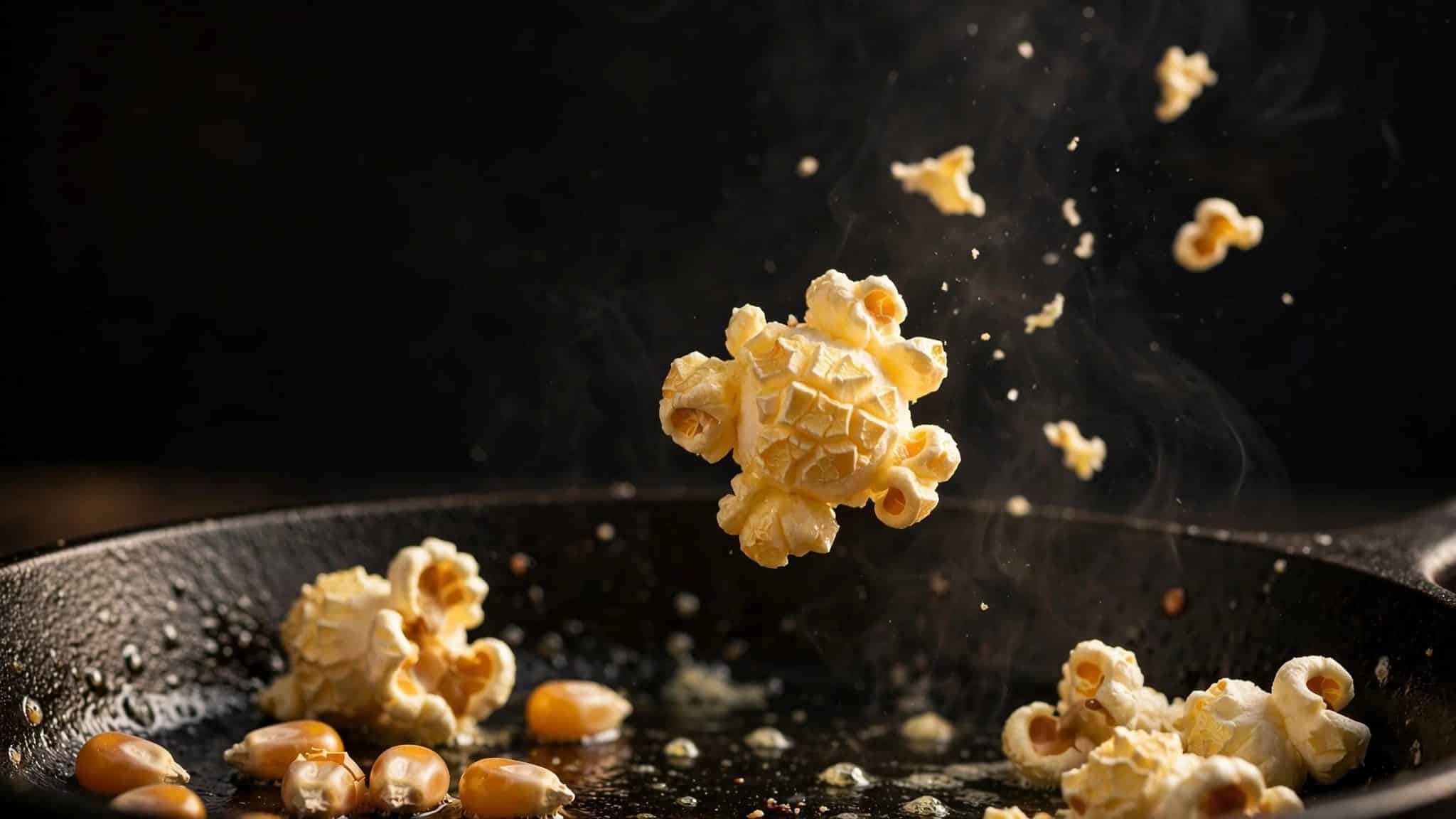
A pan of corn starts rattling, and suddenly its small, hard kernels become a bowlful of something you can eat by the handful. If you’ve wondered why popcorn pops, the answer is hidden in what each kernel keeps sealed inside.
Heat turns that hidden water into steam. The kernel holds on until it can’t, and the result is considerably more dramatic than you might expect from a grain. Here’s what happens before you hear the first pop.
This post may contain affiliate links. If you make a purchase through these links, I may earn a small commission at no extra cost to you.
Why popcorn pops: water inside a strong shell
Popcorn kernels need enough moisture to make steam and a strong outer shell to trap it. Together, these give them the popping ability to puff. Without either, the familiar puff won’t happen.

The hull holds everything together
The hard covering around a popcorn kernel is called the pericarp, or hull. Inside it are starch and a small amount of water. The hull matters because it lets pressure build as the kernel heats.
This is why you can’t expect the same performance from any corn you happen to find. Sweet corn on the cob has a different structure and moisture content. Heating it may cook it beautifully, but it won’t produce a bowl of popcorn.
Water supplies the pressure
As the kernel gets hotter, its internal water becomes steam. Trapped inside the hull, that steam pushes outward while the starch heats and softens.
According to Popcorn.org’s explanation of the kernel, popcorn needs roughly 13.5 to 14 percent moisture to pop. It’s a surprisingly particular requirement for a snack that seems happy to explode at random.
What happens at the moment of the pop?
The sound makes popping seem instantaneous. Inside the kernel, heat and pressure have been building for a while. The audible pop is the moment the hull finally gives way.
Heat brings the kernel to its breaking point
In a study of popcorn’s popping temperature, E. Virot and colleagues found that almost all their tested kernels popped at around 180°C (356°F). That describes the kernels in the experiment, not a temperature you need to dial into a pan.
Differences in popping ability mean kernels reach their breaking point at different times. That’s why a batch begins with scattered pops, grows noisy, then slows again.
Soft starch becomes the white puff
When the hull breaks, the pressure drops abruptly. Steam escapes, and the softened starch expands outward. As it cools, that expanded starch firms into the irregular white shape we recognize as popcorn.
The white part isn’t the hull somehow turning fluffy. It’s the kernel’s interior, suddenly given room to expand. Next time you find a brown fragment attached to a popped piece, you’re looking at part of the shell that held the whole process back.
Why do some popcorn kernels stay unpopped?
Every bowl seems to have a few unpopped popcorn kernels at the bottom. A kernel’s popping ability depends on its moisture, intact hull, and how evenly the batch is heated.
Too little moisture means too little pressure
A kernel that has dried out may not build enough pressure to burst. Moisture guidance varies a little by source: Cactus Corn’s estimate for consistent popping is 13.5 to 15 percent, compared with Popcorn.org’s narrower range. The shared point is that the water inside matters.
That doesn’t mean pouring water over dry kernels will fix them. The moisture needs to be inside an intact kernel, where it can create pressure as it heats.
A damaged hull lets steam escape
A cracked hull can’t hold pressure as well as an intact one. The kernel may heat up without ever producing that sudden burst. Uneven heating can leave some kernels behind, too.
Keeping the heat on until every last kernel pops is tempting, but the popped pieces are still in the pan. They can scorch while you wait for a few holdouts. A handful of unpopped kernels is usually preferable to a whole batch that tastes burnt.
Does the cooking method change the science?
A stovetop pan with vegetable oil, an air popper making air-popped corn, and a microwave all supply heat differently. Inside the kernel, the basic sequence stays the same: water heats, pressure rises, the hull breaks, and starch expands.
For stovetop popcorn, use medium high heat and move the pan periodically so kernels spend less time sitting in one hot spot. In a microwave, follow the package directions and stop when the popping slows. Neither method can rescue a kernel with too little internal moisture or a damaged hull.
If a batch does scorch, the smell can linger longer than the snack. Cleaning the microwave with steam can help loosen the residue afterward. It won’t bring back the burnt popcorn, unfortunately.
Key Takeaways
The answer fits inside one kernel. Water creates the pressure, the strong hull contains it, and heated starch expands when that hull breaks. Good popping depends on all three parts working together.
The process also explains those unpopped kernels at the bottom of the bowl. Some may be too dry, some may have damaged hulls, and others may not have heated enough before the batch was removed.
Questions about popcorn kernels
Why doesn’t corn on the cob pop?
Corn on the cob is usually sweet corn, not popcorn. Its kernels don’t have the same combination of a pressure-holding hull, internal moisture, and starch that makes popcorn pop well.
That difference is useful at dinner: sweet corn is pleasant to bite into because its kernels are tender. Popcorn’s tough hull is far less appealing until heat does its work.
Can old popcorn kernels still pop?
They can, provided they retain enough moisture and their hulls are intact. A batch that leaves more unpopped kernels than usual may have dried out during storage, though uneven heating is another possibility.
Store unpopped kernels in a closed container rather than leaving the bag open. Keeping their moisture where it belongs gives them a better chance when it’s time to heat them.
The small surprise inside every kernel
That first pop in the pan is the sound of a tiny container reaching its limit. Once the hull breaks, the starch inside has its moment to expand.
So the next time someone asks how it happens, you can point to the kernel itself. It arrives with the water, starch, and strong shell needed for the whole performance.


