
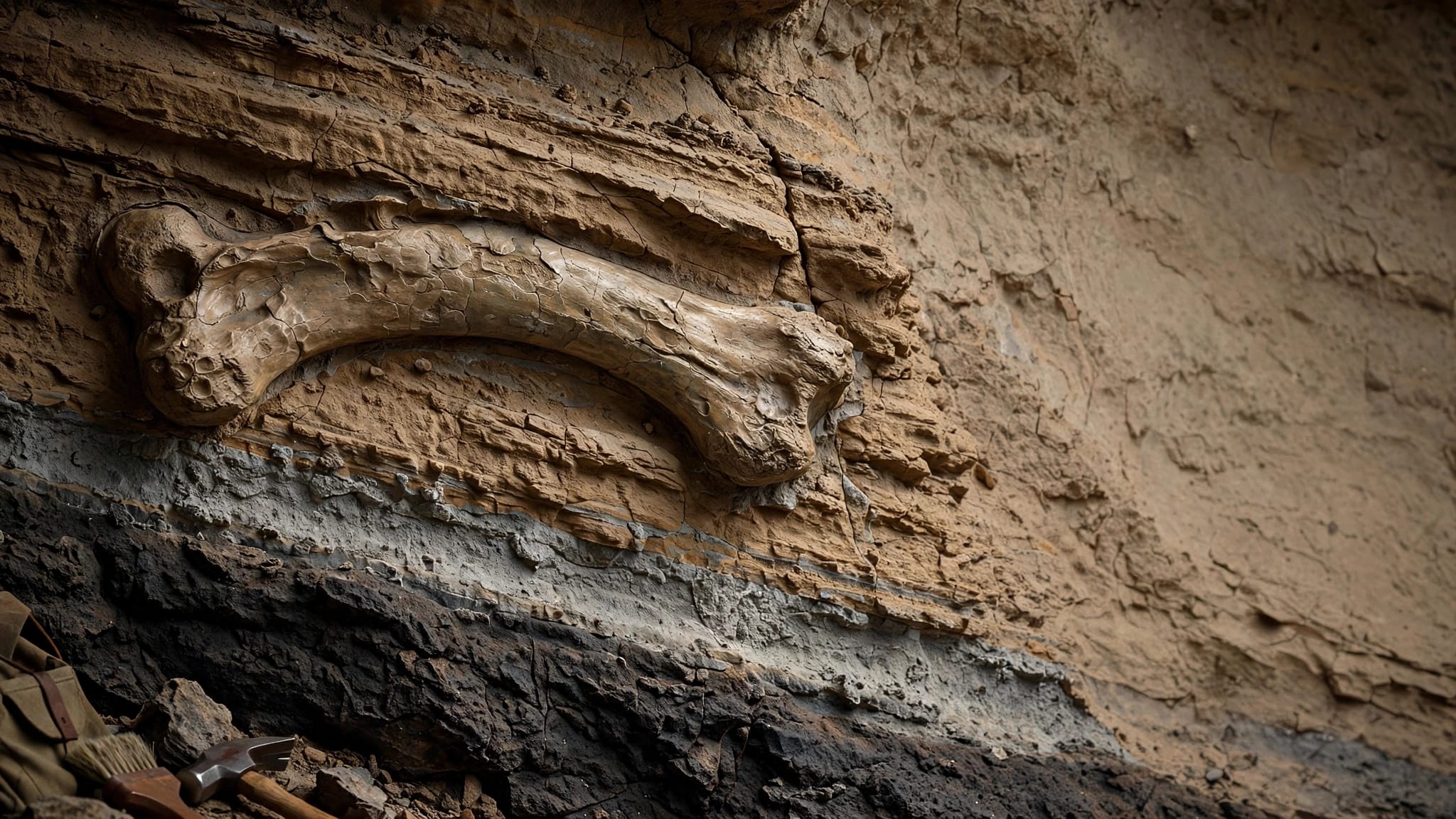
A fossil’s age can come from a rock that contains no fossil at all. Dating fossils can involve measuring nearby volcanic rocks, then working out where the remains fit in the sequence.
If you’ve wondered how a museum can confidently label a skeleton millions of years old, that geological context is the answer. The number comes from several linked observations, rather than a test that announces an animal’s birthday.
The first step is understanding exactly what scientists are trying to date.
This post may contain affiliate links. If you make a purchase through these links, I may earn a small commission at no extra cost to you.
Dating Fossils Begins With Their Geological Context
A fossil, its burial layer, and a nearby volcanic rock record different events. The organism lived and died. Sediment buried its remains. A volcanic eruption may have happened before or afterward.
Scientists need to connect those geological events before assigning an age.
That distinction matters because a laboratory measurement belongs to the material tested. Measuring a volcanic mineral tells researchers about that mineral’s history. Field observations establish how its age relates to the fossil.
Through stratigraphy, geologists record where a fossil was found, which layer contained it, and what lies above and below. A specimen removed without that information can lose much of its value as evidence.
Two approaches work together. Relative dating establishes the order of events: older, younger, before, after. Numerical dating, often called absolute dating, estimates an age in years.
“Absolute” sounds reassuringly final, but it doesn’t mean perfectly exact. Every numerical age comes with uncertainty, and every fossil-age estimate needs a defensible connection to the dated material.
Relative Dating: Reading the Order of Rock Layers
Before asking how many years have passed, scientists establish what happened first. This is the geological equivalent of arranging photographs before checking their dates.
What the position of a layer tells you
In an undisturbed sedimentary sequence, the law of superposition explains why lower layers generally formed before those above them. Comparing stratigraphic layers can show whether a fossil predates or postdates another fossil-bearing layer.
Real rocks aren’t always so cooperative. They can be folded, faulted, tilted, or partly eroded. Geologists examine those disturbances rather than assuming every cliff is a neatly stacked calendar.
A break in deposition also matters. Two touching layers may be separated by a substantial gap in time. Their physical closeness doesn’t establish how closely their ages match. Relative dating supplies a sequence, but it cannot turn the thickness of a layer into a reliable number of years.
How index fossils connect distant places
Some fossil species are useful time markers because they were geographically widespread but existed for a relatively short interval. These are index fossils.
The National Park Service describes index fossils and fossil biozones as evidence diagnostic of particular intervals in Earth’s history.
Biostratigraphy, a part of stratigraphy, uses matching fossil assemblages to correlate layers in different locations, even when the rocks look different. These index fossils can include certain ammonites and species within groups such as trilobites.
The species matters. Finding any trilobite doesn’t provide a narrow date, since the entire group existed for hundreds of millions of years.
Radiometric Dating: Measuring a Mineral’s Clock
Radioactive isotopes change into other isotopes at characteristic rates. Researchers measure these changes to estimate how long a suitable mineral has recorded them.

What radioactive decay measures
An isotope is a version of an element with a particular number of neutrons. An unstable parent isotope decays into daughter isotopes.
A half-life is the time required for half of a radioactive isotope to decay. Individual atoms decay unpredictably, but large populations follow a predictable statistical pattern. Comparing isotope ratios and applying the known half-life can reveal elapsed time, provided researchers understand the starting conditions and the mineral’s later history.
Radiometric measurements can support absolute dating by providing a numerical age. The clock must have a meaningful starting event, such as crystallization or cooling, and retain the relevant isotopes well enough for the results to remain interpretable.
Before analysis, researchers examine whether minerals are suitable. Polarizing microscopes reveal crystal properties that help geologists identify minerals and assess their condition.
Why potassium and argon are useful
Potassium-argon dating and argon-argon dating use the decay of potassium-40 into argon-40 to investigate suitable rocks and minerals. Uranium-lead dating is another method used with appropriate minerals.
The USGS guide to dating rocks explains that argon-argon geochronology uses this decay system to determine when volcanic rocks formed.
Argon is a gas, so its escape or retention is important. Scientists must consider whether later heating disturbed the record or whether the sample contained argon unrelated to the elapsed time being measured.
The instrument produces measurements. Geological interpretation determines what those measurements mean.
How Volcanic Ash Can Bracket a Fossil’s Age
A volcanic eruption can spread ash across a large area in a short time. Preserved among sedimentary layers, volcanic ash can serve as a datable marker around a fossil-bearing layer.

Suppose a fossil-bearing layer sits between two volcanic layers formed by separate eruptions. Dating suitable minerals in both ash beds can bracket the fossil’s burial.
The lower ash bed predates the fossil-bearing layer. The upper bed postdates it, so the fossil’s age is constrained by geological context, not directly measured.
Scientists don’t simply average the two dates. Burial could have occurred anywhere within the interval, and gaps in sediment accumulation may complicate the sequence.
They also establish whether an ash bed records fresh fallout or ash that was moved and deposited again. Reworked ash can contain minerals older than the layer where they now sit.
A precise mineral age can still be the wrong age for a fossil if the mineral was redeposited later.
Ash is useful because it can supply dated events around a fossil. Its value depends on understanding how it arrived there.
Checking Whether the Dates Tell the Same Story
Dating fossils becomes more convincing when independent observations agree. A good result must fit both laboratory measurements and the rocks themselves.
Checking the samples
Researchers analyze multiple mineral grains rather than relying on one measurement. They check for clustered results, differing histories, and compatibility with the isotope system’s half-life.
An unusually old grain may have been inherited from older rock. A younger result may reflect disturbance after formation. Those possibilities need investigation rather than convenient dismissal.
Sedimentary rocks need particular care because their grains can predate deposition. Dating a grain washed into a river doesn’t automatically date the river deposit.
Sample preparation, contamination checks, and repeated measurements help separate useful evidence from misleading material. Agreement between measurements is reassuring only when researchers have tested the assumptions they share and checked the samples’ history.
Checking the geological sequence
Laboratory ages should fit field relationships and stratigraphy. A layer identified as younger through relative dating shouldn’t consistently yield an older formation age without an explanation.
Scientists compare dated layers, including volcanic layers, with fossil assemblages and, where available, magnetic patterns preserved in rocks. Earth’s magnetic field has reversed repeatedly, so matching a local pattern to an established chronology can provide another check.
Disagreement is a reason to re-examine the interpretation. Perhaps a fault displaced the layers or sediment was redeposited. These geological events, or heating that altered a mineral’s isotope record, may explain a mismatch.
Cross-checking matters because an impressive-looking number can’t repair a mistaken reconstruction of the site. Several compatible lines of evidence provide stronger support than repeatedly measuring the same flawed sample.
Lucy: A Real Fossil With a Numerical Age
Lucy, the partial skeleton catalogued as AL 288-1, offers a familiar example of why numerical dating matters.
The Smithsonian’s Human Origins Program reports that Lucy’s skeleton is around 3.18 million years old, based on later advances in absolute dating techniques.
That age places her in geological time and helps anchor the fossil record of human evolution. Anatomy can reveal how an organism moved or how it compares with related species. Chronology establishes when those characteristics existed.
The Smithsonian’s overview doesn’t identify the particular dated material or technique behind that number. The age alone therefore shouldn’t be treated as evidence that Lucy’s bones underwent a particular laboratory test.
The distinction is easy to overlook. “This fossil is around 3.18 million years old” reports a conclusion. Explaining how researchers reached it requires the dating evidence and its geological connection to the specimen.
Can Scientists Date the Fossil Material Itself?
Whether preserved remains can be dated depends on their composition, condition, and age. There is no universal test for everything called a fossil.
Carbon-14 dating is useful for relatively young organic material. Its half-life is about 5,730 years. After death, radioactive carbon decays without the organism replacing it through normal biological exchange.
Over long intervals, the remaining signal becomes too small to distinguish reliably from background and contamination. This is why the method is used for younger remains and archaeology, including work on the Pömmelte ritual sanctuary. It is not a general solution for ancient geological fossils.
Other isotope systems operate on different timescales. The USGS radiometric time scale notes that potassium-argon dating can be applied to suitable rocks as young as a few thousand years and to the oldest known rocks.
An absolute dating result provides a numerical age estimate, but the material tested still matters. A measurement of material associated with a fossil must connect to the organism’s life or burial. Otherwise, it is not a fossil-age estimate.
Key Takeaways
The strongest fossil ages combine an event sequence with numerical measurements. Relative dating establishes the order; suitable minerals provide clocks for particular geological events.
Context makes the connection between those clocks and the fossil. Researchers must check for transported remains, redeposited minerals, disturbed layers, and altered isotope records.
An age estimate is therefore an argument supported by several observations. Its uncertainty is part of the result, not an embarrassing detail to leave off the museum label.
Frequently Asked Questions
Do scientists date the fossil itself?
Sometimes, but many fossil ages come from dating suitable rocks associated with the fossil rather than the remains themselves. The measurement must connect to the fossil’s life or burial to support an age estimate.
How does volcanic ash help date a fossil?
If a fossil-bearing layer lies between volcanic ash beds, dates from suitable minerals in the ash can bracket when the fossil was buried. The lower bed formed before the fossil-bearing layer, and the upper bed formed afterward.
Does radiometric dating give an exact age?
No. It provides a numerical estimate with uncertainty, and researchers must establish what event the dated material records. Geological context helps determine how that event relates to the fossil.
Can carbon-14 date ancient fossils?
Carbon-14 dating is useful for relatively young organic material, but its signal becomes too small to measure reliably over long intervals. It is not a general method for dating ancient geological fossils.
The Age Is in the Evidence Around It
A fossil can receive a well-supported age even when its own material isn’t what scientists measure. Nearby rocks preserve events that help place its burial in time.
The task is to connect those events carefully and test whether independent evidence agrees. Precision is useful only when the geological interpretation is sound.
That museum label rests on a history reconstructed from the ground, with each layer helping establish what happened before and after the organism lived.


