
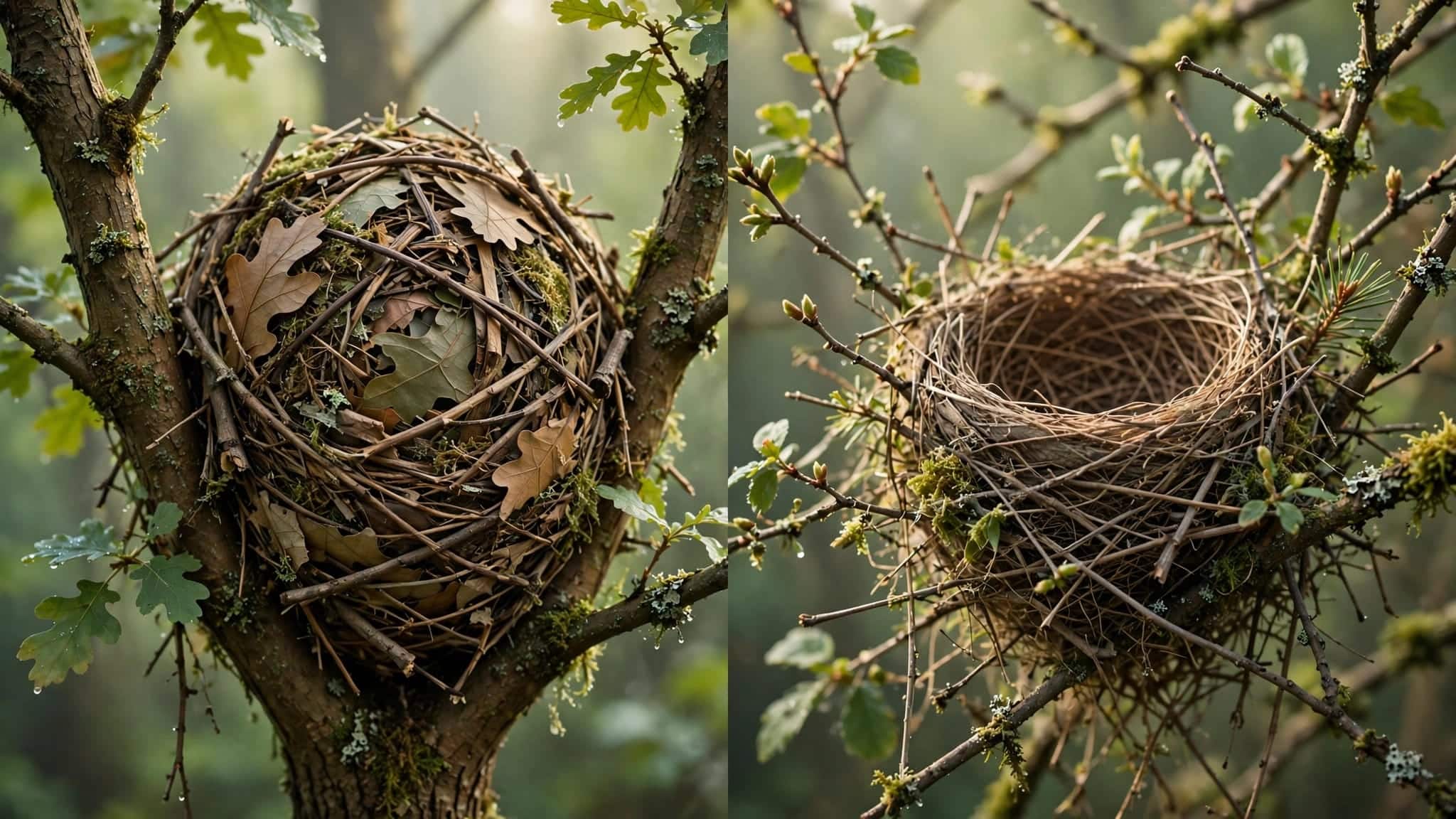
The easiest way to tell a bird nest from a squirrel drey is to look for a leafy roof. A squirrel’s familiar leaf nest is usually an enclosed ball, while many common bird nests are open cups or platforms.
Size helps, but a large nest doesn’t automatically belong to a large bird. Squirrels build surprisingly substantial homes, and their architecture can look rather untidy from the pavement. Start with the structure, then consider its materials, position, and possible occupants.
This post may contain affiliate links. If you make a purchase through these links, I may earn a small commission at no extra cost to you.
Key Takeaways
- A squirrel drey is usually a rounded, enclosed bundle of leaves, twigs, and other vegetation, often built in a branch fork beside the trunk. Many common bird nests are open cups or stick platforms.
- Shape and materials are more useful clues than size alone. Some birds build enclosed nests, and summer dreys can be thinner than winter ones.
- Squirrels use dreys for sleeping, resting, and raising young, and may also shelter in tree cavities. Many birds use their constructed nests mainly while raising chicks.
- Watch from a distance for an animal entering or carrying material to the nest. Don’t approach, shake the branch, or disturb the structure.
Bird nest vs squirrel drey: the quickest clues
A drey is a tree squirrel’s nest made from vegetation. Its rounded outline and mixture of foliage and small sticks usually offer stronger clues than its height alone.
These differences help narrow down what you’re seeing.
| Feature | Squirrel drey | Common bird nests |
|---|---|---|
| Shape | Rounded, usually enclosed | Often an open cup or platform |
| Size | Roughly one to two feet across | Small cups to enormous platforms |
| Materials | Leaves, twigs, grass, shredded bark | Varies; often sticks, grass, or mud |
| Position | Often beside the trunk in a branch fork | Depends strongly on species |
| Entrance | Small opening, often difficult to see | Open top in cup and platform nests |
| Use | Shelter throughout the year | Mainly eggs and developing chicks |
Shape and materials together are your strongest starting point. Audubon’s squirrel and bird nest comparison explains why a messy clump in a tree fork can cause confusion.
There are exceptions. Some birds build enclosed nests, and summer squirrel nests can be much thinner than winter dreys. Treat these clues as a pattern rather than a set of rules that every animal has agreed to follow.
Where a squirrel builds and what holds it together

Look beside the trunk
Dreys are commonly built 20 to 40 feet above the ground, often where a substantial branch meets the tree trunk. That fork provides support for a structure roughly one to two feet in diameter.
Height isn’t a strict minimum, though. Available branches, shelter, and tree shape influence where a squirrel settles.
Look for foliage held together in a rounded mass after the surrounding branches have become bare. A cluster that appears attached to the tree’s framework is more suggestive than loose debris caught temporarily between small branches.
Understand the layers beneath the mess
Squirrels weave a supporting platform of twigs, then build up the sides into a rounded shell. Greenery, grass, moss, and shredded bark fill and line the structure.
A grey squirrel’s substantial drey can have three layers: an outer shell of sticks and leaves, woven tender shoots beneath it, and a soft nest lining of grasses, feathers, or fur. The outside offers protection against wind and rain; the lining helps retain warmth.
The Woodland Trust’s guide to squirrel nest construction describes how these apparently scruffy bundles become practical shelters. What looks like garden debris has considerably more organisation inside.
What common bird nests look like instead

Crows, hawks, and eagles leave different outlines
Crows build open cups with sticks, including pencil-length pieces and longer sticks. From below, the cup can be difficult to recognise, but it generally lacks a squirrel drey’s continuous leafy covering.
Hawks and eagles usually build broad stick platforms. Their size explains why people sometimes assign a large squirrel drey to an impressive bird of prey.
Look at the edges. A raptor nest often has projecting sticks and a flatter profile. A drey generally looks rounder, with foliage filling the gaps. Neither feature identifies an owner with certainty, but together they help.
Smaller birds offer useful contrasts
An American robin’s nest is an open cup reinforced with mud and lined with fine material. A Baltimore oriole makes a hanging pouch, often suspended towards the ends of branches.
Woodpeckers excavate cavities, while chickadees and other birds can occupy existing holes. Those shelters won’t resemble an exposed drey at all.
This variety matters because “bird nest” describes many different structures. A leafy ball near a trunk is a good squirrel clue, but an enclosed shape alone doesn’t settle the question everywhere.
How squirrels use their shelters through the year
Winter brings repairs and better shelter
Squirrels use dreys for sleeping, resting, and raising young throughout the year. Most birds use their constructed nests mainly between egg-laying and the departure of their chicks, although nesting cavities may also provide winter roosts.
In autumn, squirrels add material and strengthen their shelters. During winter, they often favour a natural tree hollow or an old woodpecker tree cavity, which offers better protection against wind and rain.
Mass Audubon’s explanation of squirrel winter shelter describes this preference. When suitable cavities aren’t available, squirrels can remain in dreys and sometimes share them for warmth.
An exposed nest also carries risks. Owls and other nocturnal predators pose real risks, so a secure entrance and sheltered position matter.
Breeding changes the household
Grey squirrels can raise two litters annually. They often mate in January or February and again in early summer. After a pregnancy of about six weeks, kits arrive in late winter or spring, with another litter possible in late summer.
That distinction matters: January and February commonly describe mating, rather than a fixed birth season. NC State Extension’s grey squirrel profile describes the midwinter and summer breeding pattern.
June and July can bring fresh material gathering as young squirrels become active. Juveniles develop nest-building skills, but an adult carrying foliage isn’t evidence of a deliberate teaching session.
Squirrels often maintain a main nest and one or two extras for resting or emergency escape. Some also store food in sheltered nest sites, although grey squirrels mainly bury separate caches.
Different squirrels have different preferences
A grey squirrel commonly builds in deciduous trees, including oaks and beeches. Their dreys become easier to spot when those trees shed their leaves. The nest was often there all along; the tree has simply stopped providing camouflage.
Red squirrels tend to favour pines and other conifers. Evergreen foliage offers concealment throughout the year, so finding their shelters can require more patience.
Geography matters here. The Eurasian red squirrel and the American red squirrel are different species, despite sharing a common name. Their local habitats and nesting choices aren’t identical.
A flying squirrel also uses cavities and can build smaller outside nests, often in conifers. Their nocturnal activity makes them less conspicuous than squirrels that bustle about during daylight.
A nest’s tree and size can suggest an occupant, but neither identifies a squirrel species reliably. Seeing the animal is much stronger evidence than deciding that a particular pine looks like suitable accommodation.
How to tell whether a nest is occupied
Watch the entrance without approaching
The clearest evidence is an animal entering or leaving. For grey and red squirrels, watch from a comfortable distance during daylight. Binoculars can help you distinguish movement at the nest from a squirrel merely passing along a branch.
Fresh greenery or recently added small sticks suggest maintenance. Repeated journeys carrying material are stronger evidence, especially when the squirrel disappears into the same opening.
Still, a quiet nest isn’t necessarily abandoned. Its occupant may be resting, feeding elsewhere, or using another shelter.
A drey can look empty because its entrance is hidden against the tree trunk. An invisible doorway isn’t evidence of an empty home.
Leave the structure undisturbed
Don’t climb towards a nest, shake the branch, or pull material aside. Vulnerable animals may be concealed inside, and disturbance can interrupt parental care.
Our guidance on photographing birds without disturbing them applies well here: use distance and patience rather than arranging a closer encounter.
A drey outdoors doesn’t mean squirrels are nesting in your attic. Repeated entry through a roof opening is a different matter. If building repairs are needed, a qualified wildlife professional can avoid sealing dependent offspring inside.
Common questions about dreys and bird nests
Do squirrels take over bird nests?
Sometimes squirrels reuse or modify abandoned bird nests. That means the original builder and the current occupant may be different animals.
Squirrels can also raid active nests for eggs or chicks, but a visit doesn’t necessarily mean they’re moving in. Watch what the animal does: carrying lining inside and settling there tells you more than a brief inspection.
This is another reason to combine structural clues with behaviour rather than relying entirely on the nest’s appearance.
Why don’t you see baby squirrels?
Newborn squirrels remain concealed in the nest during their earliest development. They begin life helpless, with closed eyes, and depend on their mother for warmth and milk.
By the time squirrel kits venture outside, they already look recognisably squirrel-like. Their hidden nursery stage explains why you may see plenty of squirrels without ever spotting an obvious newborn.
A mother can also move her young between shelters, so the absence of activity at one drey doesn’t establish that the family has disappeared.
Read the structure, then watch the occupant
A rounded bundle of leaves and twigs, tucked into a strong tree fork, is a good candidate for a squirrel drey. An open cup or broad stick platform points towards a bird, with exceptions worth remembering.
The most dependable identification combines structure, materials, and behaviour. You don’t need to inspect the nursery yourself. Often, a little patient watching lets its resident answer the question.


