
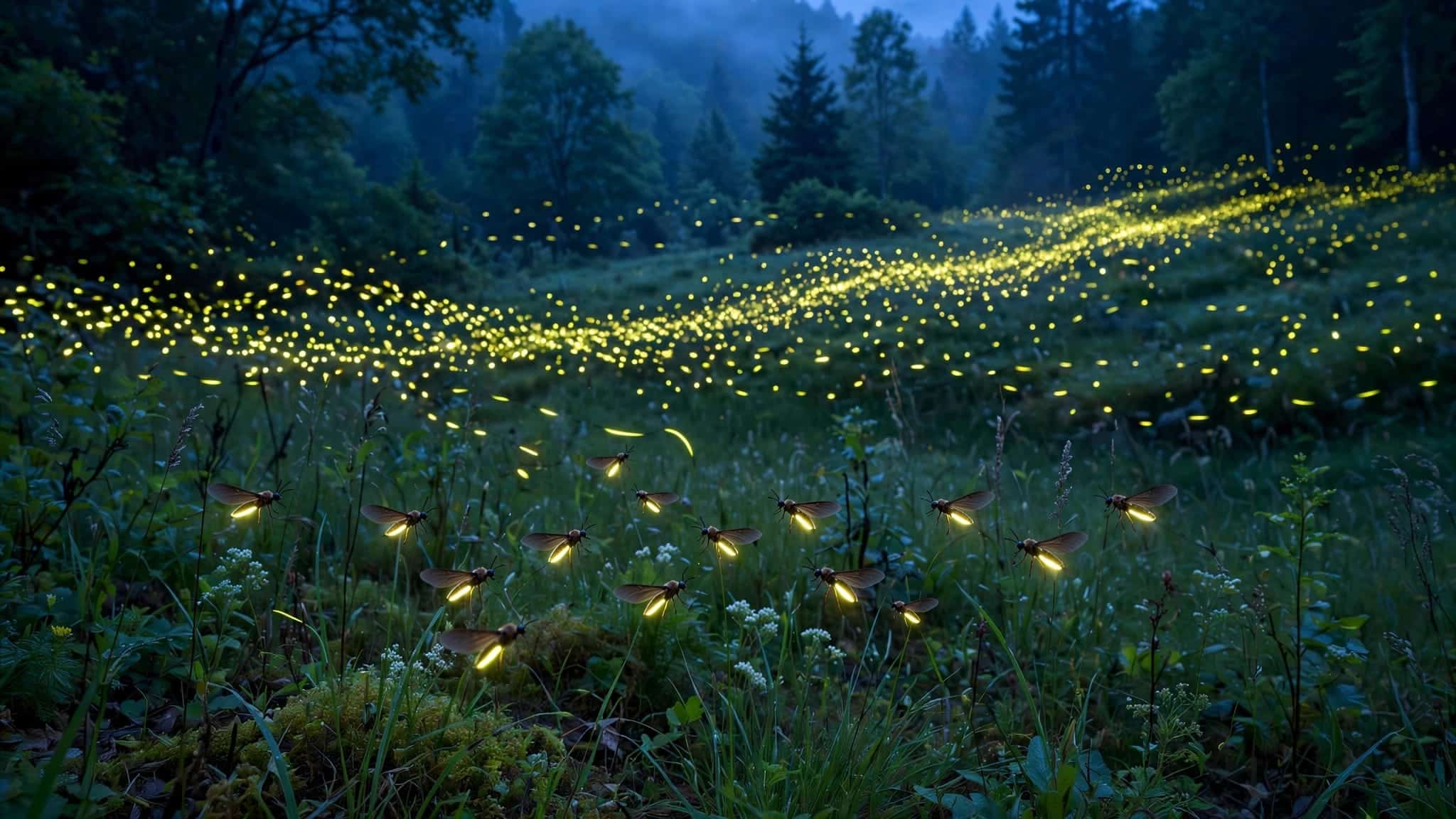
Synchronous fireflies flash together because nearby insects respond to one another’s light and adjust their timing. Their shared rhythm is part of courtship, allowing thousands of small signals to become a much more noticeable display.
The surprising part is that there’s no central leader. Each insect follows local cues, yet a patch of forest can appear to blink together. To understand how that happens, it helps to separate the mechanics of keeping time from the reason for doing it.
This post may contain affiliate links. If you make a purchase through these links, I may earn a small commission at no extra cost to you.
Key Takeaways
Only a small minority of lightning bugs use synchronized flashing as a mating behavior. Their rhythms differ by kind, and their brief adult seasons make timing a visit important. Darkness matters just as much: artificial light can interrupt the signals you’re hoping to watch.
How Synchronous Fireflies Find a Shared Rhythm
Each insect adjusts to its neighbors
A firefly has an internal rhythm that influences when it flashes. In these insects, each firefly responds to nearby flashes and adjusts its timing, with no leader directing the group. These repeated adjustments allow a swarm to settle into a shared pattern.
Think of people finding a common clapping rhythm. Each person hears nearby claps and makes small corrections. Nobody needs instructions from everyone else in the room.
Researchers including biophysicist Orit Peleg have studied this process using recordings of thousands of insects. Their research on natural firefly swarms examines how coordinated flashing emerges through these interactions.
The whole forest doesn’t always blink at once
What looks perfectly simultaneous can contain smaller groups, shifting patterns, and waves of activity rather than one uniform rhythm. Trees and vegetation limit which neighbors an insect can see.
Synchrony therefore doesn’t require every firefly to communicate with every other firefly. Local connections can allow a swarm to produce a much larger shared rhythm.
The light itself comes from a chemical reaction in the abdomen’s lantern organs. Luciferin reacts with oxygen through the action of an enzyme called luciferase. The insect regulates its light production, producing a precisely timed signal rather than a continuous glow.

Why Flash Together When You’re Looking for a Mate?
A shared display attracts attention
Male fireflies fly low over vegetation and flash to attract females, which often watch from leaves or the ground. The pattern helps identify a suitable partner of the same species.
Flashing together can make the combined display easier to detect than one isolated insect’s signal. A male may gain visibility by joining the group, even though the other males are also potential competitors.
This fits a broader feature of animal courtship behaviors: a display has to work from the receiver’s point of view. Brightness, timing, and viewing position all affect whether a signal gets noticed.
Darkness is part of the conversation
For fireflies that produce synchronized bursts, the pauses matter too. Dark intervals can make a female’s response easier to distinguish from the males’ flashing.
However, scientists haven’t settled every question about the evolutionary benefits of synchrony. Different species may gain different advantages from coordinating their signals.
Joining the rhythm doesn’t guarantee a mate. It helps establish the conversation, but the female still has a say. Even an insect with excellent timing can have an unsuccessful evening.

Which Fireflies Synchronize, and How Was It Discovered?
There are more than 2,000 firefly species worldwide, including more than 170 in the United States and Canada. Researchers continue to identify more. Most don’t produce the coordinated displays people travel to see.
The National Park Service recognizes three types of synchronous fireflies in North America. Two especially well-known examples are Photuris frontalis and Photinus carolinus. Their timing differs enough that treating them as one blinking phenomenon can be misleading.
Scientific recognition of American synchrony also has an unexpected history. In the 1990s, citizen naturalist Lynn Frierson Faust helped bring Tennessee’s displays to researchers’ attention.
She had read that synchronous fireflies weren’t known in the Western Hemisphere. That didn’t match the flashing her family had watched in the Smokies, so she contacted researchers.
The insects hadn’t suddenly acquired the behavior. People familiar with the place had already seen it. What changed was its recognition within the scientific community, a useful reminder that careful observation doesn’t require a laboratory.
Where and When Can You See the Displays?
Congaree National Park, South Carolina
At Congaree National Park, the synchronous firefly is Photuris frontalis, affectionately called “snappy syncs.” Its flashes have a steady, metronome-like rhythm, roughly twice per second.
That rate is typical of snappy syncs, though other synchronous firefly displays have different rhythms. Activity is generally associated with a brief peak period in late spring, often during May.
Adults emerge from the ground and have only a few weeks for mating. Their appearance depends partly on weather and development, so the season isn’t an appointment the insects keep on a calendar.
Great Smoky Mountains National Park, Tennessee
Near Elkmont, Photinus carolinus produces groups of flashes followed by shared dark pauses. The Great Smoky Mountains’ synchronous firefly display features this pattern.
Late May and early June are the usual planning window. However, the published 2026 viewing event dates were May 20 through 27, illustrating why “early June” isn’t a fixed annual promise.
These parks aren’t the only places in North America with synchronous fireflies. Populations occur elsewhere in the Southeast and Appalachians, including parts of Tennessee, North Carolina, South Carolina, Alabama, and Florida. A suitable location matters more than a state boundary.
Why the Parks Use Visitor Lotteries
A firefly gathering can attract far more people than its viewing area can comfortably accommodate. Foot traffic, artificial lighting, and visitors wandering off established routes all create problems during a brief peak breeding period.
Congaree introduced its lottery in 2021, using the Smokies’ system as a model. Research conducted during the COVID-era interruption to normal visitation found that synchronous firefly populations near Congaree’s main viewing area had visibly decreased.
The peak-season system limits attendance to about 400 people per night. Rather than admitting everyone who arrives, the park allocates limited vehicle access through a random drawing. Successful applicants receive access for a designated evening.
Visitors are asked to leave at 10 p.m. This gives the insects an undisturbed portion of the night for mating and for females to lay eggs in the soil. The display can continue for hours after people have gone.
The Smokies also uses a lottery to manage its high-demand viewing opportunity. These arrangements protect the conditions that make the gathering possible, rather than simply managing a queue.
How to Watch Without Interrupting the Signals
Choose an established viewing position away from artificial lights and insect spraying. Stay on designated routes, settle in, and allow your eyes time to adjust.
Patience helps because different fireflies follow different schedules. Some flash for relatively brief periods, so moving repeatedly between locations can mean missing the activity around you.
White light from flashlights, phone screens, and camera flashes can overwhelm the insects’ visual conversation. Red flashlights are generally less disruptive, but their brightness and direction still matter.
Red flashlights aren’t permission to illuminate the display. Keep them pointed toward the trail and switch them off when you can.
Protect them from disturbance by not catching insects or stepping into vegetation for a closer photograph. A female waiting near the ground is easy to overlook. The best viewing position is one that lets you watch without rearranging anyone else’s courtship.
Protecting Fireflies Beyond the Viewing Trail
Firefly conservation includes the long periods when lightning bugs aren’t flashing. Larvae often spend months or longer in soil, leaf litter, or decaying material before becoming adults.
An extinction-risk assessment reported by Xerces identified 18 threatened species, representing 14% of those assessed. That is roughly a tenth of the more than 170 species known in the United States and Canada, with substantial uncertainty remaining for poorly studied kinds. The finding shouldn’t be paraphrased to mean all 18 are endangered.
Loss of suitable living areas, pesticides, and light pollution are among the major threats to fireflies. Protecting them means caring for more than their brief summer performance.
At home, avoid unnecessary lawn pesticides, retain suitable patches of leaf litter, and reduce outdoor lighting. Dark, sheltered habitat supports insects through stages of life that visitors rarely notice.
A tidy-looking yard can still leave room for this. Every leaf doesn’t need an immediate eviction notice.
Common Questions About Synchronous Fireflies
Are synchronous fireflies rare?
Synchronization is unusual among firefly species, although a healthy local population can contain thousands of insects. Something can be abundant in one woodland and absent from apparently similar places nearby.
The famous displays also require the right combination of species, setting, season, and darkness. Seeing ordinary lightning bugs doesn’t mean a synchronized gathering is about to begin.
Will they flash throughout the summer?
The concentrated mating display usually lasts only a few weeks at a particular location. You may see other firefly species earlier or later, but they won’t necessarily share the same rhythm.
Weather also affects nightly activity. A reserved viewing place provides access to habitat, not a guarantee that the insects will perform on demand.
A Shared Rhythm Built From Small Responses
Synchronous fireflies create a coordinated display through individual reactions to nearby light. Their timing helps courtship signals travel through the darkness without anyone directing the whole group.
Understanding the display also changes how we watch it. Keeping the habitat dark and undisturbed protects the conversation that brought us there, including the part that continues after we leave.


