
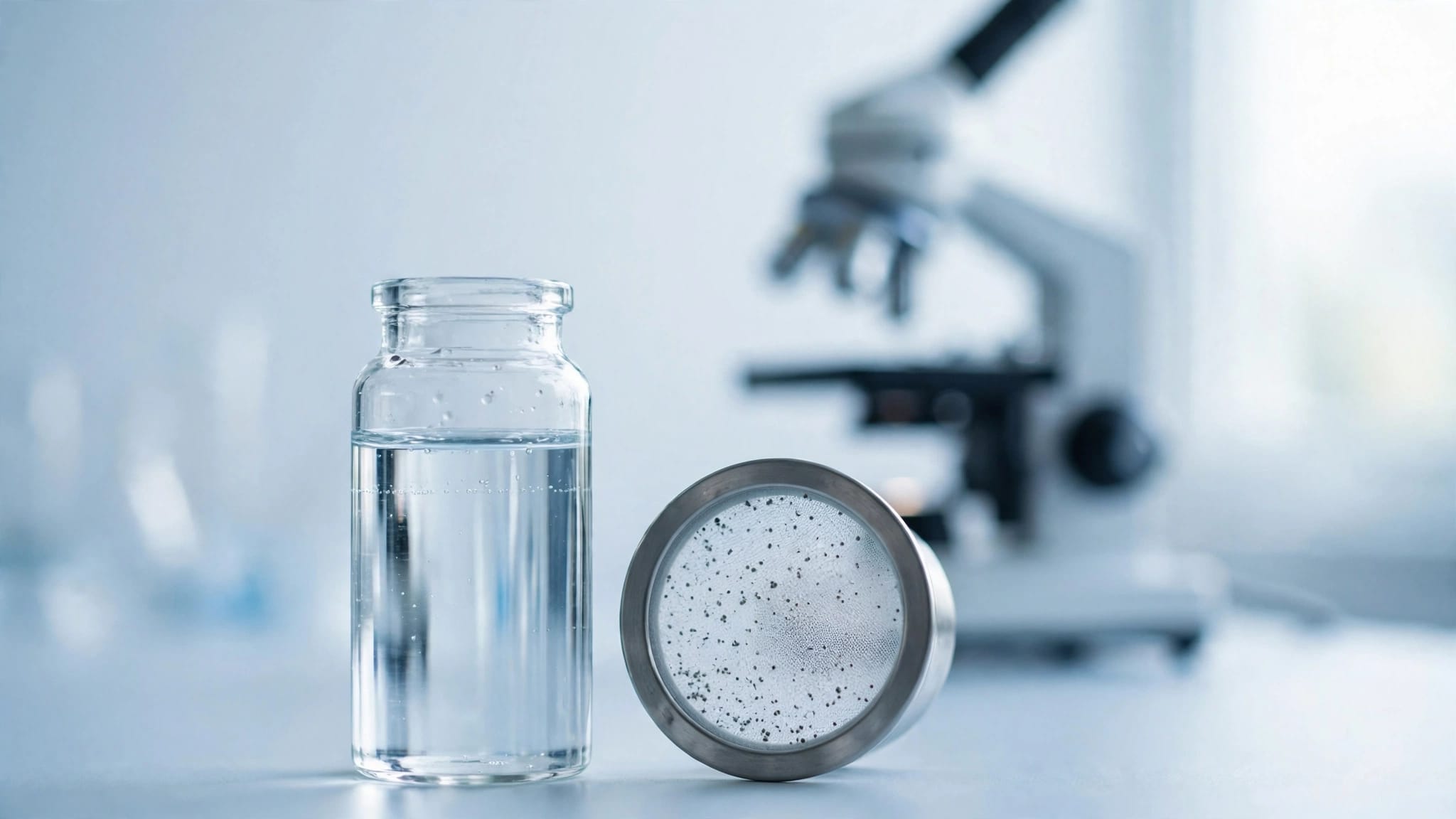
Detecting microplastics in drinking water usually involves collecting a sample, filtering out particles, and using laboratory instruments to identify which particles are plastic. A microscope can help find suspicious specks, but chemical identification is what gives a result its meaning.
That clear glass of water may look perfectly ordinary, which makes the question interesting: how does one find something too small to see, and tell it apart from everything else floating around?
The answer begins with a closer look at what researchers are trying to catch.
This post may contain affiliate links. If you make a purchase through these links, I may earn a small commission at no extra cost to you.
What counts as a microplastic?
Microplastics are small pieces of plastic, often described as particles smaller than 5 millimeters. That covers a surprisingly broad range, from a fragment you might notice on a fingertip to particles far too small to spot without specialized equipment.
They can appear as fragments, fibers, films, or other shapes. A worn piece of plastic packaging and a fiber shed from synthetic clothing might look completely different, yet both can fall under the microplastics umbrella.
The World Health Organization’s information sheet points out that these particles vary in size, shape, density, and chemical composition. That variety makes them difficult to measure with a single tool.
Plastic can enter water through several routes, including the breakdown of larger waste. Looking at ways of reducing plastic waste in the kitchen offers one perspective on how ordinary objects can become part of a much larger pollution problem.
How laboratories prepare a water sample
Before anyone identifies a plastic particle, they need to separate possible particles from the water. That sounds straightforward, but a careless sample can pick up fibers and dust that weren’t in the water to begin with.

Collecting and filtering the water
A laboratory may collect water in a suitable container or pass it directly through filters at the sampling point. The filters hold back particles above a certain size while water passes through.
The amount of water matters. A larger sample can make it easier to detect particles that are present at low concentrations, although it may also leave the lab with more material to examine.
Filter size matters too. If the openings are too large, smaller particles can pass through. A fine filter can catch smaller particles, but it may also collect sediment and other material that complicates the analysis.
Separating particles from other material
What remains on a filter isn’t a neat pile of plastic. It can include minerals, biological material, and other particles that happened to be in the water.
Depending on the sample and method, the lab may remove some unwanted material before analysis. Care is needed because preparation can damage or remove the particles the researchers are trying to measure.
Think of it as sorting a mixed bowl of crumbs. The goal is to make the interesting pieces easier to find without accidentally throwing them away.
Why seeing a particle isn’t enough
A microscope gives researchers a closer view of the material on a filter. They can look at particle shape, estimate size, and select possible plastics for further testing.
But appearances can be deceptive. A transparent fragment could be plastic, a mineral, or another material. A thin fiber might have come from synthetic fabric, or it could be made of a natural substance.
Color and shape can help scientists decide what to investigate, but they don’t prove what a particle is made of. Even an impressive-looking image leaves an important question unanswered: what’s the material?
Some screening techniques make certain particles easier to see, but a reliable identification generally calls for a chemical measurement as well. This distinction matters when comparing test results. A count of “suspicious particles” doesn’t necessarily mean the same thing as a count of confirmed plastic particles.
How labs identify plastic particles
To identify the material, laboratories can use spectroscopy. The name sounds formidable, but the idea is approachable: different materials interact with light in different ways.
The resulting pattern can be compared with known patterns for plastics such as polyethylene or polyester. A good match helps the lab identify the particle’s polymer, the material that gives the plastic its structure.

Infrared spectroscopy
Fourier-transform infrared spectroscopy, usually shortened to FTIR, measures how a material absorbs infrared light. Combined with microscopy, it can identify small particles while also showing where they are on a sample.
In its 2019 report on drinking-water microplastics, the WHO described microscopy combined with FTIR as capable of identifying particles down to roughly 10 to 20 micrometers. That is a description of the method’s capability, not a guarantee that every laboratory will achieve the same result.
Raman spectroscopy
Raman spectroscopy uses a laser to examine how light changes after interacting with a material. Like FTIR, it can provide a pattern that helps identify a polymer.
Raman can be useful for smaller particles, although performance depends on the equipment and the sample. Fluorescence or material stuck to a particle can make a reading harder to interpret. Both methods require suitable reference information and careful analysis.
What happens when particles get smaller?
A micrometer is one-thousandth of a millimeter. As particles approach that scale, finding them and identifying their material becomes increasingly difficult.
The limits of a reported result
On March 11, 2024, the European Commission adopted a harmonized methodology for measuring microplastics in drinking water. Its reporting scope covers particles between 20 micrometers and 5 millimeters, with a separate upper length of 15 millimeters for fibers.
A result produced within that scope doesn’t describe every plastic particle in the sample. Particles below the method’s lower reporting limit remain outside the result, even if an instrument can sometimes examine smaller material.
That difference is easy to miss. An instrument’s capability and a particular method’s reporting range are related, but they aren’t always identical.
The challenge of nanoplastics
Even smaller pieces are often called nanoplastics. Their size makes them harder to isolate, identify, and count, particularly in a complex water sample.
The U.S. Environmental Protection Agency’s overview of microplastics analysis describes different approaches to sampling and measuring particles across size ranges. No single result should be treated as a complete inventory of every size of plastic in the water.
How do labs prevent accidental contamination?
Plastic particles are common in the surrounding environment. That creates an awkward possibility: the lab could find a fiber that landed in the sample after collection rather than one that came out of the tap.
Keeping unwanted fibers out
Researchers use procedures designed to limit contamination during collection and analysis. They may keep samples covered, use carefully cleaned equipment, and pay attention to materials that could shed particles.
The concern extends beyond the water itself. A dusty work surface or fibers in the air can complicate the result, especially when the number of particles in the sample is small.
Using blanks and recovery checks
A blank is a control sample used to reveal contamination introduced during collection or processing. For example, clean water can go through parts of the same procedure as the drinking-water sample.
Labs can also use recovery checks to assess how much of a known material survives the process. If particles are lost during preparation, the final count may be lower than the amount originally present.
These controls help explain what a number means. A count without information about contamination and particle recovery leaves important parts of the story untold.
Can you test for microplastics at home?
A home test may help you collect material from water, but reliably identifying microplastics generally requires specialized laboratory analysis. A visible speck on a filter, by itself, doesn’t establish that the speck is plastic.
What a home filter can show
Passing water through a fine filter can reveal particles that weren’t obvious in the glass. This can be interesting to look at, particularly under magnification.
The difficulty is identification. A household filter collects whatever it can trap, which may include sediment and fibers as well as plastic. The filter’s own size limits also determine what it can catch.
A home microscope can make a particle look more convincing, but magnification alone doesn’t reveal its chemical identity. The particle might be photogenic. That doesn’t make it plastic.
Why ordinary water tests answer different questions
Common home water tests often measure characteristics such as pH or dissolved solids. Those measurements can be useful for other purposes, but they aren’t a count of microplastic particles.
The same goes for a water-quality reading displayed by a meter. A low or high number on that device doesn’t identify polymer fragments, their sizes, or their concentration.
For a meaningful microplastics result, the useful details are the measurement method, the particle sizes covered, and whether the material was identified chemically. A test that leaves those details out gives you less to interpret.
How to read a laboratory result
A laboratory report may present a count of particles per liter, describe the polymers found, or provide information about particle size and shape. Each detail answers a different question.
Counts, sizes, and polymer types
A particle count tells you how many particles were reported in a given volume. It doesn’t tell you their combined mass, and it doesn’t automatically describe their health effects.
Size matters when comparing results. A test that includes smaller particles may report a higher count than one that only looks for larger pieces, even when the water samples are similar.
Polymer identification adds another piece of information. Finding polyethylene, for example, tells you something about the material, but it doesn’t automatically reveal where that particular particle originated.
Mass isn’t the same as particle count
Some laboratory methods measure the mass of plastic material rather than identifying and counting individual particles. That can be useful, but it answers a different question.
One relatively large fragment can weigh more than many tiny particles. Comparing a mass result with a particle count is therefore a little like comparing the weight of a bowl of rice with the number of grains. Both describe the bowl, but neither number can replace the other.
What does a detection mean for your health?
Finding microplastics in a sample tells you that the method detected particles within its measurement range. It doesn’t, on its own, tell you what health effect that exposure might have.
The WHO’s drinking-water work identifies gaps in the evidence about exposure and potential risks. Its 2019 announcement on microplastics in drinking water calls for more research while emphasizing the importance of addressing established drinking-water hazards.
That distinction is reassuring in one sense and unsatisfying in another. Researchers can detect particles without yet having all the answers about what every type, size, and level of exposure means for people.
Can water treatment remove microplastics?
Water treatment can remove particles, including some microplastics, but removal depends on the treatment process and the particles involved. A filter’s performance also depends on its design, condition, and the size of what it is trying to capture.
Reverse osmosis uses a membrane to separate water from many unwanted substances. As with desalination and drinking-water quality, the treatment process and the finished water are part of a broader system that includes monitoring.
A filter and a test answer different questions. Treatment is intended to remove material; testing investigates what remains within the range a method can measure. Neither makes the need for careful sampling disappear.
The small details behind a clear answer
Detecting microplastics means more than finding a speck. Researchers need to collect the water carefully, separate particles, and use chemical measurements to identify what they are.
A result becomes more useful when you know its size range and method. The water may look clear throughout, but the answer depends on how closely the laboratory was able to look.


