
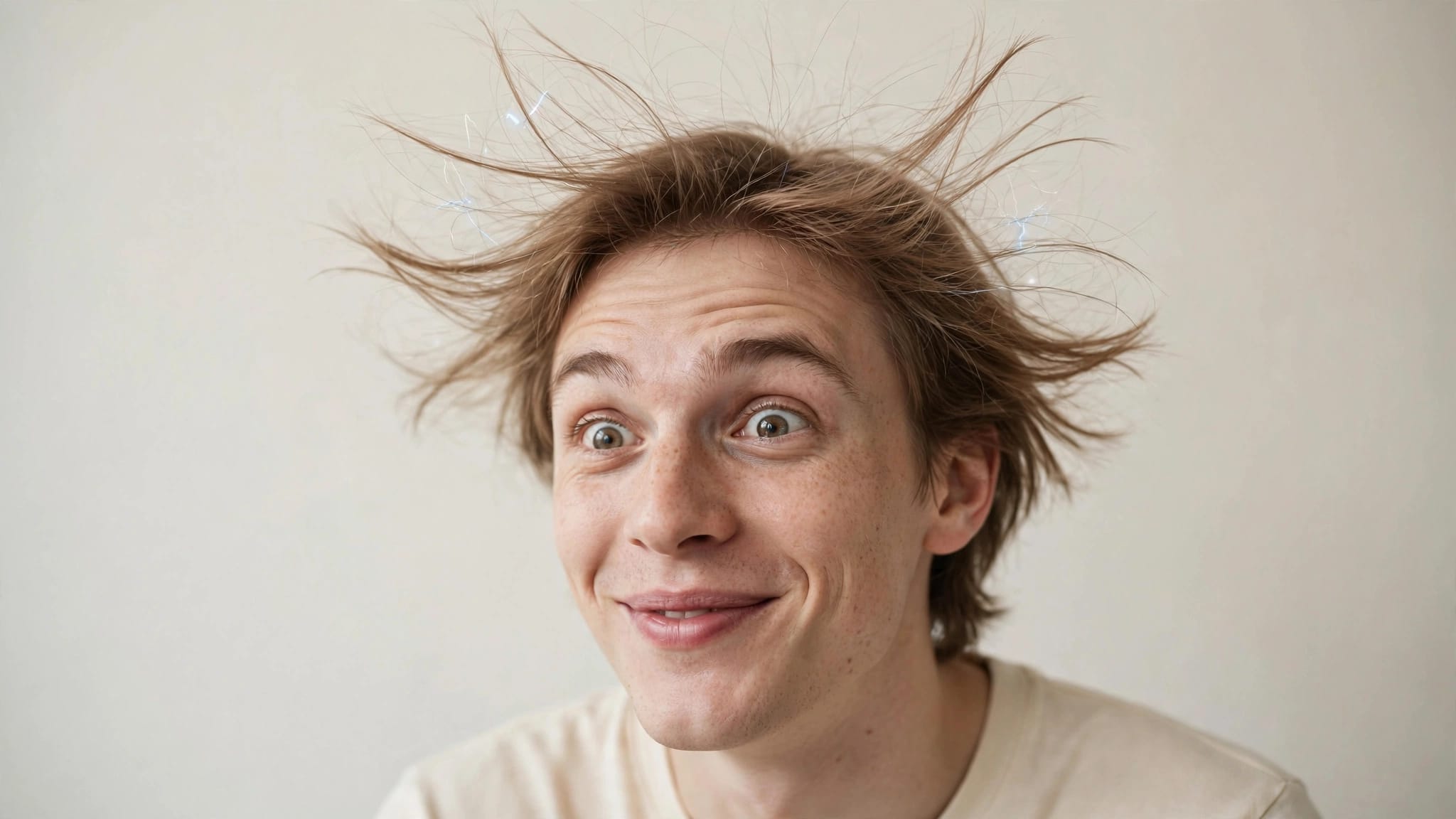
Static electricity makes hair stand up when strands carry the same kind of electrical charge and push away from one another. If that push is strong enough, a tidy hairstyle can begin to resemble a startled dandelion.
A nearby charged object can also pull hair toward it, which adds another twist to the story. To understand the difference, it helps to start with what electric charges do when they meet.
This post may contain affiliate links. If you make a purchase through these links, I may earn a small commission at no extra cost to you.
Why Static Electricity Makes Hair Stand Up
Imagine that each strand of hair has suddenly developed a preference for personal space. When neighboring strands carry the same kind of charge, they push away from each other. That push is called repulsion.

Like Charges Push Apart
Electric charge comes in two types, called positive and negative. Charges of the same type repel, while opposite types attract.
When many strands carry the same kind of charge, they push away from their neighbors in different directions. Hair is flexible, so the strands can bend and spread rather than staying together. The result is that familiar flyaway look.
Hair Has Other Forces to Contend With
Electrical repulsion isn’t the only force acting on your hair. Gravity pulls the strands downward, while their weight, stiffness, and attachment to your scalp affect how they move.
If the electrical push is strong enough compared with those effects, strands can lift and separate. If it isn’t, you might see a few flyaways rather than a full head of hair standing on end.
What Happens When a Charged Balloon Is Nearby?
A charged balloon can make hair move even before it touches the strands. This happens because an electric charge creates an electric field, an effect in the space around it that can exert a force on other charges.
You can’t see the field itself, but you can see hair respond to it. Depending on the situation, the balloon may pull strands toward its surface.
Attraction Has More Than One Cause
Opposite charges attract, so a charged balloon and an oppositely charged object can pull toward each other. A charged balloon can also attract an object that has no overall charge.
In that case, the balloon’s electric field causes a small rearrangement of charge within the object. The effect is called polarization. It helps explain why a charged object can pull on something that was electrically neutral overall.
Attraction and Repulsion Can Appear Together
Hair moving toward a balloon and hair spreading apart aren’t necessarily competing explanations. A balloon can attract strands while those strands also push away from one another.
Think of a group of people trying to move toward the same doorway while each keeps some distance from their neighbors. Their shared direction doesn’t mean they have stopped spreading out.
Why Some Hair Stands Up More Easily
Not every strand responds in the same way. A long strand has more hair for gravity to pull on than a short strand of similar thickness. A stiff strand may also bend differently from a flexible one.
The amount and arrangement of charge matter, too. If the electrical forces are uneven, one part of a hairstyle might lift while another stays close to the head. A dramatic result depends on the balance of forces across individual strands, rather than a single switch that turns every hair upright.
Distance also matters when a charged object is nearby. Move a balloon closer and the force on the hair can become more noticeable. Move it away and the strands may settle back toward their usual position.
Is Static Hair Related to Magnets or Lightning?
Static hair and magnets both involve forces that can act across a distance. However, the familiar force between two charged hair strands is an electric force, not the attraction you see between a magnet and a piece of iron.
A magnetic field can produce its own striking patterns. For example, a liquid called ferrofluid forms spikes near a magnet as magnetic forces compete with gravity and the liquid’s surface tension. Those spikes may look a little like standing hair, but the two displays have different explanations.
Lightning has a closer connection to static electricity because it involves an electrical discharge. Its scale is vastly different from a few flyaway hairs. In one common type of cloud-to-ground lightning, a channel can develop in steps of roughly 50 metres, with pauses of about 50 microseconds.
Scientists can also create electrical discharges in controlled settings. The process behind laboratory lightning shows how much there is to learn from a spark, although a hairstyle and a lightning flash shouldn’t be treated as identical events.
How to Explain Static Hair to a Curious Child
Start with the idea that hair strands can carry electrical charge. When nearby strands carry the same kind, they push apart. If the push is strong enough, the hair lifts and spreads.
Then point out that a charged balloon can pull on hair as well. This gives a child two things to look for: strands moving toward the balloon and strands moving away from one another.
A useful follow-up is to ask what changes when the balloon moves closer or farther away. Watching the direction of the hair helps turn a funny moment into a question about forces. There may be several forces at work, so the answer can be more interesting than it first appears.
The Small Forces Behind a Big Hair Day
Standing hair is a visible result of forces you can’t see directly. Strands carrying the same kind of charge push apart, while a nearby charged object can attract them.
Once those electrical forces are no longer strong enough to keep the strands lifted, gravity and the hair’s own shape have more say. The hairstyle may settle down, but the little science lesson is worth keeping.


