
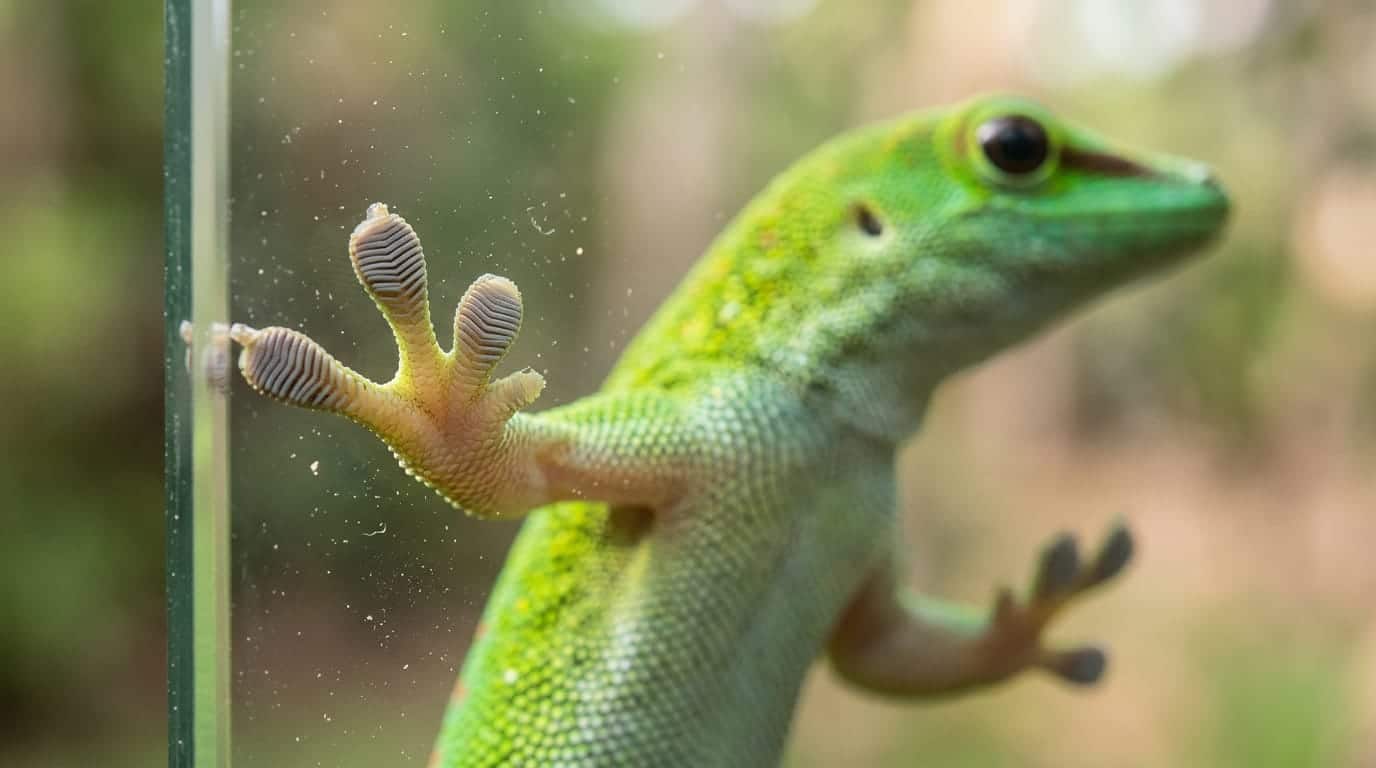
Gecko feet let their owners walk up walls by making incredibly close contact with a surface. Tiny structures on their toes bring thousands of microscopic tips near the wall, where weak molecular attractions add up to a useful grip.
The surprising part? A gecko can attach and release those feet with every step, without leaving a trail of glue. To understand how, we need to look a little closer at what happens between a toe and a wall.
This post may contain affiliate links. If you make a purchase through these links, I may earn a small commission at no extra cost to you.
How a Gecko Walks Up a Wall
Imagine trying to walk up a window in socks. Your feet might press against the glass, but they wouldn’t give you much of a grip. A gecko faces the same pull of gravity, yet its toes are equipped to make contact with the glass in a different way.

As the animal places a foot down, its toe pads engage with the surface. The foot can then support part of its weight while the other feet move. On a ceiling, those same pads can help hold the gecko against gravity as it travels upside down.
This ability depends on more than having sticky toes. The pads need to make contact, bear a load and release again. If the gecko couldn’t let go easily, its impressive climbing skills might come with a rather inconvenient problem: getting stuck to the window.
The Tiny Structures on Gecko Feet
A gecko’s toe pad may look smooth at a glance, but a closer look reveals a layered structure. Each level helps bring the smallest parts of the foot close to the surface.

From Toe Pads to Tiny Hairs
The ridges visible under many gecko toes are called lamellae. These ridges carry tiny hairlike structures called setae. They’re not the same as the hair on your head, but the comparison helps you picture their fine, flexible shape.
A setal array can adapt to small variations in a surface. That flexibility matters because even a wall that looks smooth to us has an uneven structure at a much smaller scale. A single flat pad would struggle to make such close contact across every bump and dip.
The Even Smaller Tips
Each seta branches into smaller structures called spatulae, named for their flattened tips. A Nature account of gecko adhesion describes between 400 and 1,000 spatulae on each seta.
Think of a paintbrush with bristles that divide into many finer ends. Each end has an opportunity to meet the surface. In a gecko’s foot, those numerous contact points allow the animal to make use of molecular forces that would be far too weak to notice at the level of a single tip.
The shape of the tips also matters. Their flattened ends can lie close to a surface, rather than touching it only at a narrow point. Close contact is where the physics starts to get interesting.
What Makes Gecko Feet Stick?
The attraction associated with gecko feet is often explained through van der Waals forces. These are weak attractions between molecules that become important when surfaces are extremely close together.
One way to picture them is to think about the movement of electrons within molecules. Their distribution can briefly become uneven, creating a tiny electrical imbalance. That imbalance can influence a nearby molecule and produce an attraction between them.
A single interaction is tiny. When many spatulae get close enough to the wall, however, their contributions can add up. It’s a bit like having a large group of people each give a gentle pull: one person’s effort may seem slight, but the combined effect can be noticeable.
Why Close Contact Matters
Van der Waals attraction falls off rapidly with distance. A foot doesn’t need to merge with the wall, but its tiny tips do need to get extremely close to it.
This helps explain why the branching structure is so useful. The spatulae aren’t merely there to increase the apparent size of the foot. They help the gecko establish many close contacts with the surface beneath it.
Is One Force Doing All the Work?
Van der Waals interactions have strong experimental support as an explanation for gecko adhesion. The full picture can also depend on the surface and its surroundings. A review of gecko adhesion mechanisms discusses the evidence and the questions researchers have examined.
So, while molecular attraction gives us the central idea, it’s sensible to think about the foot as a physical system. Its shape, movement and contact with a particular surface all influence the grip.
How Does a Gecko Let Go?
Sticking to a wall is useful. Releasing quickly is useful too, especially when your next meal isn’t going to wait for you to finish peeling your foot off the glass.
Gecko toes solve this problem partly through the direction in which they move. The setae tend to point toward the heel. As a foot engages a surface, the direction of the load helps the structures make contact and develop grip.
A Pull in the Right Direction
Try placing your hand flat on a table and sliding it toward you. Now imagine that the contact between your hand and the table changes depending on the direction of that movement. Gecko setae have a directional response somewhat like that, although the structures involved are far smaller and more specialized than a human hand.
Researchers studying the adhesive force of a single gecko seta found that its orientation affected the force it produced. The result helps explain why a gecko’s grip depends on how it places and loads its foot, rather than on contact alone.
Peeling Instead of Pulling
When it’s time to move, a gecko can release its toes with a peeling motion. The contact is removed progressively, rather than all at once.
You can see the advantage when you peel a strip of tape. Lifting one edge is easier than trying to pull the entire strip straight off in a single movement. A gecko’s foot isn’t tape, but the comparison helps explain why the angle and order of release matter.
How Scientists Studied the Grip
For a long time, gecko feet invited an obvious question: what exactly was holding the animal up? Looking at the whole foot showed that it worked, but it was harder to separate the contribution of its tiny structures from the animal’s movements.
In 2000, Kellar Autumn and colleagues reported measurements of individual gecko setae. Their study of a single foot hair examined how the structure contacted and pulled away from a surface. The force measurements supported the idea that van der Waals interactions contribute to adhesion.
Studying one seta also made the role of direction easier to see. A gecko doesn’t need to think about molecular attraction as it walks, but the orientation of its foot changes what happens at the contact points.
That distinction is helpful when we describe the animal’s ability. The foot isn’t a mysterious substance with a permanent sticking power. It’s a structure whose performance depends on how it’s used.
Can Gecko Feet Grip Any Surface?
A gecko’s climbing ability has limits. A window, a rough rock and a wet leaf offer different conditions, even if each looks like a perfectly reasonable place for a small lizard to explore.
Smooth, Rough and Dirty Surfaces
A smooth surface can give the tiny tips plenty of opportunities for close contact. Roughness can make that contact more complicated, although a flexible toe pad can still conform to some uneven surfaces.
Dirt matters too. If particles sit between the spatulae and a surface, they can interfere with contact. Gecko feet have been studied for their ability to shed some particles during movement, but that doesn’t mean they stay perfectly clean in every situation.
Water and Surface Chemistry
Moisture can change how the foot and a surface interact. Its effects depend on the amount of water and the properties of the surface, so a dry window and a wet one shouldn’t be treated as identical climbing conditions.
The foot has its own chemistry, too. Research described by Brookhaven National Laboratory found an ultra-thin layer of lipids on gecko feet. That adds another detail to a system in which both physical structure and surface properties matter.
Do All Geckos Have Wall-Climbing Feet?
Geckos are a varied group of lizards, and they don’t all have the broad adhesive toe pads we associate with a gecko on a window. Their feet reflect the places they live and the surfaces they use.
A gecko moving across a sandy habitat, for example, faces different challenges from one climbing smooth leaves or walls. Claws can also help a lizard grip suitable rough surfaces, where they catch on small irregularities. Adhesive pads and claws are different tools, and a species’ feet may be suited to more than one kind of movement.
This is a useful reminder when you see a picture of a gecko hanging upside down. You’re seeing an animal using an adaptation suited to its surroundings, not a trick shared in exactly the same way by every member of the group.
What Can We Learn From Gecko Feet?
Gecko feet have inspired researchers to develop materials that grip without the kind of liquid glue used in many conventional adhesives. The goal is often to create surfaces that can attach and release when needed.
Adhesives Inspired by Nature
Some gecko-inspired materials use arrays of tiny synthetic structures to increase contact with a surface. Their designs borrow the general principle of many small contact points, although they don’t reproduce a living gecko’s foot in every detail.
A reusable gripping material could be useful where residue is unwanted, or where an object needs to be picked up and released repeatedly. The challenge is making that grip work reliably under the conditions a real device will encounter.
Why Copying a Gecko Is Difficult
A gecko’s foot is more than a collection of tiny hairs. It combines flexible structures, toe movement and control of the direction in which force is applied.
A manufactured adhesive also has to deal with practical complications such as dust, wear and surfaces that aren’t perfectly smooth. Nature offers a useful starting point, but copying the appearance of a toe pad doesn’t automatically reproduce everything the animal can do.
A Closer Look at the Wall Walker
A gecko’s walk up a wall depends on a simple idea with an elaborate design behind it: many tiny contacts can create a useful grip. Flexible toes, branching setae and molecular attractions all have a part to play.
The next time you see a gecko on a window, look at its feet. Those small pads are managing a rather impressive balance between holding on and letting go.


