
Bills don’t feel hard because the math is impossible. They feel hard because they appear at random, like raccoons in your trash, and they always show up when your brain is already full.
A 10-minute bill pay routine fixes that by giving money tasks a home. Not a “someday” home. A weekly home, on purpose, on Friday, when you can shut the week down and stop waking up to surprise due dates.
The goal is simple: most bills run on autopay, reminders keep you honest, and you do one small manual step each week to catch what automation misses.

Pick a Friday slot, then make a one-page bill map
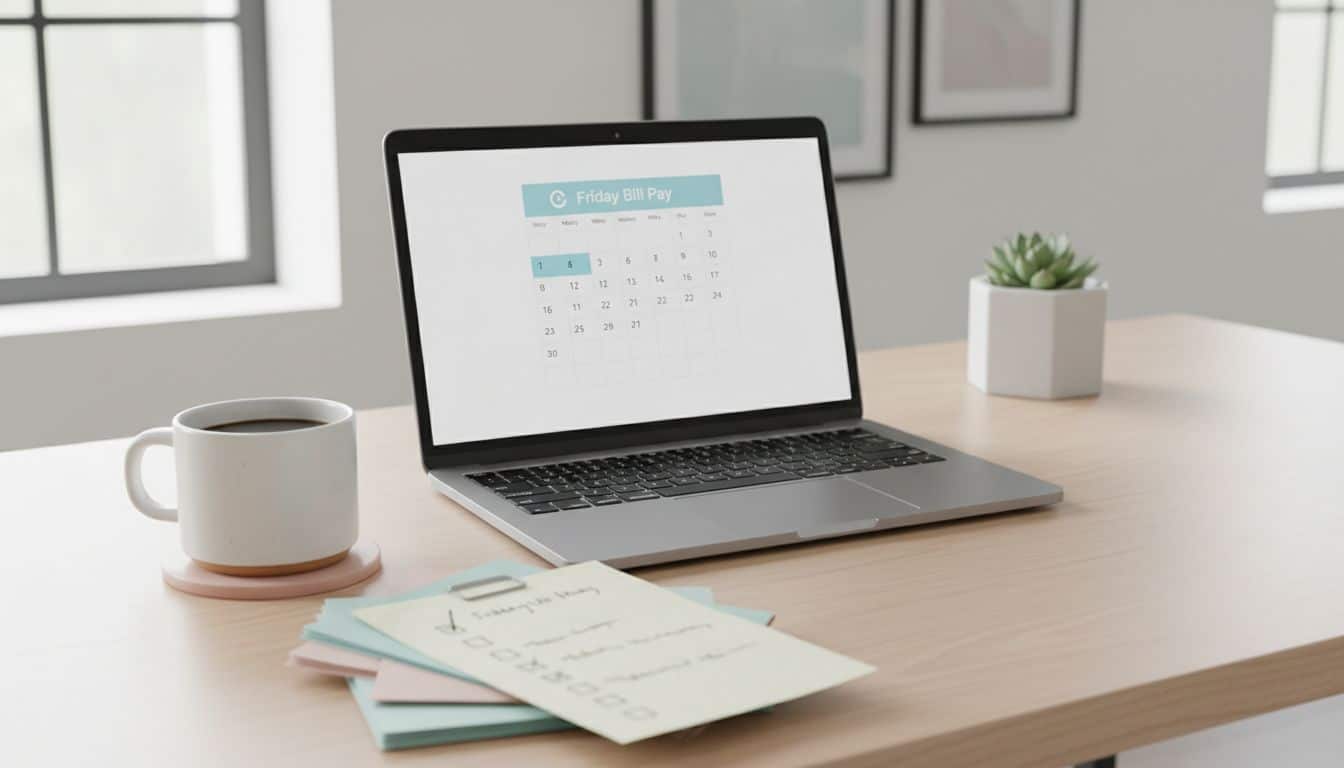
First, choose a time that’s boring and repeatable. “Friday at 8:20 a.m.” works better than “Friday sometime.” Put it on your calendar as a recurring event with a 10-minute duration. Treat it like brushing your teeth, not like a finance hobby.
Next, make your bill map. This is not a fancy spreadsheet unless you love spreadsheets. It’s just one list that answers three questions for every bill: when is it due, how is it paid, and where does the money come from?
If you need a visual starting point, skim examples of bill pay checklists and bill calendars. You’re not copying their system, you’re borrowing the layout so your brain relaxes.
Here’s a simple way to label each bill, so your list stays readable:
| Bill type | Best default | What you’ll watch |
|---|---|---|
| Fixed monthly (rent, phone) | Autopay | Account balance before draft |
| Variable monthly (electric, water) | Autopay with alerts | Bill amount spikes |
| Credit cards | Autopay minimum (at least) | Statement balance and due date |
| Annual or weird bills | Reminder first | Due date and login access |
The win here is clarity. Once every bill has a lane, due dates stop feeling “sneaky.” They’re still due, but they’re no longer hiding.
A quick safety move helps, too: keep a small buffer in your checking account. Late fees often happen because timing fails, not because people don’t care. A buffer buys you time when life gets loud.
Turn on autopay, but add two guardrails so it doesn’t bite you
Autopay is great at consistency. It’s also great at quietly failing when your card expires, your bank flags a charge, or you switch accounts. So you want autopay, but you also want a seatbelt.
If you’re new to it, this autopay overview from Bankrate is a clear primer on what to set up and where people get tripped up. It’s worth five minutes, once, so you don’t learn the hard way.
Now the two guardrails.
First guardrail: use autopay where it fits the bill. Fixed bills are easy. Variable bills are still fine on autopay if you also get alerts. Credit cards deserve special handling. If you do nothing else, autopay the minimum payment so you avoid late marks. Then your Friday routine becomes the moment you decide whether to pay the full statement balance or extra.
Second guardrail: make autopay pull from the right place. Whenever you can, pay bills from one “bills account” (often your main checking). Fewer accounts means fewer surprises. If you must use a credit card for rewards, keep the expiration date and billing zip code current, because those tiny details cause big failures.
For a balanced look at tradeoffs, see pros and cons of automatic payments. The main takeaway is simple: autopay reduces late fees, but it needs light supervision.
Autopay isn’t “set it and forget it.” It’s “set it and check it briefly, on a schedule.”
That schedule is your Bill-Pay Friday. Autopay does the heavy lifting, and your routine keeps it from drifting into chaos.
Set reminders that actually work, then do the one manual step each Friday
Reminders fail when they’re vague. “Pay bills” is vague. Your brain can’t picture the first move, so it dodges the whole task.
Instead, set reminders that match how you’ll act.
Use two reminders for the same weekly routine:
- A short “preview” reminder midweek (Tuesday or Wednesday) that says: “Bills drafting soon, check balance.”
- Your Friday reminder that says: “Bill-Pay Friday, open list, confirm drafts, pay the one manual bill.”
If you like using a payment app as a cue, Google Pay includes recurring reminders. Their help page on setting up payment reminders shows the general idea, even if your country or app options differ.
Now, the one manual step. This is the part that keeps your system from becoming “mostly automated, occasionally disastrous.”
During your 10 minutes, do this one thing: pay or schedule anything that isn’t already on autopay, then confirm next week’s drafts won’t overdraft you. That’s it.
In real life, that manual item is often one of these:
- A credit card extra payment (beyond the minimum).
- A “weird” bill that changes (medical, school, one-off services).
- A subscription you’re canceling, switching, or disputing.
Subscriptions are sneaky because they blend into the background. If that’s your pain point, a separate tracker can help. CNBC has a practical roundup of apps that track and manage subscriptions so you can spot the charges you forgot you agreed to at 11:47 p.m.
One more trick, especially if you have ADHD or you’re just tired: keep your bill log where you’ll trip over it. Pin it to your phone notes, put it in a finance folder, or tape a simple list inside a cabinet door. Reduce the “where did I put it?” friction and the whole routine gets easier.
If your routine depends on motivation, it won’t last. If it depends on placement and a reminder, it probably will.
Conclusion: Make Friday the place bills go to live
A good bill pay routine isn’t about being perfect. It’s about being predictable. Autopay handles the repeatable stuff, reminders keep you from time-blindness, and your one weekly manual step catches the strays.
Set your first Bill-Pay Friday for this week, even if you only map your bills and turn on one autopay. Next Friday, you’ll improve it again. After a few rounds, due dates stop sneaking up, because they finally have an address.


