
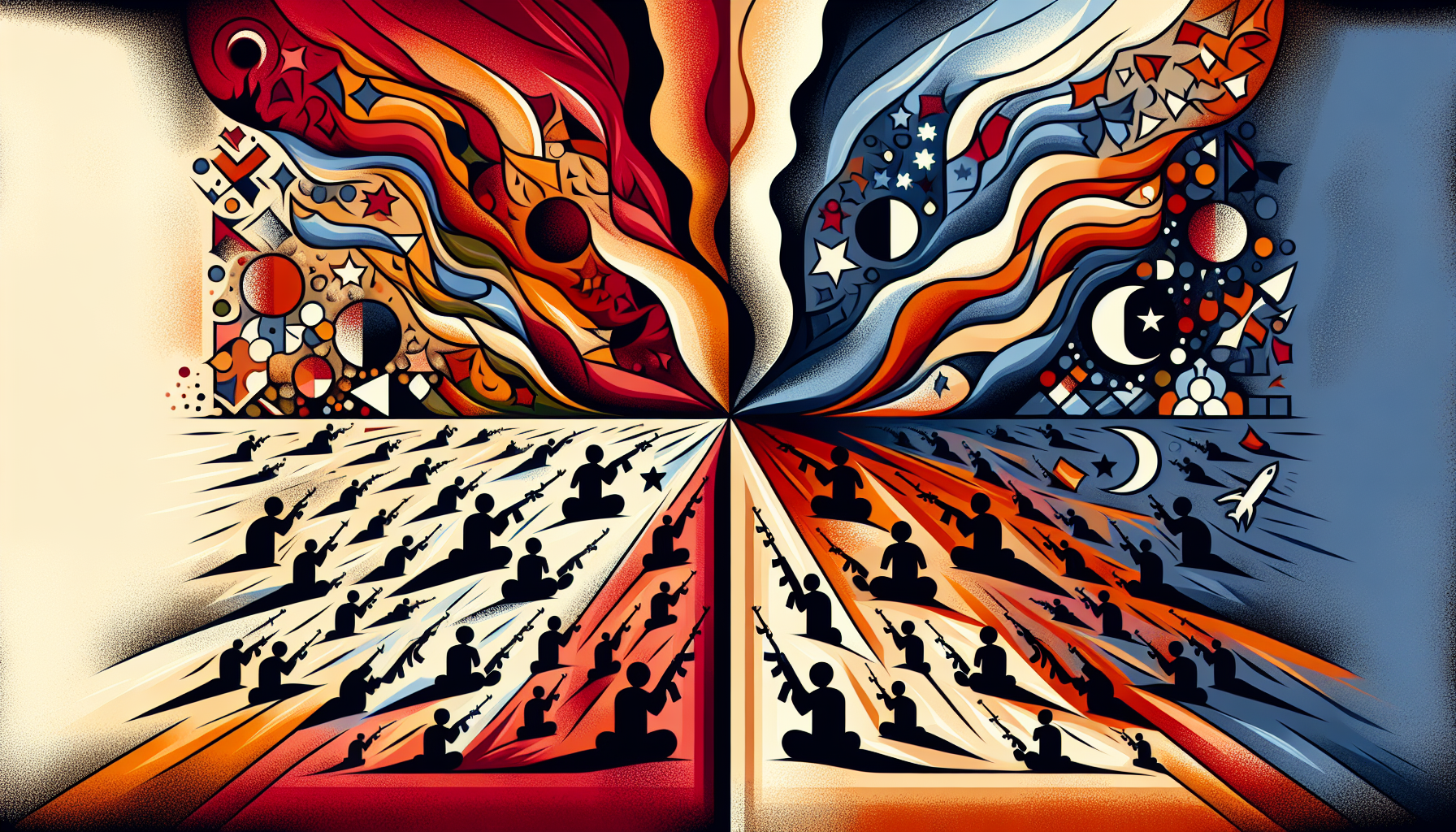
Ethnic and religious divisions often serve as fault lines in societies, shaping identities and igniting tensions. When left unchecked, these same divisions can escalate into violence, fueling atrocities such as war crimes. Understanding their role in such conflicts isn’t just crucial—it’s necessary to confront the root causes and promote accountability. By unpacking the intersection of ethnicity, religion, and power, we uncover how these divisions are manipulated, turning shared differences into weapons of destruction.
Understanding Ethnic and Religious Divisions
Warfare often emerges from differences that run deep within societies. Among the most potent of these are ethnic and religious divisions. These divides are more than labels; they form identities, shape group loyalties, and sometimes set the stage for conflict. Wars and crimes against humanity often exploit these fault lines, but what do these terms truly mean? Let’s break them down.
Definition of Ethnic Divisions
Ethnic divisions stem from the distinctions made between human populations based on shared cultural traits, language, ancestry, or history. At their core, ethnic divisions form when these distinctions are not only recognized but also politicized or weaponized. When ethnicity becomes the basis of identity in a way that excludes others, tensions can arise.
For example:
- In Rwanda, the Hutu and Tutsi ethnic groups once lived together peacefully. However, political manipulation of their differences triggered a genocide that killed nearly a million people in 1994.
- In the Balkans, ethnic groups such as Serbs, Croats, and Bosniaks clashed during the 1990s, leading to war and mass atrocities.
Ethnic division doesn’t inherently lead to violence; it’s the exploitation of these distinctions for power and control that drives conflict. The complexity lies in how society defines “us” versus “them,” often based on historical grievances or cultural misunderstandings.
For further resources on this topic, you might find this article from Collins Dictionary insightful.
Definition of Religious Divisions
Religious divisions arise when differences in faith, beliefs, or practices become grounds for segregation or discrimination. Throughout human history, religion has been both a source of unity and division. Wars, reforms, and movements often reflect deep-seated religious distinctions. These divisions can manifest externally in conflicts or internally within societies where sectarian divides grow.
Take, for instance:
- The Protestant and Catholic strife in Ireland, which spanned decades, illustrates how religious identity drove national and political conflict.
- In the Middle East, Sunni and Shia Muslims remain divided along theological and political lines, shaping regional power struggles.
Historical moments like the Reformation or the Crusades show that religious discord isn’t new—it’s interwoven with human history. Yet, understanding these divisions also means recognizing that faith itself doesn’t inherently cause violence. It’s the manipulation of religious identities and doctrines, often intertwined with politics, that exacerbates divisions.
For a deeper dive into the historical dynamics of religious divisions, consider exploring this resource from Britannica.

Photo by Avneet Kaur
Understanding ethnic and religious divisions isn’t just about defining them; it’s about exploring how these identities evolve in shared spaces. What happens when differences are celebrated? And when they’re scorned? Context and history help illuminate why these fault lines exist, serving as a map to prevent their misuse.
Historical Context of War Crimes Related to Divisions
War crimes often stem from the deep fractures within societies, where ethnic and religious divisions are weaponized. These divisions, rooted in identity, culture, and history, are sometimes exploited to justify acts of mass violence. Understanding the historical context behind such atrocities offers a lens to grasp how societal breakdowns occur under the weight of manipulated tensions. Let’s examine two cases where these dynamics played out with brutal consequences.
Case Study: The Rwandan Genocide
 Photo by Nur Yilmaz
The Rwandan Genocide in 1994 stands as one of the most harrowing examples of ethnic division leading to mass violence. Rooted in colonial-era policies, Rwandan society saw ethnic lines between Hutus and Tutsis become entrenched over time. The distinctions between the two groups—largely fabricated by European colonizers—defined societal hierarchies, with Tutsis seen as elite and Hutus as laborers.
But how did this tension explode into genocide? Hateful propaganda played a central role. Radio broadcasts dehumanized Tutsis, referring to them as “cockroaches.” Over just 100 days, extremist Hutu militias and civilians decimated Tutsi populations with chilling precision. Nearly 1 million people were murdered, while countless others were displaced.
The Rwandan case highlights how ethnic divisions aren’t simply pre-existing rifts in society; they can be exacerbated by systemic oppression, political manipulation, and deliberate acts of violence. A closer look is provided by Divided by Ethnicity, which explains the ideological groundwork that gave rise to this genocide.
For another perspective on the historical context, you can explore The Genocide Against the Tutsi in Rwanda.
Case Study: The Yugoslav Wars
The Yugoslav Wars of the 1990s presented a chaotic period where ethnic and religious nationalism became lethal tools in the hands of political leaders. Following the dissolution of Yugoslavia, tensions between ethnic Serbs, Croats, and Bosniaks boiled over. This fracturing wasn’t solely ethnic—it carried deep religious undertones, with Orthodox Christians, Catholics, and Muslims forming key identity markers for various factions.
Within this context, “ethnic cleansing” became a grim hallmark of the conflict. Entire villages were razed, civilians massacred, and atrocities such as the Srebrenica massacre, where over 8,000 Muslim Bosniaks were murdered, shocked the world. Leaders manipulated centuries-old grievances, sharpening the divisions to stoke fear and consolidate power.
The role that ethnic and religious divisions played in the Yugoslav Wars is starkly evident in the way leaders framed their enemies. The atrocities committed weren’t isolated—they were part of a broader agenda fueled by propaganda, fear, and the desire for dominance. To dive deeper, see Yugoslav Wars, a comprehensive overview that explores the complex dynamics at play.
Moreover, the History of Ethnic Tensions further unpacks the roots of these divisions and their catastrophic consequences.
By examining these two cases, it becomes clear that ethnic and religious divisions, when exploited, create fertile ground for war crimes. The manipulation of identity-based divides turns neighbors into enemies, reshaping peaceful communities into battlegrounds. Each historical account not only sheds light on the tragedies of the past but also warns of the dangers that lie when divisions are allowed to fester unchecked.
Mechanisms of Conflict Escalation
Ethnic and religious divisions alone do not inherently lead to violence; rather, they become potent triggers when conditions are manipulated or inequalities deepen. Understanding these mechanisms sheds light on how such divides spiral into war crimes and mass atrocities. Let’s take a closer look at two significant drivers behind this escalation.
Political Manipulation of Divisions

Photo by Serhii Bondarchuk
History shows that political actors often exploit ethnic and religious divisions as pathways to seize or maintain power. Polarizing rhetoric, identity politics, and state-controlled propaganda are tools used to pit communities against one another. Division becomes a currency for power, where leaders deliberately amplify differences to mobilize support. But why? Fear and loyalty are powerful unifiers. By turning “us” against “them,” leaders galvanize their base, often at the cost of national harmony.
Take, for example, Rwanda during the 1994 genocide. Politicians used ethnicity to portray the Tutsi population as an existential threat, rallying the Hutu majority to commit mass atrocities. Similarly, in the Balkans, Serbian leaders inflamed ethnic loyalties to justify exclusion and violence. These calculated acts weren’t coincidences—they were deliberate strategies aimed at consolidating control.
For a deeper look into this phenomenon, the Fordham International Senior Theses offers an academic exploration into the manipulation of ethnicity and religion in political contexts. Additionally, this UN statement emphasizes the deliberate political exploitation of societal fractures for personal gain.
In the end, identity—whether ethnic or religious—turns into a weapon of control when politics skews its purpose. Political manipulation fosters distrust, paints neighbors as enemies, and creates an environment where war crimes seem justifiable.
Social and Economic Factors
Social and economic inequalities act as kindling in scenarios of conflict. When one group feels marginalized, whether as a result of unequal resource distribution or systemic exclusion, resentment builds. Over time, grievances shift from whispered complaints to open defiance, creating fertile ground for battles of survival.
An unequal distribution of wealth, education, and employment opportunities often aligns along ethnic or religious lines. Consider instances where one faith group predominates government positions, leaving others to languish. Or when a single ethnic group monopolizes resources, relegating others to poverty. This imbalance is more than numbers on paper—it stings, cuts deep, and fosters anger.
Take Nigeria, for instance, where economic inequality between the mostly Muslim north and the predominantly Christian south perpetuates cycles of tension and violence. Similar dynamics are observed globally, as seen in South Africa’s apartheid-era economic divides or in Myanmar, where the Rohingya Muslims have been systematically excluded.
More insights into the role of socio-economic environments in exacerbating conflict can be uncovered in this PMC article that outlines how economic disparities are tied to conflict risks. Another resource, “Constructive Conflicts”, explores how growing inequalities deepen identity divisions.
Social and economic inequalities spark an undeniable chain reaction. When systemic exclusion persists unchecked, deep-seated resentment transforms into open conflict. Combine this with existing ethnic or religious divisions, and the result is often tragic. What seems like economic injustice to one group feels like domination to another, perpetuating a cycle of division-fueled violence.
Understanding these mechanisms is not just about studying history; it’s about recognizing patterns still alive today. Political exploitation of identity and social inequalities remain pivotal in explaining the escalation of tensions into full-scale atrocities. Ignoring such systems of escalation only perpetuates cycles of violence.
International Law and War Crimes
When ethnic and religious divisions escalate into war crimes, international law steps in as both a safeguard and a call for accountability. By creating legal frameworks and presiding over tribunals, global institutions strive to address and prevent these atrocities. But how effective are these measures when divisions run so deep? Understanding the legal mechanisms at play sheds light on how justice operates in the most challenging conflicts.
Legal Frameworks for Prevention

Photo by Kindel Media
To prevent war crimes rooted in ethnic and religious division, several international frameworks have been established. One of the most notable is the Genocide Convention, ratified in 1948. This treaty aims to criminalize genocide and holds individuals accountable, regardless of their official role or status. Unlike domestic laws, international conventions transcend borders, providing a universal standard that countries must adhere to.
The Genocide Convention defines genocide as acts aimed at destroying, in whole or part, a national, ethnic, racial, or religious group. This includes mass killings, forced relocation, and cultural erasure. Why does this matter? It prevents perpetrators from claiming immunity due to their position or arguing that their acts were mere political measures.
Other frameworks include the Rome Statute of the International Criminal Court (ICC), which specifically lists crimes against humanity, war crimes, and genocide. The ICC’s mandate is crucial for prosecuting violations that national courts fail—or refuse—to address. By focusing on individual criminal accountability, these frameworks not only prosecute perpetrators but also deter potential crimes in ongoing conflicts.
For more information, explore the Genocide Convention and International Law on Genocide.
Case Law Examples
International courts and tribunals have dealt extensively with war crimes arising from ethnic and religious tensions. These cases reflect how laws are applied to bring perpetrators to justice.
The International Criminal Tribunal for the former Yugoslavia (ICTY) stands as a landmark in international justice. One notable example is the case of General Radislav Krstić, convicted for his role in the Srebrenica massacre. More than 8,000 Bosniak men and boys were systematically murdered in a campaign of ethnic cleansing. The ICTY found that these acts constituted genocide, reinforcing the power of international law to address atrocities fueled by religious and ethnic hatred.
Similarly, the International Criminal Tribunal for Rwanda (ICTR) played a pivotal role in prosecuting those responsible for the 1994 Rwandan Genocide. Former Prime Minister Jean Kambanda was one of the first individuals to be convicted of genocide and crimes against humanity. The ICTR’s focus on high-ranking leaders sent a strong message: responsibility for war crimes extends beyond the battlefield.
The ICC has also taken on prominent cases. One example is the trial of Omar al-Bashir, former President of Sudan, for genocide and crimes against humanity in Darfur. Although ongoing challenges remain in bringing him to custody, the case underscores the court’s determination to hold leaders accountable for atrocities against specific ethnic and religious groups.
For further reading, check the ICTY Krstic Judgement and learn more about current ICC cases here.
From the Genocide Convention to real-world tribunals, international law provides essential tools to combat war crimes driven by ethnic and religious divides. But enforcing these laws requires more than statutes; it demands collective commitment and action. Each tribunal, each case, is a testament to the global effort to ensure justice in the darkest of times.
Prevention and Reconciliation Efforts
Ethnic and religious divisions, while foundational to many identities, often carry the weight of conflict when misused. Yet, hope is rooted in strategies that foster reconciliation and proximity. Prevention and reconciliation efforts hold the power to transform potential battlegrounds into spaces of understanding and unity. Let’s explore two key pillars that contribute to these efforts: education and community engagement.
Role of Education in Conflict Resolution

Photo by Ketut Subiyanto
Education is much more than just textbooks and classrooms; it’s a tool to shape how communities view one another. When applied thoughtfully, it fosters dialogue, dismantling stereotypes and building empathy between groups that might otherwise stand divided. Why does this matter? Because reducing conflict often starts with dismantling fear and misunderstanding.
Well-designed conflict resolution education programs provide students with skills to manage disputes and bridge divides. For instance, many schools in post-conflict regions incorporate inclusive curricula that highlight the shared histories of diverse ethnic or religious groups. These lessons emphasize collaboration, showing how communities have historically thrived together rather than apart.
A prime example can be found in regions recovering from violence, such as Rwanda. Post-genocide, peace-focused curriculums were introduced in schools to address trauma and promote reconciliation between Hutu and Tutsi youth. Lessons included not just the horrors of the past but also the ways forward—encouraging a sense of shared destiny.
Education doesn’t just operate through formal institutions. Youth programs, theater projects, and storytelling workshops also nurture understanding in ways textbooks cannot. These creative outlets allow individuals from conflicting groups to share their narratives, fostering personal connections that break down prejudices. Resources like Conflict Resolution Education further illustrate how education equips individuals with constructive problem-solving strategies.
When we prioritize education in these settings, we stop reinforcing negative patterns and start building relationships rooted in respect and mutual appreciation.
Community Engagement Initiatives
To stitch together the fractures of conflict, you need more than just policy changes—you need people actively connecting across divides. Community engagement initiatives serve as bridges, turning abstract concepts of unity into tangible relationships. Through grassroots efforts, these programs empower locals to take reconciliation into their hands.
A stellar example is the Parent Circle – Families Forum in Israel and Palestine, where families who’ve lost loved ones to conflict come together. Despite their pain, these individuals foster dialogue, proving that reconciliation is both possible and deeply personal. Programs like this create safe spaces where emotions collide but also heal; where differences are acknowledged but connection takes priority.
Another effective model is neighborhood-led revitalization initiatives seen worldwide. In post-war neighborhoods in Bosnia, interfaith community centers were built to bring local leaders—Muslims, Orthodox Christians, and Catholics—together. These centers hold events like shared meal days, festivals, and women’s entrepreneurship workshops. They emphasize coexistence not as an abstract goal but as a daily practice.
In the US, civil rights initiatives had a ripple effect, inspiring engagement projects globally. Movements like these prove that when communities lead the charge, they build deep-rooted, lasting change. A collection of compelling examples can be explored in Top 10 Community Engagement Examples.
What’s even more remarkable about these initiatives? They are rarely costly and often creatively driven. Small group dialogues, art installations, or youth soccer teams can have profound impacts. By gathering people with different faiths, ethnicities, or languages, initiatives provide the practical proximity needed to unlearn divisiveness and embrace shared humanity.
Through targeted education and hands-on community involvement, reconciliation becomes not just a possibility but a growing reality for divided societies. These approaches remind us: united action changes lives.
The Role of International Organizations
International organizations play a pivotal role in reducing the impact of ethnic and religious divisions that often escalate into war crimes. By addressing the root causes of conflict and promoting reconciliation, these entities serve as vital players in international peace efforts. Let’s dive deeper into two fundamental ways they contribute to mitigating conflicts and advocating for vulnerable populations.
Peacekeeping Missions: Discussing the Effectiveness of Peacekeeping Missions in Mitigating Conflict

Photo by Osama Naser
Peacekeeping missions often take center stage in efforts to stabilize regions fractured by ethnic or religious violence. While missions cannot erase deep-seated divisions, they do serve as tools to reduce immediate threats and protect civilians. But how effective have they been in creating lasting peace?
The United Nations (UN) leads most global peacekeeping operations, deploying troops to regions mired in conflict. Their presence acts like a buffer—preventing clashes and enforcing ceasefires. For instance, peacekeepers have helped de-escalate violence in South Sudan, where religious and ethnic differences have sparked ongoing tensions. By creating demilitarized zones and ensuring humanitarian aid reaches affected populations, these missions save countless lives.
However, criticisms persist. Some argue that peacekeepers often lack sufficient resources or clarity in their mandates. The Central African Republic (CAR) mission, for example, faced challenges in effectively addressing hostilities between Christian and Muslim factions. Despite limitations, evidence generally supports the idea that peacekeeping missions reduce active conflict while buying time for political solutions. For more information on their impact, visit this UN overview on peacekeeping resilience.
While peacekeeping missions are no silver bullet, they represent an essential step toward mitigating violence. They offer neutral ground for dialogue and, more importantly, ensure some form of protection for those caught in the crossfire.
Human Rights Advocacy: Reviewing the Role of NGOs and International Bodies in Advocating for Affected Populations
When ethnic and religious divisions spiral into violence, victims often find their most ardent advocates in Non-Governmental Organizations (NGOs) and international human rights bodies. These groups shine a spotlight on abuses, ensuring that the voices of vulnerable communities resonate globally.
Human rights organizations like Amnesty International and Human Rights Watch document atrocities, providing detailed evidence of war crimes for tribunals and global audiences. Their work acts as the moral compass for international intervention. Take the Rohingya crisis in Myanmar, for example. NGOs played a central role in exposing the systematic ethnic cleansing against this Muslim minority, pushing for international pressure and sanctions.
Additionally, NGOs like Doctors Without Borders fill critical gaps by offering medical aid in conflict zones, while organizations like UNICEF focus on displaced children. Beyond immediate relief, human rights groups lobby to hold perpetrators accountable. The International Criminal Court (ICC) often relies on these entities for data and eyewitness accounts when building cases.
The collaboration between NGOs and larger bodies, such as the United Nations High Commissioner for Refugees (UNHCR), amplifies their impact. Together, they create systems that address humanitarian needs while advocating for policy changes. More insights can be found in this resource on human rights challenges.
Without these organizations, the plight of affected populations might remain invisible. By bridging the gap between suffering communities and international institutions, they serve as both protectors and voices for those silenced by violence.
Conclusion
Addressing the role of ethnic and religious divisions in war crimes is a critical step toward sustainable peace. These divisions, while often rooted in cultural or historical differences, become dangerous tools when misused for political or social control. Recognizing how they are manipulated provides opportunities to prevent atrocities before they escalate.
Efforts to counteract these divides must focus on fostering unity and promoting accountability. International laws, education, and grassroots community efforts are key components of this strategy. Such actions ensure that societies prioritize shared humanity over constructed differences.
How societies confront these tensions determines whether divisions remain barriers or become bridges.


