
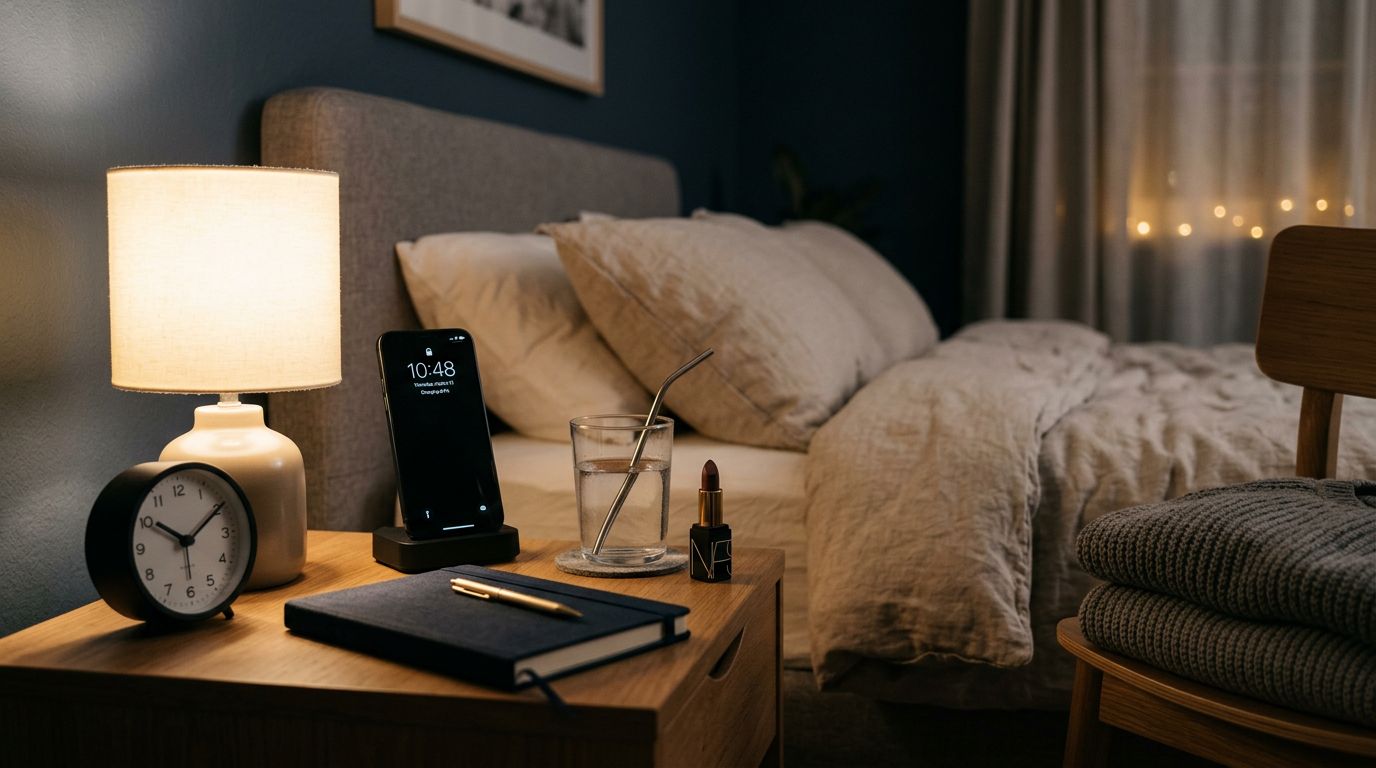
If your nightstand looks like a tiny thrift store table, you’re not alone. A water glass, three lip balms, a half-read book, charging cables, yesterday’s socks, and that one mystery receipt. It’s a lot for a space that’s supposed to help you wind down.
A nightstand reset routine fixes that without turning your evening into a cleaning project. It’s short on purpose. Seven minutes is enough to clear the visual noise, set up tomorrow, and make your bed feel like a calmer place to land.
This isn’t about perfection. It’s about waking up without immediately hunting for your phone, your meds, or your sanity.
Why a 7-minute nightstand reset routine works when you’re tired

Photo by Natthanon Chinnasri
Nightstand clutter feels small, but it hits hard because it’s the first and last thing you see each day. When the surface is crowded, your brain treats it like open tabs. Even if you don’t “think” about it, you still process it.
Seven minutes works because it respects reality. At night, willpower is low. Decision-making is slower. If you tell yourself you’ll do a full tidy, you’ll likely do nothing. A tiny routine, however, is easier to start, so it actually happens.
This is also why it helps with ADHD and overwhelm. The nightstand becomes a reliable landing zone, not a surprise box. The same few actions, in the same order, reduce choices. Fewer choices means less friction.
There’s a sleep angle too. A reset routine is a cue. It’s like dimming the lights before a movie starts. You’re telling your body, “We’re closing the day.” That matters if your mind tends to sprint the moment your head hits the pillow.
Finally, it saves morning time in a sneaky way. You don’t gain an hour, but you stop losing ten minutes to silly searches. Shoes of the bedside world (chargers, glasses, tissues) stay where they belong, so tomorrow starts with less bargaining.
Get your nightstand “reset-ready” with a simple home for each item
A nightstand reset routine only stays easy if the nightstand is set up for easy wins. If every item requires a decision, the routine turns into a negotiation. The goal is to give your hand a clear place to put things, even when you’re half-asleep.
Start by choosing what truly belongs there. Think of your nightstand like a small boat. It can carry the essentials, but it can’t carry your whole life. Keep it to the items that support sleep, comfort, or tomorrow morning.
A helpful rule is “one layer.” If you stack objects on objects, you create extra steps. Extra steps are where routines go to die. Instead, give yourself a few simple containers, then make them the default.
- Trash out, trash lives nowhere: Put a small bin beside the nightstand, or commit to a nightly “one-hand scoop” to the kitchen trash. Wrappers and tissues multiply fast.
- A charging spot that doesn’t wander: Choose one charger, one location. If cords slide, use a clip, a small tray, or even a binder clip in a pinch.
- A drop zone for tiny things: A small dish holds rings, earbuds, lip balm, and hair ties. Without it, those items spread like glitter.
- A water plan: Decide on a bottle or a lidded cup. It reduces spills and makes “clear the glass” less annoying.
- A paper limit: If you must keep notes, use one small notebook. Loose paper becomes instant clutter.
If an item doesn’t have a home, your brain becomes the home. That’s a bad trade at bedtime.
Once the homes exist, the routine becomes simple returning, not constant deciding.
The 7-minute nightstand reset routine (minute by minute)
Set a timer for seven minutes. A timer is kinder than “I’ll do this quickly,” because your brain trusts a real boundary. Also, if you stop at seven, you’re teaching yourself that this routine won’t take over your night.
- Minute 1, clear the surface fast: Use one sweep to remove anything that doesn’t belong (cups, plates, random packaging, kids’ toys). Put items in a temporary “carry pile” in your hand or a small tote. Speed matters more than sorting right now.
- Minute 2, trash and dishes leave the room: Take obvious trash out, and move dishes to the sink area. If you can’t leave the room, place them by the door as a guaranteed next step. This prevents the “I’ll do it later” loop.
- Minute 3, return essentials to their homes: Put the charger where it belongs, glasses in the same spot, and lip balm in the dish. Keep the motions identical each night. Repetition is what makes it feel automatic.
- Minute 4, set up tomorrow’s first minute: Place what you need to start the day smoothly (meds, inhaler, glasses, a hair tie, a sticky note with one priority). Don’t stage your whole life, only the first step. Morning-you will thank you quietly.
- Minute 5, reset the sleep cues: Put a book or journal where you’ll reach it, then remove stimulation triggers. That might mean moving the TV remote away, flipping your phone face-down, or putting it on a charger across the room if scrolling is your kryptonite.
- Minute 6, wipe and straighten: Use a tissue, microfiber cloth, or the edge of a clean shirt to wipe dust rings or sticky spots. Then align the lamp, coaster, and dish. A straightened surface reads as “done” to your brain.
- Minute 7, close the loop: Put the carry pile items away, or choose one parking spot for them outside the bedroom. End by turning off the main light, then keep lighting soft. The last minute is about closure, not new tasks.
If seven minutes feels too tight, don’t expand it right away. Keep the timer, but simplify the steps. For example, skip wiping on weekdays and do it every third night. The routine should fit your life, not compete with it.
Conclusion: a calmer bedside is a calmer start
A nightstand doesn’t need to be fancy to feel peaceful. It just needs less random stuff and a few clear “homes.” With a nightstand reset routine, seven minutes becomes a small ritual that lowers stress at night and removes friction in the morning.
Tonight, set the timer and do a messy first version on purpose. Then stop at seven minutes anyway. The win is consistency, not impressing anyone with your nightstand.


