
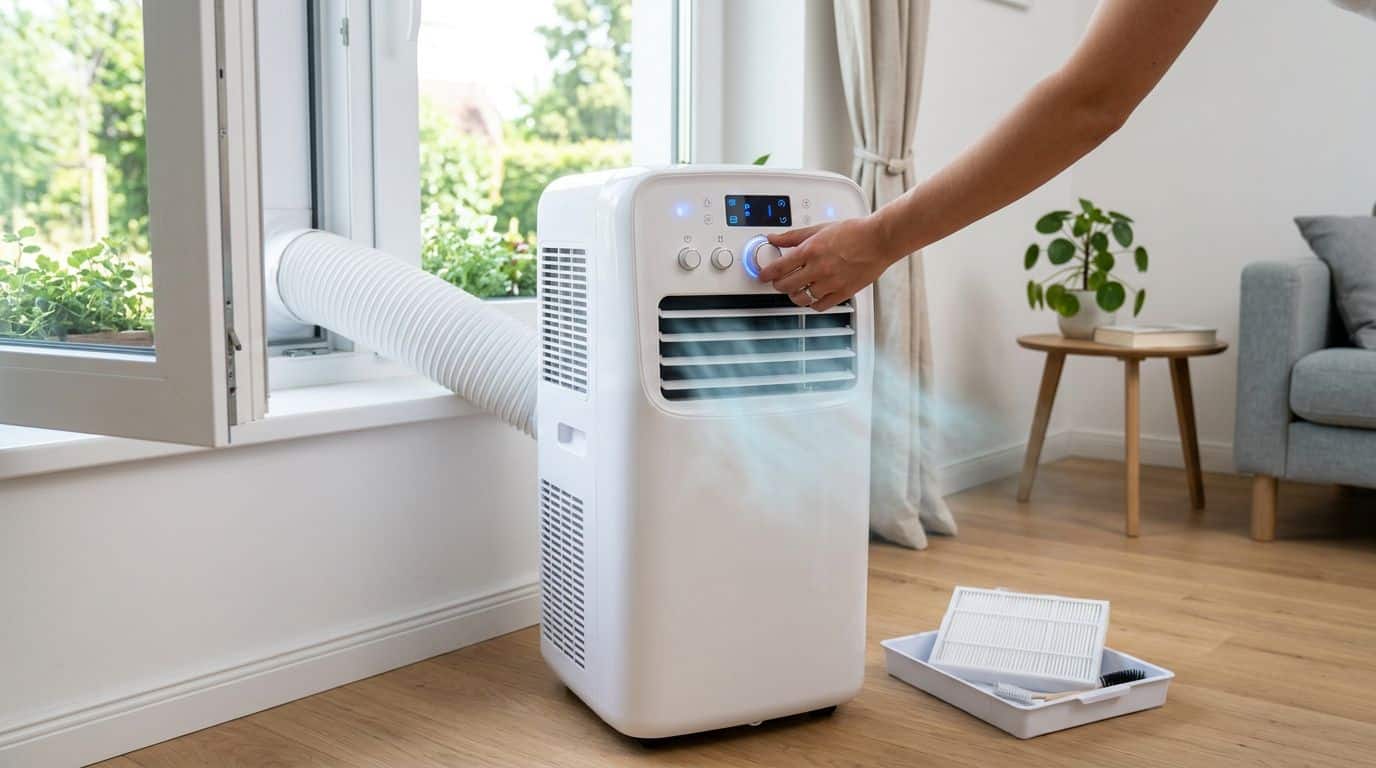
When a portable AC hums away and the room still feels sticky, it can make you doubt your own thermostat, your windows, and maybe your life choices. A machine that sounds busy but fails to lower the temperature is maddening.
The good news is that having a portable air conditioner not cooling the room usually comes down to a handful of ordinary causes. Most of them are fixable without tools, drama, or a service call. Start with the simple stuff first, because these units often fail due to very basic oversights.
Key Takeaways
- Check basic settings first: Ensure the unit is set to “cool” mode rather than “fan” or “dry,” and confirm the thermostat is set several degrees below the current room temperature.
- Prioritize airflow and maintenance: A clogged air filter or blocked intake and exhaust vents are the most common causes of poor cooling; clean these every two weeks during heavy use.
- Optimize your setup: Keep the exhaust hose short and straight, ensure the unit has proper clearance from furniture, and keep doors and windows closed to stop the AC from fighting against outside heat.
- Manage heat load expectations: Portable units are designed for spot cooling, not central air performance; if a room is too large, poorly insulated, or exposed to significant afternoon sun, the unit may be simply outmatched.
- Identify internal faults: If basic troubleshooting and cleaning fail to improve performance—especially if the compressor fails to engage or the unit displays error codes—you may be dealing with a refrigerant leak or mechanical failure that requires professional repair or replacement.
Check the easy settings before blaming the machine
A surprising number of cooling problems start with the mode, not the hardware. Portable units often have “cool,” “fan,” “dry,” and “auto.” If it is in fan mode, you are getting air movement without actual cooling. If it is in dry mode, the unit may run the compressor in a way that removes moisture more than heat.
Check your thermostat settings to ensure they are low enough to matter. If the room is 80 F and the unit is set to 77 F, you may not notice much. Drop it several degrees, use a higher fan speed at first, and give it 10 to 15 minutes. Some models also delay compressor start for a few minutes after power-up, which makes them seem lazy when they are only being cautious.
Then do the hand test. Put your hand near the cold air outlet, not the exhaust hose. The supply air should be blowing cold air that feels clearly cooler than the room air. If it does not, keep going with the checks below. If it does feel cooler but the room never improves, the problem is often setup or room conditions.
Look at the exhaust hose next. It should be attached tightly, as short and straight as the design allows, and not kinked like a garden hose that lost the will to live. That hose gets hot. If it sags, leaks, or dumps heat back into the room through a bad window seal, your AC is fighting itself.
Proper placement of your unit matters more than people expect. If the back or sides are pressed against furniture, curtains, or a wall, airflow suffers. Some units also fool their own thermostat when they are boxed into a tight corner. They cool the air around themselves, decide the room is fine, and cycle off while you keep sweating on the other side of the bed.
Finally, shut the room down a little. Close doors. Pull blinds. Turn off heat-producing lamps if you still own them. A portable unit can cool one room fairly well. It cannot win an argument with direct afternoon sun, an open hallway, and a running oven.
Airflow and maintenance are where most cooling problems hide
If the setup looks right, check the air filter before anything else. A clogged air filter is the portable AC version of trying to breathe through a scarf. Air volume drops, cooling gets weak, and the evaporator coil can get too cold and start to ice.
Most portable units have a removable mesh filter you can slide out and wash. If yours is dusty, rinse it with water, let it dry fully, and put it back. During heavy summer use, many manufacturers recommend cleaning it about every two weeks. Dirty filters are a common issue, and pet hair often accelerates the accumulation of dust and debris.

A dirty filter is easy to miss because the unit still runs. It just does not move enough air to cool the room well.
Don’t stop with the filter. Check the intake and exhaust grilles for dust buildup, especially if the unit spent the off-season in a closet or garage. A vacuum with a brush attachment helps. While you are at it, try to clean the condenser coils to improve overall ventilation. Be gentle around any visible fins, because bent fins reduce airflow too.
Water can also get in the way. Many portable air conditioners are partly self-evaporative, but that does not mean they never need draining. In humid weather, a full tank or restricted drain can hurt performance or trigger a warning light. If your model has a lower drain plug, check the manual and empty it safely.
Watch for frost or ice. If you see ice on the evaporator coil or notice cooling fades after an hour, low airflow is a prime suspect. Turn the unit off, switch to fan mode if it has one, and let the ice melt completely. Then clean the filter and make sure nothing blocks the vents before restarting.
A ceiling fan or a small room fan can help spread cooled air, which matters in bedrooms and long narrow offices. Regular maintenance, such as cleaning the unit and clearing obstructions, ensures the system runs efficiently. While these tips won’t fix a broken unit, they can solve the cold near the machine, warm near the bed problem that makes people think the AC has stopped working when it hasn’t.
Sometimes the room is winning the fight
Portable air conditioners have limits, and the box does not always make those limits obvious. Many shoppers see a large BTU rating on the front and assume that represents the total cooling capacity of the unit. What matters more for real-world performance is often the DOE SACC rating, which is usually lower and more reflective of what the device can achieve in an actual room.
That gap matters because a portable air conditioner might be marketed with a higher number while struggling with cooling efficiency in practice. If you are asking it to handle a large bedroom, a studio apartment, or a living room open to a kitchen and hallway, the room may simply be too much for it to manage effectively.
A portable AC does its best work in a smaller, closed room with a head start, not in a wide-open space that has been baking all day.
Single-hose models have another built-in handicap. They use indoor air to cool part of the machine, then send that air outside through the exhaust hose. That can create negative pressure, which pulls warm outside air back in through gaps around windows, doors, and older frames. Dual-hose units usually handle this better.
Heat load often sneaks up on people. Two computers in a home office throw off heat. So do gaming consoles, TVs, lamps, people, and kitchens. Add west-facing windows, poor insulation, and a top-floor apartment, and even a decent unit can feel weak. Sometimes the AC is not broken; it is simply outmatched.
Timing helps more than brute force. If the forecast says a rough afternoon is coming, start cooling the room earlier in the day. Close curtains before the sun hits. Keep the door shut. In a bedroom, pre-cooling for an hour before bedtime often works better than asking the unit to erase the whole day’s heat at 10 p.m.
If you are trying to cool more than one room, be honest about the mission. Portable ACs are designed as a spot cooler. Good ones can make a bedroom or small office comfortable, but they are not central air with wheels.
Know when the unit needs repair, not another workaround
Once you have checked settings, airflow, drainage, and room size, a portable AC that is still not cooling may have an internal problem. This is where the machine stops being quirky and starts being faulty. Proper maintenance is your best defense against these internal failures, as regular upkeep helps ensure the machine operates efficiently for years.
Listen to what the machine is doing. If the fan runs but the compressor never kicks on, you may hear only steady fan noise with no deeper change in sound. If it clicks, hums, then shuts off, that can point to an electrical issue or a failing compressor. Repeated tripped breakers, a burnt smell, or visible leaks from places other than the drain area are all red flags.
Some units also throw error codes when a sensor goes bad or the condensate system has trouble. Check the manual for the exact code, because guessing does not help here. A room sensor that reads the wrong temperature can make the unit short cycle or stop cooling long before the room is comfortable.
Reset the unit to see if it clears the issue. Unplug the machine, wait about 10 minutes, then restart it in cool mode. This can clear a control glitch on some models. It will not fix a damaged compressor or refrigerant leaks, but it can save you from chasing a temporary electronics hiccup.
If the unit is under warranty, use it. Brands like LG, Whynter, Midea, Honeywell, and Black+Decker all have model-specific support paths, and the serial number matters. Keep your receipt if you have it. If these troubleshooting steps fail, you may have refrigerant leaks, which require a professional HVAC technician to diagnose and repair. Because portable units are compact appliances, sealed system repairs are often expensive compared with the price of replacement.
For older budget models, replacement is sometimes the sensible answer. If the hose is brittle, the window kit barely seals, the unit ices up repeatedly, and the cooling is weak even after a full cleanup, you may be throwing patience at a portable air conditioner that has already done its shift. Renters should also consider the room itself. Poor windows, weak circuits, and awkward venting paths can make a decent unit seem defective.
Frequently Asked Questions
Why does my portable AC blow air but not cold air?
This is usually due to the unit being set to “fan” mode instead of “cool,” or the thermostat being set too high to trigger the compressor. First, verify your settings, then check that the air filter is clean and the exhaust hose is correctly vented to the outside.
How often should I clean the air filter?
During peak summer months when the unit is running constantly, you should aim to clean the mesh filter every two weeks. Simply slide the filter out, rinse it with water, and ensure it is completely dry before sliding it back into place.
Is it normal to see ice on my air conditioner?
No, ice buildup on the evaporator coils is a sign of poor airflow, often caused by a dirty filter or blocked vents. Turn the unit off, allow the ice to melt completely, and thoroughly clean the intake and filter before restarting it.
Why does my room stay hot even when the AC is running?
Your unit might be outmatched by the size of the room, high levels of heat-producing electronics, or poor insulation that lets heat in. Try pre-cooling the room before the hottest part of the day and ensure all doors and windows are tightly sealed to maximize efficiency.
Final thoughts
When a portable air conditioner is not cooling as expected, the cause is usually less mysterious than it feels in the moment. The wrong mode, a dirty filter, blocked airflow, a leaky hose connection, or a room that is simply too large account for most of these common headaches.
If the air coming out never feels cooler after those basics are addressed, stop bargaining with the machine. That is the point where warranty support, professional repair, or a complete replacement makes more sense than another round of wishful thinking.
A portable air conditioner does not have to make the room perfect, but it does have to make the environment noticeably better. If it cannot do that, something is off, and now you know exactly where to look to solve the problem.
This post may contain affiliate links. If you make a purchase through these links, I may earn a small commission at no extra cost to you.


