
Water has a way of disappearing when people need it most. In an arid climate, evaporation drains an open canal fast, while a hidden water source may sit out of reach beneath dry ground.
The paired terms qanats foggaras describe an old form of subterranean water engineering. A qanat and a foggara carry groundwater from an aquifer to a settlement through an underground canal, protecting the water supply from surface heat. Together, the qanat and foggara are gravity-fed, without fuel, a pump, or a temperamental engine to argue with at dawn.
Look below the desert surface, and the engineering begins to make perfect sense.
This post may contain affiliate links. If you make a purchase through these links, I may earn a small commission at no extra cost to you.
Key Takeaways
- Qanats and foggaras are closely related, gravity-fed underground water systems that carry groundwater from an aquifer to settlements, fields, or oases.
- The names and construction details change by region: Iran is associated with qanats, Algeria with foggaras, and related systems include kariz, falaj, and khettara.
- Underground flow reduces evaporation and avoids fuel-powered pumping, but the system remains limited by aquifer recharge and can fail when modern wells lower the water table.
- Skilled workers and fair water-sharing rules were essential for maintaining tunnels, measuring water, and preventing disputes among users.
- Restoring these systems requires more than clearing sand; it also depends on aquifer health, safe repairs, local knowledge, and shared maintenance plans.
Qanats foggaras: one water idea, different desert homes
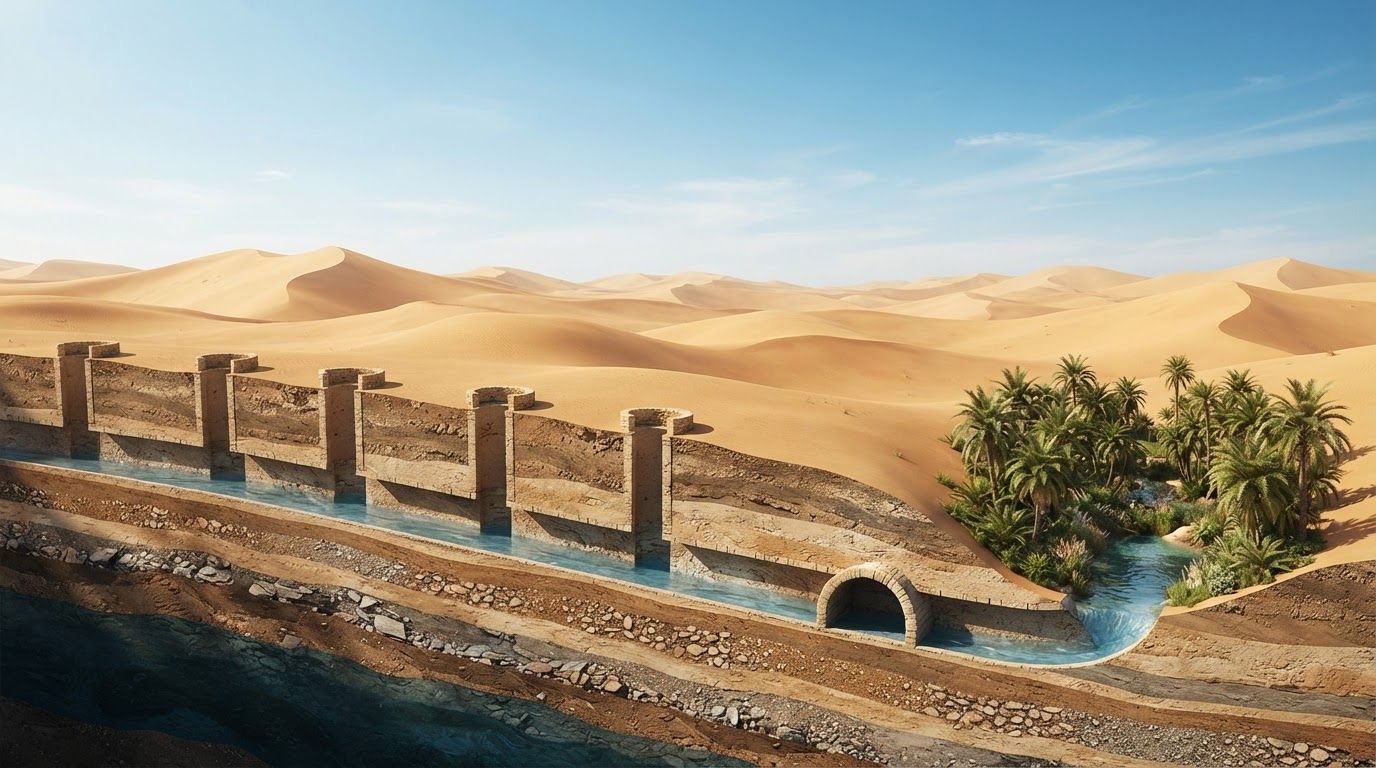
At their core, a qanat and a foggara are close relatives. Both draw groundwater from an uphill aquifer and guide it through a gently sloping underground gallery until it reaches fields, homes, or an oasis at a lower elevation.
The Persian qanat tradition is most closely tied to Iran, where the technology developed more than two millennia ago. The FAO’s record of Kashan’s qanat irrigation systems traces this irrigation system to as early as 800 BC. In Algeria, the same broad engineering family is called a foggara, though local designs aren’t identical.
Names changed as the water knowledge traveled
People adapted the idea to local geology, language, and custom. In Afghanistan and parts of Pakistan, it is often called a kariz or karez. A kariz follows the same basic logic as a qanat, while a nearby wind tower serves a separate household role. Oman has its aflaj (plural), while a single channel is called a falaj and each falaj can join a larger network. Morocco uses khettara, a name UNESCO describes as the regional cousin of Algeria’s system in its dryland water resource guide.
Iranian systems often begin near mountain foothills, where water seeps through gravel and soil on an alluvial fan. In the Algerian Sahara, a foggara is strongly associated with oases, especially Touat, Gourara, and Tidikelt. There, the tunnel makes it possible for date palms and small farms to exist where the landscape otherwise looks like it has politely declined the offer.
Comparing a single foggara with a wider network does not produce a winner. It shows one adaptable idea, reshaped by the ground beneath people’s feet.

How a qanat carries groundwater without a pump
The system looks simple in a diagram. Building one was anything but simple.
The tunnel starts where the water table is higher
For a qanat, builders first located a dependable underground source near a recharge area, often at the foot of mountains or beneath a gravel plain. They traced it to an aquifer whose water level stood above the settlement.
They dug down to it through a deep access point, sometimes called the mother well.
From there, workers excavated a narrow underground canal that sloped downhill toward the settlement. Groundwater entered the gallery naturally and moved toward the outlet by precise gravity flow. Once above ground, it could be split between households, gardens, and fields.
A foggara, kariz, and falaj use closely related gravity-fed principles, though local construction details differ. Iranian examples, including a Persian qanat, show how the same method was adapted to local landscapes.
A line of vertical shaft openings marks the route overhead. One vertical shaft gave workers access, while a second opening provided ventilation and a way to lift out soil and rock. Seen from above, these openings can look like a trail of small craters crossing the desert.
A tiny mistake in slope could ruin the whole job
The gradient in a qanat had to be shallow enough to prevent the water from tearing away the tunnel floor. It also had to be steep enough to keep the flow moving. Too flat, and water stalled. Too steep, and the channel eroded or collapsed.
A misread or falling water table could leave the gallery dry or change its flow. That is why the people who dug these channels were skilled specialists, not simply anyone with a shovel and a free afternoon. The work demanded surveying, patience, and a good understanding of local geology and water movement.

Why gravity-fed water made sense in an arid climate
A qanat does not create water. It draws groundwater from an aquifer and carries only what natural recharge can replace.
Underground flow protects water on the journey
Keeping water below ground reduces evaporation before it reaches the outlet, a valuable benefit in an arid climate. The qanat works with the aquifer’s recharge rate rather than manufacturing a new supply.
Gravity flow also removes the need for diesel, electricity, or replacement pumps. A functioning system can provide a steady flow day and night without pumping faster than the source can recover.
A qanat’s limitation is also its safeguard: it cannot draw more water than the underground source sends into the tunnel.
That does not make every system automatically sustainable. The water table can still fall when pumping outpaces recharge. Fields still need careful irrigation, and an irrigation system can worsen soil salinity without good drainage. These limits apply to related systems, too, since both a foggara and a falaj depend on recharge. Communities must watch the water table instead of treating it like a bottomless cupboard.
Water also cooled homes and supported daily work
In parts of Iran, builders paired this water with a wind tower, known as a badgir. Air drawn through or across cool moving water could lower indoor temperatures. It wasn’t air conditioning as we know it, but on a hot afternoon, the wind tower likely felt close enough.
These systems also supported reservoirs, watermills, and sometimes a yakhchal, helping extend the water supply beyond irrigation. The Persian Qanat World Heritage listing is part of the UNESCO World Heritage record and includes water reservoirs, watermills, and worker rest areas across eleven sites.
The people below ground and the rules above it
A tunnel can move water. It cannot settle an argument over whose turn it is to use it.
Muqannis worked where daylight could not reach
In Iran, specialist qanat diggers were known as muqannis. They entered narrow, dusty galleries to clear sediment, repair weak sections, and keep the shafts open.
Maintenance was never a one-time chore for a qanat. Floods could wash debris into a shaft, and fine sediment could slow the flow. Muqannis surveyed damaged passages, where a partial collapse could cut off a village’s water. Inspecting a vertical shaft was dangerous, especially when the tunnel ran deep. A Persian qanat depended on skilled labor, as did related systems such as the kariz.

Photo by Giant Asparagus
Foggara water depended on fair measurement
In the Algerian oasis communities of Touat and Tidikelt, water allocation became a skilled profession. Water bailiffs measured shares, directed water distribution, and helped repair channels that divided water between users.
This was not a ceremonial role for foggara water measurers. A small error could leave one family’s palms dry while another received too much. UNESCO recognized the knowledge of foggara water measurers in 2018 as heritage needing urgent safeguarding.
The human system mattered as much as the tunnel. Shared foggara rules for water rights, repair duties, and timing kept a limited supply from turning into a daily feud. Without them, a dispute or neglected repair could threaten the water supply.
Why many qanats and foggaras are falling silent
Electric pumps can improve short-term access. A deep borehole can bring up groundwater faster and with far less manual labor than digging a long gallery. That convenience has a hard edge, because heavy pumping can lower the water table.
When modern wells draw down the source, a functioning qanat may lose its flow. A foggara, kariz, or falaj can face similar pressure in some regions. These examples show a regional problem, though each system may have different causes.
Urban migration has reduced the pool of people willing to carry out dangerous repairs in a qanat or foggara. Drought, collapsed shafts, and neglected distribution channels add to the trouble. Land degradation and abandoned oasis agriculture can also intensify desertification.
Repair begins with water, not nostalgia
Restoring an old foggara or persian qanat isn’t as simple as clearing out sand and taking a few photographs. Communities need to know whether the aquifer still recharges, whether new wells are drawing down the water table, and whether the original water-sharing rules can work today.
The physical work comes next: inspecting a vertical shaft, stabilizing dangerous sections, removing blockages, and repairing channels at the outlet. Local residents need a real role in protecting the water supply and maintaining water distribution. A restored tunnel with no agreed maintenance plan won’t stay restored for long.
The example of qanats foggaras still offers a useful lesson for modern water planning. A system works better when the rate of use is tied to the rate of renewal, a basic principle of sustainable water management.
Frequently Asked Questions
Are qanats and foggaras the same thing?
They are closely related forms of underground, gravity-fed water engineering. A qanat is most strongly associated with Iran, while foggara is the term commonly used for similar systems in parts of the Algerian Sahara, with local differences in design and management.
How does a qanat move water without a pump?
A qanat begins at an underground water source located above the settlement or fields. A gently sloping gallery carries groundwater downhill by gravity, while vertical shafts provide access, ventilation, and a way to remove excavated material.
Why were qanats and foggaras useful in deserts?
Their underground channels protected water from much of the evaporation caused by intense surface heat. Because they relied on gravity rather than fuel or electricity, they could provide water without pumping faster than the aquifer could naturally recover.
What causes qanats and foggaras to stop flowing?
Heavy pumping from modern wells can lower the water table below the level of the underground gallery. Drought, reduced recharge, collapsed shafts, sediment, neglected repairs, and the loss of skilled workers can also weaken or silence a system.
Can these traditional water systems be restored?
Restoration is possible when the aquifer still recharges and communities can support safe repairs and regular maintenance. It also requires workable water-sharing rules, because a repaired tunnel will not remain useful if the source is overdrawn or the distribution system is neglected.
A desert lesson written underground
A qanat and a foggara were never quaint relics of a simpler past. Alongside the kariz and falaj, they were practical, regionally adapted answers to limited water.
Their tunnels joined engineering with restraint and supported a daily water supply. Qanat-supported settlement design could even include a wind tower, while foggara rules joined survival with fairness.
The desert didn’t make people wait for better technology. It taught them to use gravity, patience, and shared limits, the foundations of sustainable water management.


