
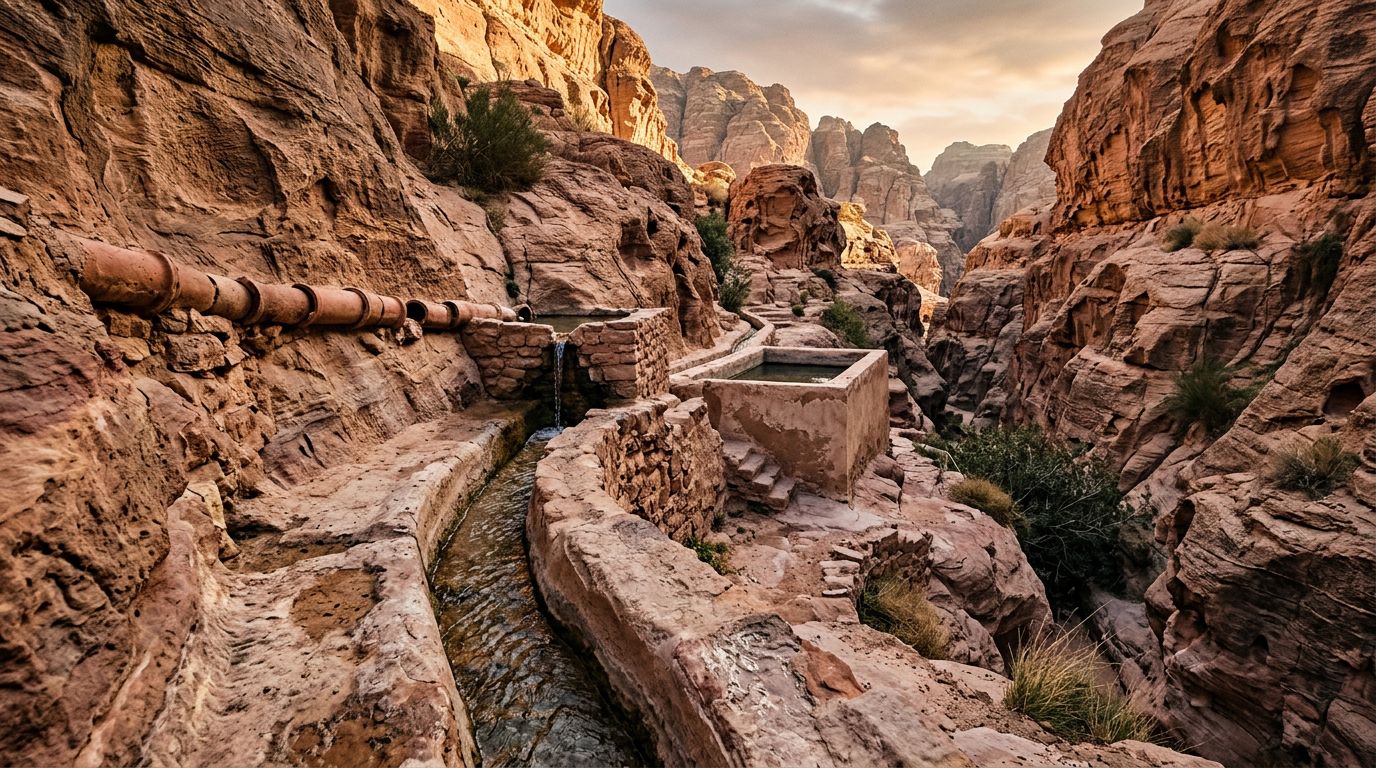
In a desert environment, cities don’t fail only because they lack water. They fail when rain arrives in a furious rush, vanishes into sand, or tears through a canyon before anyone can catch it.
At Petra, the city’s hydraulic network turned that problem on its head. Its systematic water collection captured seasonal runoff, redirected dangerous floods, stored water below ground, and shared it through a city built among sandstone cliffs. The clever part was not finding one magic spring. It was treating every drop as something worth catching.
This post may contain affiliate links. If you make a purchase through these links, I may earn a small commission at no extra cost to you.
Key Takeaways
- Nabataean water channels turned unreliable desert rain, seasonal runoff, and springs into a dependable urban water supply.
- Rock-cut channels, dams, settling basins, terracotta pipes, and underground cisterns worked together to catch, slow, clean, store, and distribute water.
- Plaster-lined cisterns reduced seepage and evaporation, while gravity-fed routes moved water without pumps across Petra’s uneven landscape.
- Flood-control works protected the Siq, fields, and settlements while terraces helped retain soil and moisture for agriculture.
- Control of hidden water sources supported Petra’s trade, daily life, and military security, making the desert a little less welcoming to rivals.
Why Nabataean water channels went underground
The Nabataeans lived in a place where water was unreliable, but not absent. The rain water arrived in short bursts, springs ran in certain places, and flash floods could roar through a wadi with frightening force. Their answer was a connected water management system of channels, dams, cisterns, pipes, and reservoirs. It supported water collection, storage, and distribution across the city.
Some waterworks sat in plain sight. Others were cut into rock, buried beneath streets, or tucked into ravines where the sun couldn’t drink them dry.
The desert had water, but it arrived badly
Petra sits in a rocky basin with steep slopes and narrow gorges. When heavy rain hit those slopes, water rushed downhill instead of soaking gently into the ground. A modern town might call that a drainage headache. For an ancient city, it could be fatal.
Ancient Nabataean builders read the slope of every valley. They guided rainwater from cliffs and gullies into channels before it could carry away soil, stone, animals, or unlucky people. Springs also fed parts of the network, giving Petra more than one source when the weather turned mean.
This was no small collection of buckets and hopeful thinking. An overview of Petra’s hydraulic works describes a system built around dams, reservoirs, cisterns, channels, and agricultural water control.
Below ground, water lasted longer
Underground cisterns were practical for three simple reasons. They reduced evaporation, kept stored water cooler, and made it harder for dirt and animals to spoil the supply.
A cistern could be carved into sandstone, lined with waterproof plaster, and filled through a narrow opening. Rainwater travelled through rock-cut gutters or channels, then settled before entering storage. Sediment had time to drop out instead of turning every reservoir into a muddy soup.
Not every Nabataean water channel was hidden. Yet placing storage below ground made good sense in a desert where shade was rare and water couldn’t be replaced by turning a tap.
The route water took through Petra
Water moved through Petra in stages. First it had to be caught. Then it had to be slowed down, cleaned as much as possible, stored, and delivered where people needed it.
That sounds obvious now. It was much harder when your pipes were clay, your reservoirs were cut from rock, and a storm could wreck careless work in an afternoon.
Rock-cut channels caught runoff early
Along the Siq, Petra’s famous narrow entrance gorge, channels were cut into the walls to guide water away from the route below. The gorge was both an entrance and a flood corridor, an awkward combination if you enjoy staying dry.
A stone dam and related diversion works helped keep sudden water out of the main passage. In some places, open channels carried spring water along the rock face toward the city. Terracotta pipes took over where a covered line or tighter control was needed.
By the middle of the first century BCE, Petra appears to have had separate conduits drawing on several regional water sources. That redundancy mattered. A broken line did not have to leave the entire city thirsty.
Cisterns and settling basins did the patient work
Fast water is useful only after it slows down. Nabataean engineers built basins where sand and grit could settle before water entered a cistern or pipeline. It was basic physics, applied with great discipline.
The system used gravity feeds instead of pumps or animals. Builders selected routes with care. These engineering techniques depended on carefully measured gradients. A channel that sloped too sharply would damage itself, while one that sat too flat would stagnate. The right angle had to be found across uneven rock.
Nabataean water channels were part drain, part reservoir, and part lifeline. Their purpose changed with the season, which is why the network was more useful than a single well.

Waterproof cisterns were built to hold their nerve
A carved hole in sandstone is not automatically a reservoir. Water finds cracks. It stains, seeps, slips away, and leaves you standing beside an expensive empty cavity.
The Nabataeans addressed that problem with water-resistant plaster applied to cistern walls, channels, and other storage works.
The famous “cement” was hydraulic plaster
People often call the Nabataean lining waterproof cement. The phrase gets the point across, though “hydraulic plaster” is closer to what many of these surfaces were. Lime-based mixes, sometimes described with crushed pottery, made the lining far less porous.
Such materials are often compared with Roman opus signinum, a water-resistant mortar that also used ceramic fragments. The exact recipe could vary by site and repair period, so it is safer not to imagine one guarded formula used everywhere.
What survives is the better clue. Plastered underground cisterns, channels, and subterranean reservoirs show that builders planned for deliberate, long-term water storage.
Pipes carried water where open channels could not
Ceramic pipelines gave the Nabataeans more control than an exposed trench. Surviving examples were generally terracotta conduits, which could cross a built-up space, enter a reservoir, or follow a protected route through difficult ground.
Open channels still had their place. They were easier to inspect and could carry large flows. Pipes helped where water needed shielding or a more precise path. The two methods worked together, rather than competing like ancient plumbing teams having a row.
A survey of Nabataean water systems connects this approach to wider desert settlement patterns, where rock-cut and plastered cisterns made long-distance movement more possible.
Dams turned flash floods into useful water
A flash flood is not a gift if it destroys your fields. The Nabataeans used a stone dam, retaining walls, and other barriers across wadis to slow that force down.
Some structures stored water in pools. Others held back debris and gave runoff time to spread across the ground. Together, these works supported water collection, improved nearby farmland, and reduced erosion.
The Siq needed flood control, not just decoration
Visitors tend to look upward in the Siq, which is understandable. The walls are enormous, and the light can feel almost theatrical. The engineering deserves attention too.
Dams and diversions helped steer floodwater away from the main gorge. A rock-cut tunnel linked to the Mudhlim Dam diverted part of the flood flow around the Siq. That channel guided water away rather than storing it for later use. It was public safety work, though nobody was putting up a maintenance notice.
A Petra water-management study describes the Siq as an important part of the Nabataean hydraulic system, not merely a dramatic entrance to the Treasury.
Terraces made agriculture possible outside the city
Beyond Petra’s urban core, terraces and small water-control works trapped runoff and soil on slopes. That supported cultivation in a hard, dry setting.
This matters because desert survival was not only about drinking water. Communities needed grain, fruit, grazing land, and enough stored food to endure poor seasons. Dams could protect a settlement from floodwater while helping its fields keep moisture. One wall could do more than one job, which is always nice when stonecutting is involved.

Hidden water brought trade and military advantage
The Nabataeans became wealthy through caravan trade across Arabia and the Levant. This included the frankincense trade and valuable goods from across the region. A desert caravan crossing dry country needed reliable water, not an impressive speech about courage.
Knowing where water could be found, stored, or accessed gave the Nabataeans a strategic advantage over outsiders. It also let them support settlements such as Petra far from large rivers.
Diodorus described wells outsiders could not find
Historical accounts add context. The ancient historian Diodorus Siculus described wells dug at convenient intervals, with their locations kept secret from other peoples.
Diodorus describes hidden water knowledge as a source of safety. His account does not prove that Petra depended on one secret reservoir.
That distinction matters. Archaeology shows built water systems across the region. Diodorus tells us why control of those systems had political value. If rivals could not find drinking water, they could not stay long.
During conflict, people familiar with stored water points could retreat into country that looked empty to an invading force. The desert itself became a defensive ally.
Secrecy was useful, but engineering did the heavier lifting
It is tempting to picture the Nabataeans hiding every drop underground like desert spies. The real story is more impressive. Their success rested on maintenance, planning, local knowledge, and a network with more than one source.
Caravan routes benefited from water storage, but Petra was not merely a roadside stop. It was one of the region’s urban centers, with infrastructure supporting households, gardens, religious spaces, and public buildings. Water management helped the city grow because it made daily life possible after the caravan bells had faded.
What Petra still shows visitors
Many of Petra’s channels, dams, openings to underground cisterns, and carved water routes remain visible if you look beyond the monumental facades. Rock surfaces tell a quieter story about maintenance, repair, and careful measurement.
The Nabataeans didn’t conquer the desert by pretending it was friendly. They accepted its rules, then built a system that made sudden rain, steep rock, and scarce springs work in their favor.
Frequently Asked Questions
What were Nabataean water channels used for?
Nabataean water channels collected spring water and seasonal runoff, then carried it toward cisterns, reservoirs, fields, and buildings. Some also diverted dangerous floodwater away from routes such as the Siq.
Why did the Nabataeans build underground cisterns?
Underground cisterns reduced evaporation, kept water cooler, and helped protect stored supplies from dirt and animals. Many were carved into sandstone and lined with hydraulic plaster to limit seepage.
How did water move through Petra without pumps?
The Nabataeans used gravity-fed channels and pipes built along carefully measured gradients. Open channels carried larger flows, while terracotta conduits offered a more protected and controlled route.
Did Nabataean dams store all the floodwater?
Not always. Some dams and barriers stored water, while others slowed runoff, held back debris, reduced erosion, or redirected floods away from inhabited areas.
Why was Petra’s water system strategically important?
Reliable water allowed Petra to support households, agriculture, public buildings, and caravan trade in a dry region. Knowledge of hidden wells, cisterns, and routes could also make the surrounding desert difficult for outsiders to cross.
Final thoughts
The hidden parts of Petra were not built for mystery alone. They protected water from heat, loss, flood damage, and people who might misuse it.
Petra’s hidden channels show what happens when engineering begins with close attention to a difficult place. Beneath the rose-red stone, the city kept its most practical treasure: water saved for the next dry day.


