
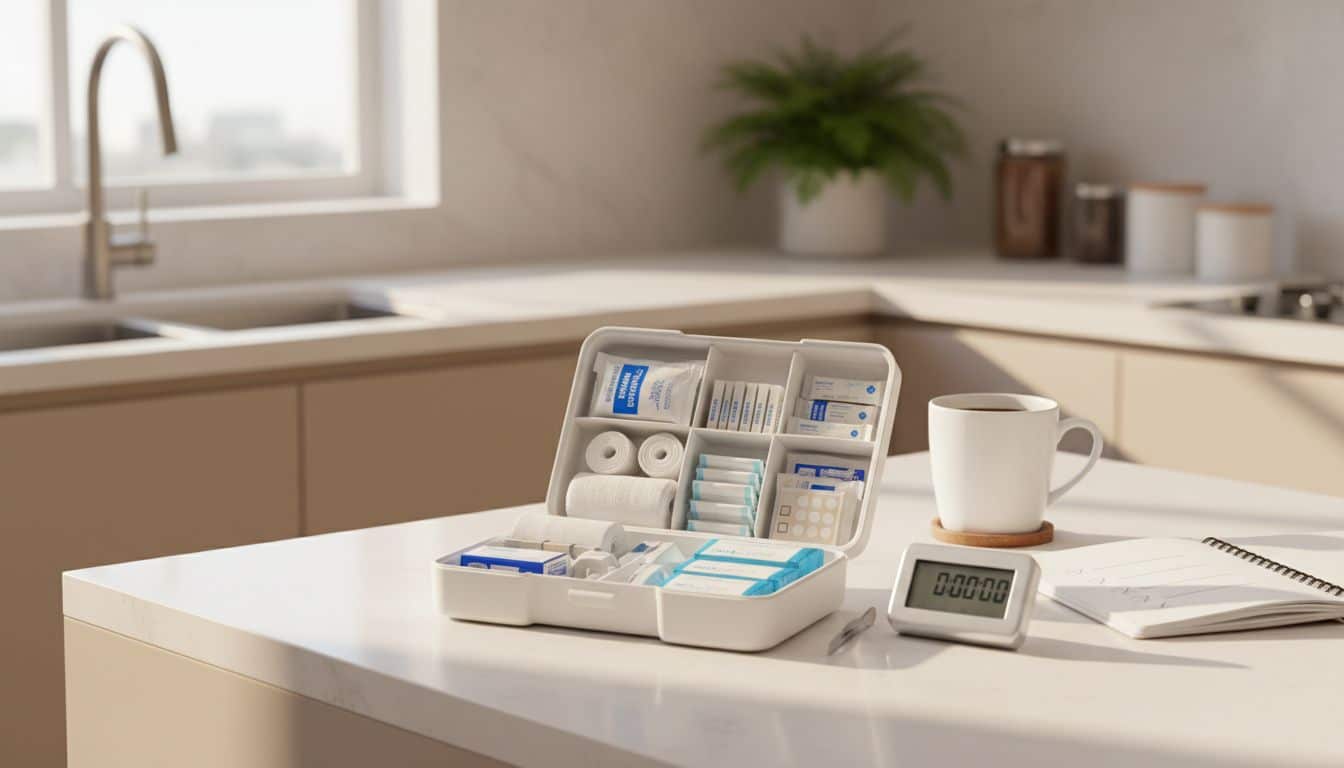
Most people don’t think about their first-aid kit until they need it. Then it’s a race: a paper cut that won’t stop bleeding, a kid with a scraped knee, a coworker with a headache that’s turning into a full mood.
A first aid kit check that takes ten minutes a week fixes that. Not because it makes emergencies fun (it doesn’t), but because it turns “Do we have what we need?” into a small habit you can keep on autopilot.
The goal isn’t a perfect kit. It’s a kit that’s stocked, easy to grab, and not full of expired mysteries.
Start with a time, a spot, and one person who owns it

Ten minutes sounds easy until Tuesday happens. So, the first setup step is about removing excuses. Pick a time that already has a rhythm. For homes, Sunday night after dishes works well. For small offices, Monday morning before the first meeting is often calmer than you think.
Next, choose the “check location.” Do the check where the kit lives, not where it’s convenient. If you drag supplies across the house, you’ll leave a trail like a snail of gauze and good intentions. Keep a pen nearby, plus a small “restock bag” (an envelope or zip pouch) for items you notice you need to buy.
Finally, assign a single owner. In a household, this might rotate, but one person should still be responsible for the reminder and the final put-away. In an office, it’s usually the office manager, admin, or safety point person. When everyone owns it, nobody owns it.
A simple setup rule helps: keep the kit in the same place, at the same height, with nothing stacked on top. If you have to move three things to reach it, you’ve already added friction.
If the check starts to take longer than ten minutes, don’t “power through.” Write the extra tasks down and save them for a monthly reset.
For supply guidance, it can help to compare your kit to a reputable baseline list, such as the King County first aid kit checklist PDF. Even if you’re not in child care, the list is practical and clear.
Use a 10-minute script so you don’t “think” your way through it

The easiest way to keep a weekly routine is to stop improvising. You want a script that feels almost boring, because boring is repeatable. Set a timer for ten minutes, then follow the same order every time.
Here’s a simple minute-by-minute flow. Adjust it once, then keep it steady.
| Minute | What you do | What you’re looking for |
|---|---|---|
| 0 to 1 | Open kit, clear the top layer | Anything obviously missing or messy |
| 1 to 3 | Refill used items | Bandages, gauze, tape, wipes |
| 3 to 5 | Check expiration dates | Meds, ointments, saline, burn gel |
| 5 to 6 | Inspect packaging | Seals intact, no torn sterile packs |
| 6 to 7 | Quick tool check | Scissors, tweezers, thermometer |
| 7 to 8 | Battery check | Flashlight works, spare batteries present |
| 8 to 9 | PPE restock | Gloves, masks if you keep them |
| 9 to 10 | Put-back and note restock | List what to buy, close kit, return it |
After a few weeks, you’ll move faster, not because you rush, but because your hands already know the path.
If you prefer a printable worksheet style for workplace compliance, a resource like this weekly first aid kit maintenance checklist can give you a structure to copy into your own routine.
To keep the ten minutes tight, focus on seven “yes or no” checks:
- Refill used basics: Replace what you used this week, even if it’s just one bandage. Half-stocked is how kits quietly fail.
- Scan expiration dates: Don’t read every label. Check the “expires” corner on the few items that commonly expire.
- Inspect seals and wrappers: Sterile items need intact packaging. If it’s torn or wet, it’s done.
- Test the flashlight: A dead flashlight is a classic. Batteries also leak, so look for crusty residue.
- Restock gloves and barriers: Gloves disappear fast. Keep at least a few pairs you can grab without digging.
- Update your mini info sheet: Emergency contacts change. So do meds and allergies.
- Confirm the kit is reachable: Make sure it didn’t migrate behind holiday platters or printer paper.
One important note: if your kit includes medicines, follow the label and your local guidance. When in doubt, ask a pharmacist what to keep and how to store it.
Keep it simple long-term with restock rules and a monthly “deeper” reset

A weekly first aid kit check works best when it doesn’t create extra errands. That’s where a few “rules of restocking” help.
First, decide what counts as a replace-now item. For many homes and offices, it’s anything that drops below a simple minimum: a handful of assorted bandages, a small stack of gauze, one full roll of tape, and at least a few pairs of gloves. When you hit the minimum, you add it to the restock list immediately.
Second, store backups near the kit, if you can. A small bin in the same closet is enough. This turns “we’re out” into “swap it now,” which keeps the weekly check short.
Third, don’t try to solve every supply problem weekly. Instead, add a monthly reset. Once a month, take five extra minutes to tidy, remove clutter, and check the less-used items. In an office, that’s also a good time to confirm you’re still meeting any internal policy.
If you want a broader, less-frequent reference for what tends to expire or wear out over time, this first aid kit update guide is a useful reminder of the items people forget.
One small habit makes a big difference: keep a single index card inside the kit with three lines: key contacts, known allergies, and where the backup supplies are stored. In an office, add the address of the building and the suite number. Under stress, people forget their own phone number. Give them fewer things to remember.
The kit isn’t just supplies. It’s also information, because calm is hard to find when someone’s bleeding.
Last, treat the kit location like a fire extinguisher. It shouldn’t be hidden, and it shouldn’t be “somewhere safe.” It should be somewhere fast.
Conclusion
A 10-minute weekly first aid kit check is less about organization and more about peace of mind. Pick a fixed time, follow the same script, and keep your restock plan boring enough to repeat. Once the habit sticks, you’ll stop wondering what’s in the kit, because you’ll already know. Set the reminder, choose your kit captain, and run your first ten minutes today, before you need it.


