
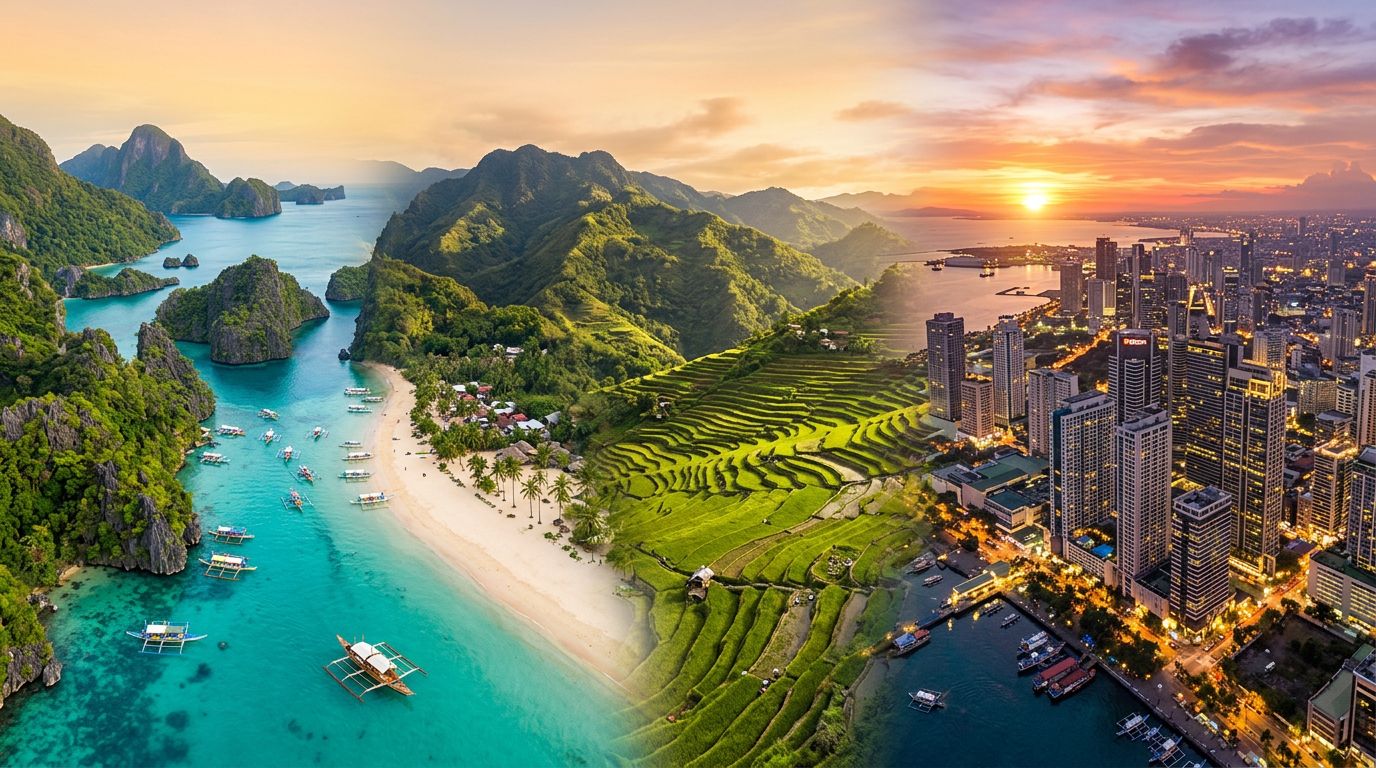
Trying to fit the Philippines into one postcard is hopeless. The country spreads across more than 7,000 islands, so each place feels a little different.
If you’re planning a trip, studying the region, or simply curious, that variety can feel hard to pin down. The clearest way to make sense of it is to start with the map, then watch how geography shapes culture, food, and travel.
Start with the map, because the Philippines is many places at once
The Philippines sits in Southeast Asia, between the South China Sea and the Pacific. On paper, it looks scattered. In real life, that means mountains, reef-lined coasts, crowded cities, quiet farming towns, and island flights that often matter more than road trips.
That spread also explains why people talk about the country almost as if it were several places sharing one passport. Manila moves fast. Smaller islands often don’t. Highland towns and beach communities can sit only hours apart, yet feel far removed from each other.
Most people begin with the country’s three main island groups, Luzon, the Visayas, and Mindanao. Luzon holds Manila, the capital, and much of the country’s political and business life. The Visayas are known for beaches, diving, and historic cities such as Cebu. Mindanao feels larger, greener, and less discussed by first-time visitors, yet it adds a huge part of the national story. A helpful geography guide to Luzon, Visayas, and Mindanao shows how those regions connect.

Photo by Archie Binamira
Landscape matters here because it shapes daily life. Volcanoes rise near busy towns. Ferries link islands where bridges don’t reach. Weather can change travel plans with little warning, especially when storms build. Even the dry and wet seasons don’t feel identical across the whole archipelago. Still, that same geography gives the Philippines much of its pull. You can leave a dense city in the morning and end the day near rice terraces, surf breaks, or a cone-shaped volcano like Mayon.
Culture in the Philippines feels familiar, then pleasantly surprising
Many first-time visitors notice how easy conversation can be. English is widely spoken, and Filipino is the national language, but daily life includes many regional languages as well. Because of that mix, the country often feels open and local at the same time.
Family ties run deep, and hospitality is part of the social rhythm. Guests are fed early and often. Neighbors know one another’s business a bit more than some travelers expect. Respect also shows up in small words, such as “po” and “opo,” which soften speech and signal courtesy. If you’re polite, patient, and willing to laugh at small mix-ups, people usually meet you halfway.
Religion and history shape the public mood too. Spanish colonial rule, American influence, Asian trade, and older local traditions all left marks. Catholic fiestas fill many town calendars, while Muslim communities in parts of Mindanao add a different rhythm, history, and food culture. That range matters, because any single stereotype misses too much.
Then there is the texture of everyday life, jeepneys painted in bright colors, basketball courts squeezed into tight neighborhoods, and karaoke performed with total confidence, whether the singer has the notes or not. City life often mixes old and new without much fuss. A person might go from church to a mall to a street stall in one evening, and none of it feels out of place.
Food follows the same pattern. Adobo is famous, yet it doesn’t define the whole table. Sinigang brings sour comfort. Lechon can turn a feast into an event. Coastal areas lean into seafood, while each region protects its own favorites. For a traveler or student, that layered mix is the point. The Philippines isn’t one clean story. It’s many stories sharing the same islands.
In the Philippines, patience and courtesy usually take you farther than rushing.
A good trip depends on timing, island connections, and realistic plans
The Philippines can look easy on a map and feel slower on the ground. Inter-island travel takes planning, and a short distance may still mean a flight, ferry, or long van ride. That is why many travelers do better when they pick one region first, then build outward. Cebu plus Bohol often works better than trying to cram four islands into a week. Manila plus Palawan also gives a strong contrast without turning the trip into a race.
As of April 2026, practical timing matters even more. The country has just come through the Holy Week rush, which pushed more than 1.35 million passengers through Manila’s main airport. Domestic fares rose sharply on busy routes, fuel costs lifted some transport prices, and some immigration and banking services ran behind after holiday closures. A mid-April typhoon warning has also put extra attention on weather in some areas. April heat can be tiring even on clear days, so water, shade, and buffer time matter as much as swimsuits.
A new tourism secretary took office in April 2026 with plans to improve transport links, rest areas, and the visitor experience. That sounds promising, but travelers should still expect some unevenness between major hubs and smaller islands. Before booking, it helps to check the official tourism portal for current destination information. For a broad route sketch, the Philippines guide from Lonely Planet is a useful starting point.
The best practical mindset is simple. Pack for heat and rain. Keep some cash once you leave large cities. Leave breathing room before ferries and domestic flights. Most of all, don’t try to finish the Philippines in one trip. The country rewards slower plans, because the missed ferry, the long lunch, or the unexpected town festival often becomes the part you remember best.
Trying to summarize the Philippines in a single image still doesn’t work, and that’s part of its appeal. The country makes more sense when you treat it as an archipelago of different moods, linked by strong family life, open hospitality, and constant movement.
If you arrive with flexibility, the scattered map stops feeling confusing and starts feeling generous.


