
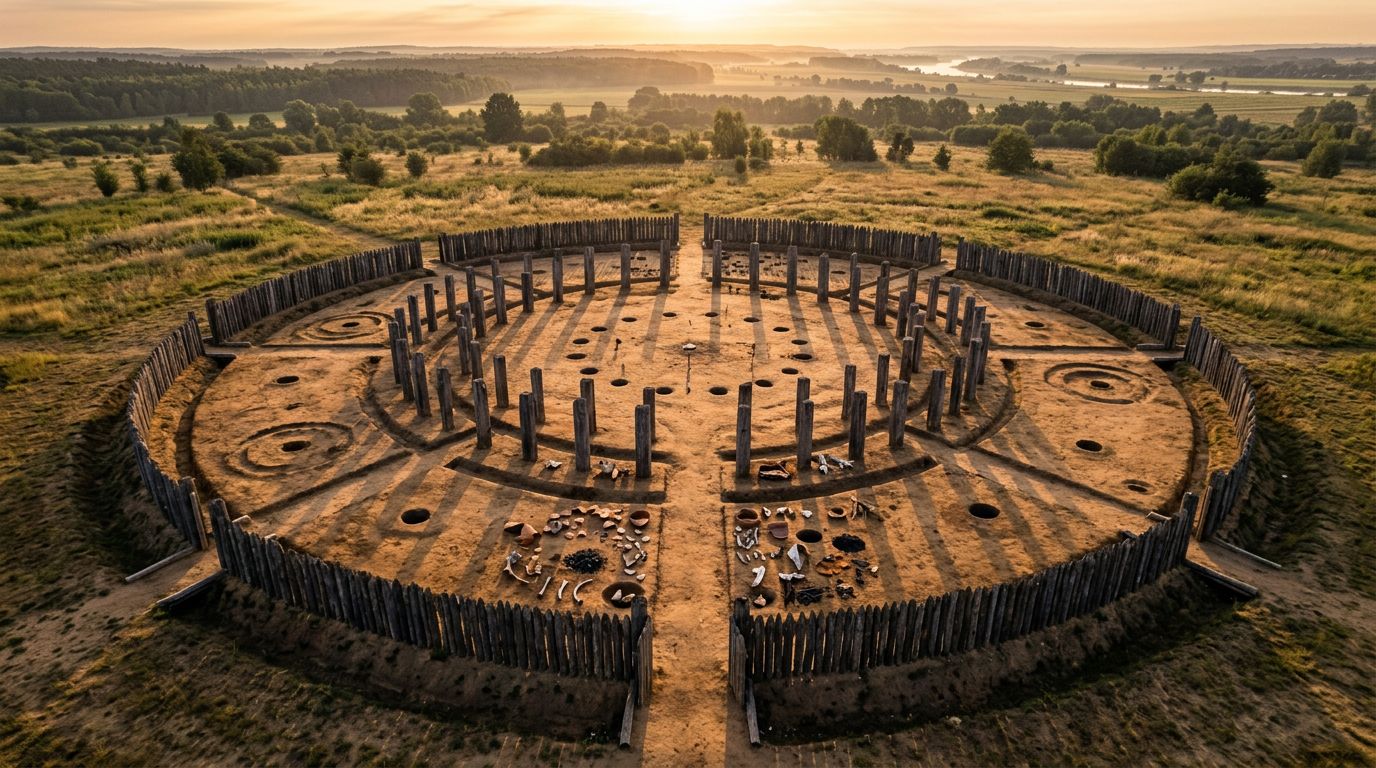
A timber circle can rot away almost completely, yet still leave a troublingly clear record behind. At Pömmelte, near Schönebeck in Saxony-Anhalt, the ground preserved outlines of posts, pits, bones, pottery, and evidence of repeated communal activity more than 4,000 years ago.
The Pömmelte rituals were not a single ceremony with a neat explanation. They involved repeated acts of gathering, feasting, depositing objects, marking the solar year, and, in some cases, violence that still makes the stomach tighten. The site is easier to understand as a busy ceremonial place, rather than a lonely prehistoric circle.
This post may contain affiliate links. If you make a purchase through these links, I may earn a small commission at no extra cost to you.
Key Takeaways
- Pömmelte was a long-lived timber ring sanctuary near the Elbe, built around 2300 BC and rebuilt across generations.
- Its circular layout, palisades, entrances, and solar alignments shaped how people moved through the site and when gatherings took place.
- Ritual deposits in 29 shaft-like pits included deliberately broken pottery, animal bones, tools, and human remains, suggesting ceremonies involving death, removal, and possible sacrifice.
- Bell Beaker and later Unetice communities used the sanctuary as the surrounding region changed through exchange, metalworking, and new social connections.
- More than 130 nearby house plans show that Pömmelte was part of a lived-in landscape, not an isolated monument visited only for festivals.
The ring sanctuary appeared first as marks in a field
The discovery of Pömmelte came through the air, not from a dramatic shovel strike. In 1991, aerial photography showed circular crop marks in farmland beside the Elbe River. Dry conditions made buried structures visible as faint patterns, including a ring ditch, but the marks did not prove its function.
Those circles turned out to be the Ringheiligtum Pömmelte, a major late prehistoric monument. Fieldwork mapped a ring ditch and possible palisade within the enclosure. A detailed history of research at Pömmelte shows how later excavations turned the marks into a fuller record of ceremonial activity and settlement.
The sanctuary at Pömmelte was built around 2300 BC, during a period of major change between the Neolithic period and Early Bronze Age. Radiocarbon dating helps assess its construction and rebuilding, but dates alone cannot explain the rituals. Metal was becoming more important, and long-distance contacts were growing. Older local traditions were meeting new customs brought by mobile communities.
Pömmelte did not simply appear, host one festival, and vanish. Its timber rings were repaired and altered across generations, and later work clarified the phases of the ring ditch. That matters because the place had a memory, and families who came later knew the circle had been important before them.
How Pömmelte rituals shaped a wooden circle
Pömmelte is often called Germany’s Stonehenge. The nickname is useful, up to a point. Both monuments were circular ceremonial places with carefully planned routes and links to the solar year. Both asked visitors to move through a designed space, not wander in casually. At Pömmelte, this ring sanctuary created a more enclosed, processional experience.
But Pömmelte had no great stone uprights. Its rings were made from wood, with post circles and a palisade, while a ring ditch reinforced the concentric plan. The outer enclosure, marked by another ring ditch, measured about 115 metres across, close to the scale of Stonehenge’s outer earthwork circuit. An additional ring ditch helped frame the entrances, giving the site a different character altogether.

Wood changes the feel of a sacred enclosure. It blocks views. It creaks in wind. A person entering Pömmelte encountered barriers, corridors, and repeated circular forms rather than gazing across an open field. The place controlled where bodies went and what they could see.
The sun mattered, but this was not a prehistoric clock
Several entrances and axes relate to important solar directions, especially the solstices. Midwinter and midsummer were moments when the year seemed to turn on itself. They were natural times for ceremonies involving death, renewal, ancestors, or communal promises.
It is tempting to call the site an astronomical observatory. That phrase is too modern and too narrow for the evidence. Nobody was sitting there with a clipboard, recording the heavens for the sake of science. The alignments made the sun part of the ritual. A sunrise or sunset could give a gathering its proper moment.
The rebuilding of the sanctuary helps explain why these alignments mattered. A post would decay. A gate could be renewed. Yet the basic pattern stayed meaningful. The sky gave people a recurring schedule, while the wooden enclosure gave that schedule a place to happen.
The shaft pits and the hardest evidence
The most unsettling Pömmelte rituals are found in 29 shaft-like pits. Archaeologists recovered deliberately broken pottery, animal bones, querns, and other objects placed below ground beside the ring ditch. These were not ordinary rubbish heaps tipped out behind a home.
Breaking an object before burial may have changed its status. Material assemblages from the ring ditch include tools and vessels whose uses ended at deposition. A fine vessel stopped being a vessel once smashed, while a quern stopped grinding grain once buried. Removal may have mattered as much as the object itself.

The ring ditch and palisade show a deliberate contrast. The enclosure stood above ground, while the shaft pits concealed deposits below.
Human remains from the ring ditch deposits add a much darker layer. Some bones came from people who had suffered severe injuries, and the deposits include women and children as well as adults. This pattern has led archaeologists to consider human sacrifice a serious possibility.
The pits do not give us a written explanation. They do show that death, damage, and deliberate burial were part of the sanctuary’s public life.
Care is needed here. Archaeology can identify trauma, placement, and repeated patterns. It cannot replay the final minutes of a person’s life. Still, this was no peaceful field shrine where people only left flowers and hopes for a good harvest.
The academic study of the ring sanctuary traces the monument’s changing phases. Finds from the ring ditch and underground deposits, together with radiocarbon dating, help establish that sequence. At Pömmelte, the evidence points to ritual acts that were planned, repeated, and sometimes brutal.
Bell Beaker people, Unetice communities, and a changing region
The first main users belonged to the Bell Beaker culture, named for its distinctive bell-shaped pottery. This was not one modern-style nation with a flag and capital. It was a broad cultural world connected by shared burial customs, objects, and contacts across Europe. The corded ware culture offers a wider comparison, but labels don’t prove every person at Pömmelte belonged to one group.
Later, the Unetice culture used the area during the Early Bronze Age. Unetice communities are strongly associated with early bronze work, social hierarchy, and far-reaching exchange. At Pömmelte, changing material finds show the sanctuary remained meaningful as the people around it changed.
That regional setting is often missed. The site lay in the Salzland area, near the Elbe and valuable salt resources around Schönebeck. This archaeological landscape included river routes, a ring ditch, and burial mounds, not all necessarily part of the sanctuary. Rivers carried people, animals, raw materials, news, and marriage ties, while salt and metal traveled far from their sources.
At Pömmelte, it would be careless to claim every offering came from a salt trade deal. The evidence doesn’t say that. Yet the sanctuary was not cut off from the wider world. Bell Beaker networks connected central Germany with distant communities through Bronze Age exchange in copper and bronze.
The Nebra sky disc was found elsewhere in Saxony-Anhalt, centuries after the site’s main use. Burial mounds elsewhere offer broader regional parallels, not proof of a shared ceremony. It should not be treated as a prop from the same ceremony. It shows central Europe remained a place where sky, status, power, and valuable materials met.
A ritual centre with people living nearby
Pömmelte’s ring sanctuary once seemed like a special place visited only on solemn days. Recent excavations challenged that picture. Around Pömmelte, archaeologists found a residential area with more than 130 house plans, including possible longhouse plans.
That is a lot of roofs, hearths, storage, animals, work, and ordinary arguments about food. The ceremonies did not happen at the edge of nowhere. They happened beside a substantial community, where a possible longhouse stood outside the ceremonial enclosure, beyond its ring ditch.
A fieldwork report on the wider Pömmelte area shows how house traces, a ring ditch, and possible longhouse plans reveal the residents who supported the sanctuary. Maintaining it required food preparation, timber work, pottery, animal care, and memory.
The nearby Schönebeck enclosure also matters, adding another ring ditch and burial mounds to the wider group. Pömmelte was part of a cluster of ceremonial sites, rather than a strange one-off circle. That makes the region feel less like a prehistoric mystery spot and more like a lived-in area where sacred places were built into everyday life.
Seeing Pömmelte without treating it like a theme park
The reconstructed ring sanctuary makes the scale easier to grasp. Walking near the rings shows how quickly a palisade could hide the horizon and turn a short route into a formal procession.
Still, the reconstruction is an informed interpretation, not a time machine. The original posts had weathered surfaces, repairs, smells of smoke and animals, and people moving through them. What you see now is a way into the evidence, not the evidence itself.
If you visit, give the outer rings, ring ditch, gates, and gaps as much attention as the centre. Pömmelte was built to direct movement. Standing still in the middle tells only half the story.
Frequently Asked Questions
What were the Pömmelte rituals?
The Pömmelte rituals were repeated communal activities at a timber ring sanctuary, including gatherings, feasting, depositing objects, and ceremonies connected with the solar year. Some deposits also involved severe violence and human remains.
Was Pömmelte used as an astronomical observatory?
The sanctuary’s entrances and axes appear to relate to important solar directions, especially the solstices. These alignments likely gave ceremonies a meaningful time and setting, rather than serving as a scientific observatory in the modern sense.
Did people practice human sacrifice at Pömmelte?
Human remains from the ring ditch include people with severe injuries, including women and children, so human sacrifice is considered a serious possibility. Archaeology can identify trauma and deliberate deposition, but it cannot reconstruct exactly how or why each person died.
Who used the Pömmelte sanctuary?
The first main users were associated with the Bell Beaker cultural world, while later Unetice communities used the area during the Early Bronze Age. These labels describe changing archaeological traditions, not clearly defined nations or single populations.
Did people live near the sanctuary?
Yes. Excavations have identified more than 130 house plans around Pömmelte, including possible longhouses, along with evidence of everyday work and settlement. The sanctuary therefore stood within a substantial community and a wider landscape of ceremonial sites.
Pömmelte keeps its secrets, but not all of them
The rituals were built around repetition: the return of the sun, rebuilding timber, burying objects, and gathering people. That repetition helped the sanctuary endure through cultural change.
The shaft pits refuse to make the site a pleasant story about ancient festivals. The circle remains compelling because Pömmelte rituals brought communal care, display, belief, and possible violence together on the same patch of ground.


