
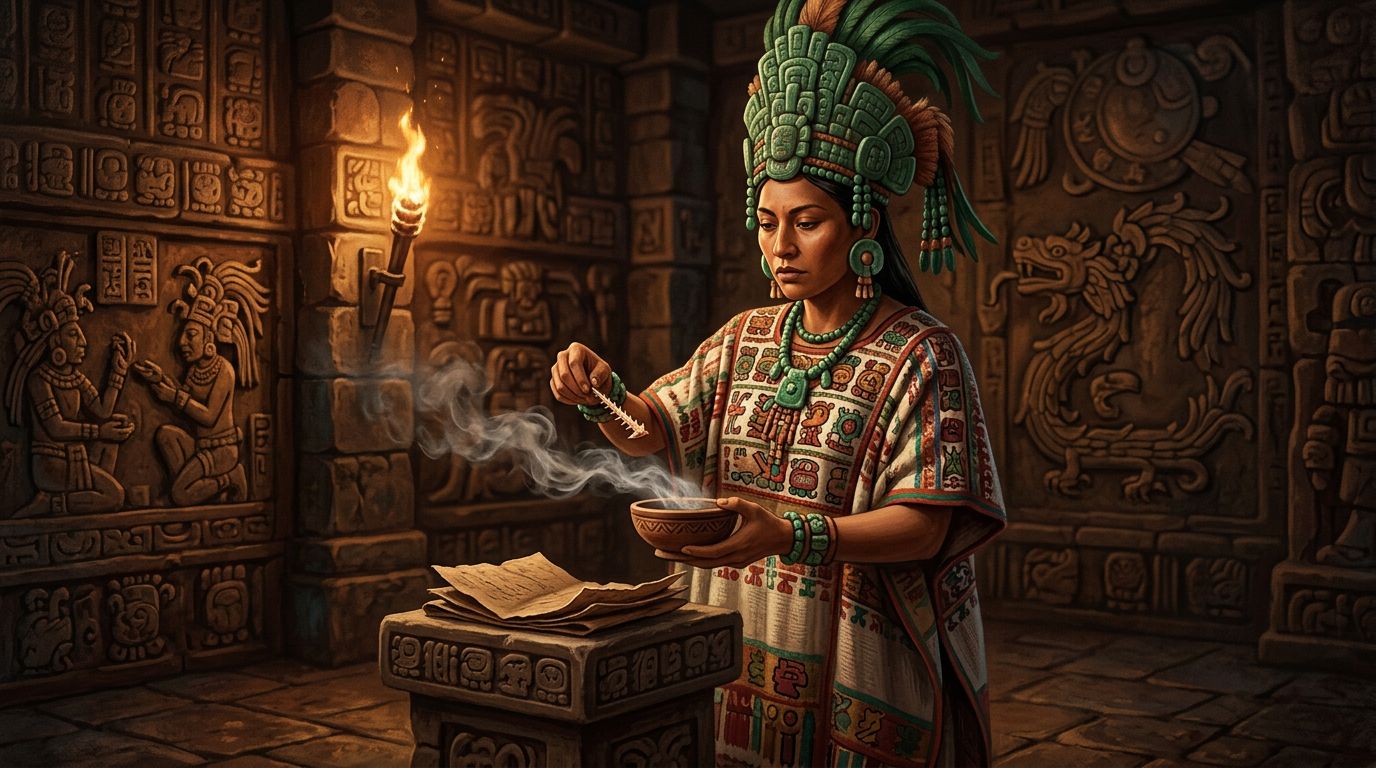
These rites can sound like something taken from the most alarming corner of a history textbook. They were painful, yes, but reducing them to spectacle misses what ancient Maya communities believed they were doing.
For royal families in Mayan civilization, drawn blood could be understood as a sacred life force, an offering, and a political statement. It could also serve as a conduit between worlds, offering contact with ancestors and gods. This is an interpretive description, not a universal translation for every Maya community; setting, participants, and timing mattered as much as the wound itself.
This post may contain affiliate links. If you make a purchase through these links, I may earn a small commission at no extra cost to you.
Key Takeaways
- Maya bloodletting was a sacred offering, a political statement, and a way for rulers to communicate with gods and ancestors.
- Royal men and women performed these rites at important moments such as accessions, calendar endings, military events, and dynastic ceremonies.
- Obsidian blades, stingray spines, shark teeth, bone perforators, and thorned cords were among the tools used, with blood sometimes collected on bark paper and burned as an offering.
- Yaxchilan Lintels 24 and 25 provide important evidence for the relationship between royal self-sacrifice, burning offerings, visions, and dynastic ritual.
- Archaeologists must interpret bloodletting through art, inscriptions, objects, and excavation context, while remembering that practices varied across Maya cities, dynasties, and periods.
Bloodletting Rituals Were Public Offerings
At ancient Maya courts, blood was understood as a concentrated offering with sacred force. Modern descriptions sometimes use the word ch’ul, or life force, as interpretive shorthand. Divine energy is another modern description, but neither phrase is a single, universally accepted Maya translation. The offering’s religious significance came from its connection to gods, ancestors, and the ritual setting. The central idea was clear: a ruler’s body could become a channel between human communities and divine beings.
Bloodletting often happened at important moments, including calendar endings, accessions, military events, building dedications, and dynastic ceremonies. These ritual acts presented sacrificial blood before an audience, rather than behind closed doors. They were public demonstrations that the royal household could fulfill its duties to the gods.
Religion and politics were not divided in Maya society as modern societies often try to separate them. A ruler who asked for rain, agricultural abundance, or protection used costly rites to reinforce political power and legitimate rule. These ceremonies had ideological undertones, but pain had a purpose: it showed that royal authority carried obligations, not only privileges.
The archaeological and historical evidence for Classic Maya blood sacrifice is extensive, though details varied by place and period. Stone monuments, painted ceramics, carved lintels, and ritual objects all help fill in the picture.
The Popol Vuh is often brought into this discussion, but it needs careful handling. This K’iche’ Maya text was written down after the Spanish invasion and is not a Classic-period manual for lowland royal ceremonies. Still, the Popol Vuh presents themes of sacrifice, death, and rebirth. Its creation story helps explain why bodily offerings made sense within wider Maya belief systems.

Who Performed These Rites, and Why It Mattered
Mayan kings are the figures most often shown giving blood. Their bodies were part of the office of kingship. Visible pain communicated rank, obligation, and political power.
Piercing an earlobe, cheek, tongue, or penis made sacrifice visible before courtiers, priests, relatives, and visiting elites. Genital bloodletting was one possible form of royal self-sacrifice. These injuries may resemble body modifications in physical form, but their ritual purpose and social setting were different.
That doesn’t mean ordinary people never offered blood. Many Mesoamerican communities practiced forms of self-sacrifice. Yet royal ceremonies dominate surviving art because ruling elites commissioned costly monuments in palaces and temples. A stone lintel could preserve elite ritual and rank, but this visibility reflects patronage, not frequency among all people.
Women also took part. The famous example is Lady Xoc of Yaxchilan, a royal woman shown drawing a thorned cord through her tongue. Her image makes one point impossible to ignore: these rites were not exclusively male acts.
A royal blood offering displayed power, but it also announced a burden. A ruler who claimed sacred status had to keep giving.
Elite women could strengthen dynastic claims through marriage, childbirth, ancestry, and ritual participation. These ritual practices could reinforce social status and support the same political order that male rulers defended through warfare and monument building. Lady Xoc was not proof that every Maya woman performed identical rites, but she was far more than a background figure in her husband’s story.
The ritual’s public nature was part of its force. A ruler did not need to make a speech about divine favor if the court could see costly devotion carved into stone, acted out in ceremony, and remembered for generations.
The Tools of Mayan Bloodletting Rituals
The tools used in these rites were chosen with care. Obsidian blades could create clean cuts during bloodletting rituals. Stingray spines, shark teeth, bone perforators, and thorned cords were also used. None of these objects were harmless, and that was rather the point.
A royal participant might pierce an earlobe or tongue with a sharp point. In some ceremonies, a cord threaded with thorns was drawn through a perforation. The blood could be collected on strips of bark paper, often called amate in modern accounts, then burned as an offering. Rising smoke was thought to carry prayers and sacred substance beyond the human world.

Sharp tools alone cannot establish either a bloodletting rite or body modifications. Obsidian blades had many uses, so archaeologists need context linking ritual acts to associated deposits, burned paper, or other evidence.
The use of stingray spines is especially striking because they came from coastal waters, while many Maya cities stood far inland. These materials weren’t random clutter. They connected ritual life to trade routes and distant environments, and could signal the social status of ruling elites. Royal households controlled the resources and exchange networks that made such materials available.
A broader overview of bloodletting across Mesoamerica also shows that Maya customs belonged to a wider Mesoamerican civilization and regional tradition. Still, there was no single ritual script followed by every city, dynasty, or century.
Yaxchilan Lintel 24 and the Meaning of Vision
Yaxchilan Lintel 24 is one of the clearest surviving images of Maya royal bloodletting. Carved for Structure 23, this stone lintel comes from Yaxchilan in present-day Chiapas, Mexico. It shows Lady Xoc kneeling as she performs tongue bloodletting, while her husband, Shield Jaguar II, holds a torch nearby.
The carving is not a casual scene from palace life. Lady Xoc wears elaborate clothing and jewelry, while Shield Jaguar’s costume and torch establish ceremony, rank, and controlled space. Their posture and surroundings show that the act mattered to the dynasty.
It’s easy to confuse this scene with nearby Lintel 25. The latter shows Lady Xoc before a bowl containing blood-marked paper, while a large Vision Serpent rises above it. A figure appears from the serpent’s open jaws, prompting some modern interpretations to describe the scene as a vision quest involving ancestors or deities.
Together, Yaxchilan Lintel 24 and Lintel 25 show a sequence many readers recognize: physical sacrifice, burning offerings, and contact with supernatural beings. Some modern readers call this a vision quest, but it was not an individual, casual search for private insight. It was a dynastic ceremony involving ancestors and deities, with religious significance for the entire community.
For a useful account of how Maya nobles linked blood offerings with ancestors, rain, and harvests, see this overview of Maya bloodletting ceremonies. The art at Yaxchilan makes those ideas visible, but it also reminds us that Maya ritual was shaped by local dynasties and their own dynastic needs.
What Archaeologists Can, and Cannot, Know
Archaeologists reconstruct bloodletting practices from the archaeological record, combining art, inscriptions, objects, and excavation context. Inscriptions from the ancient Maya sometimes use the verb ch’ahb’, often translated as “penance,” in settings connected to royal self-sacrifice. The term may also evoke life force, so translations require care. Images reveal selected ritual practices that writing alone cannot offer. The later K’iche’ text Popol Vuh offers useful comparison, but it cannot document every Classic-period ceremony.
Even so, caution matters. A carved image of a king can reveal elite ideals and social status. It does not record ordinary life, a full transcript, the words spoken, or the feelings of everyone present. Stone preserves messages well, but not doubt, argument, or fatigue.
Maya cities were independent kingdoms, not one uniform state. They participated in a broader Mesoamerican civilization while maintaining distinct dynasties, local traditions, and belief systems. Yaxchilan, Palenque, Tikal, Calakmul, and smaller centers shared ideas, but developed their own artistic styles and political traditions. Blood offerings changed with local circumstances.
It also helps to separate self-sacrifice from human sacrifice. Both could involve sacrificial blood, but they did not have the same participants or political meanings. Royal auto-sacrifice involved giving one’s own blood, and genital bloodletting was one example. Captive sacrifice involved different participants and political messages.
Frequently Asked Questions
What was the purpose of Maya bloodletting rituals?
Maya bloodletting was understood as a sacred offering and a means of communicating with gods and ancestors. It also demonstrated a ruler’s obligations, authority, and connection to the well-being of the community.
Who performed bloodletting rituals among the ancient Maya?
Royal men and women are the figures most clearly shown performing bloodletting in surviving Maya art. Ordinary people may also have practiced forms of self-sacrifice, but the archaeological record emphasizes elite ceremonies because ruling families commissioned monuments and ritual objects.
What tools were used in Maya bloodletting?
Ritual participants could use obsidian blades, stingray spines, shark teeth, bone perforators, and thorned cords. The specific tool depended on the ceremony, and archaeologists need associated evidence before identifying an object as a bloodletting instrument.
What do Yaxchilan Lintels 24 and 25 show?
The lintels depict Lady Xoc performing tongue bloodletting and engaging in a ceremony involving blood-marked paper, fire, and a Vision Serpent. Together, they are often interpreted as evidence linking royal self-sacrifice with ancestors, deities, and dynastic concerns.
How certain are archaeologists about these rituals?
Archaeologists combine monuments, inscriptions, ceramics, tools, and excavation context to reconstruct Maya bloodletting practices. These sources reveal elite ideals and selected ceremonies, but they cannot document every ritual, spoken word, or personal feeling.
The Lasting Meaning of Bloodletting
Mayan bloodletting rituals were acts of devotion, but they were never only devotional. They tied royal bodies to rainfall, ancestors, harvests, warfare, political power, and dynastic survival. The Popol Vuh also reflects broader themes of sacrifice, death, and renewal.
The images can be difficult to look at, and they should be. Yet their purpose was not shock for shock’s sake. These ritual acts expressed responsibility, not spectacle. Blood was a language of responsibility, spoken before gods and people alike.


