
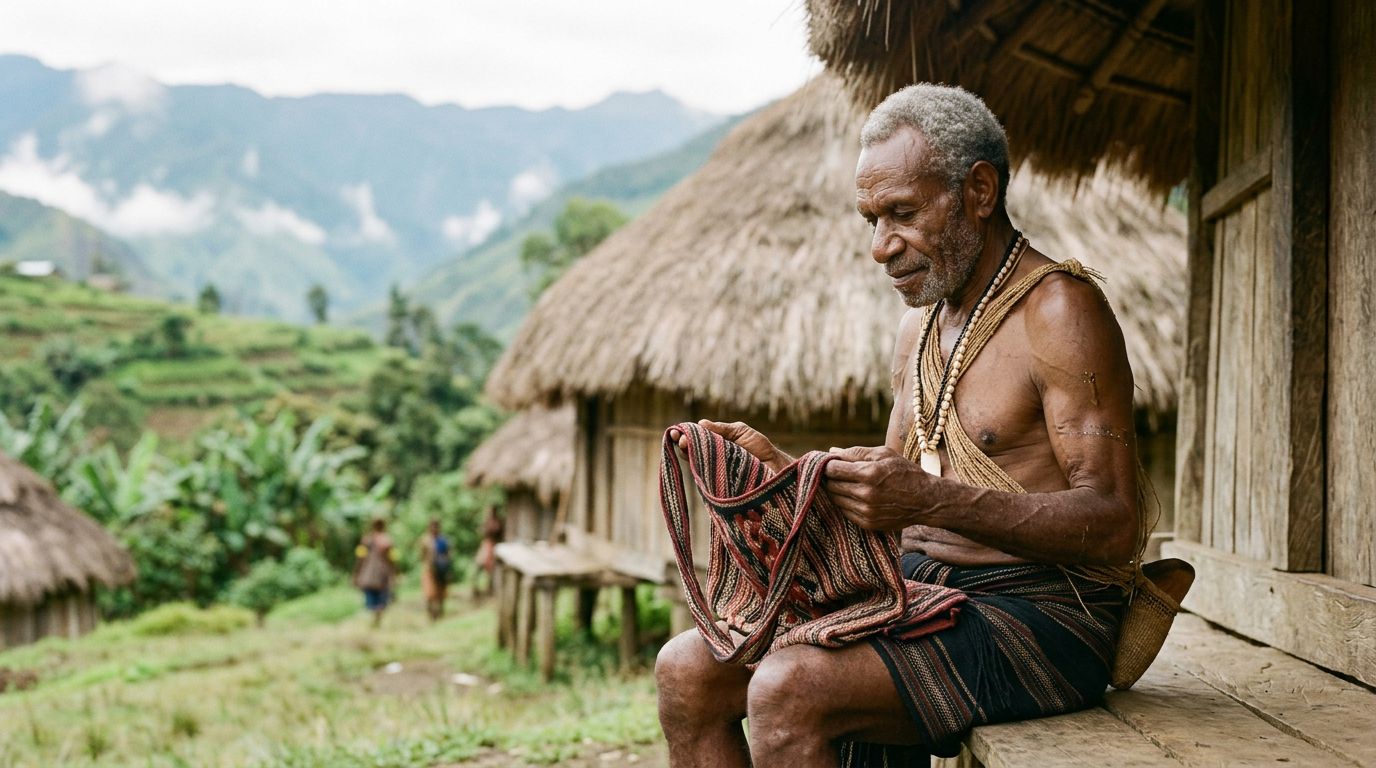
A photograph of a hand can make people stop scrolling. Online searches often use the label “Dani tribe,” but “Dani communities” is more precise. A person’s name, place, and grief still matter.
The practice, commonly called Ikipalin, is a mourning tradition associated with Dani communities in the Baliem Valley of Indonesia. It deserves more care than a shocked caption and a row of exclamation marks.
This post may contain affiliate links. If you make a purchase through these links, I may earn a small commission at no extra cost.
Key Takeaways
- Ikipalin was a mourning practice associated with Dani communities in the Baliem Valley of Papua, Indonesia, in which part of a finger was removed after the death of a loved one.
- The practice expressed grief, kinship, and spiritual beliefs; it should be understood in its cultural setting rather than treated as a shocking spectacle.
- Finger amputation carried serious risks, including bleeding, infection, tetanus, pain, and permanent loss of hand function. Historical references to herbs, heat, or soil are not modern medical guidance.
- Ikipalin is now rare and mainly associated with older generations, while safer ways of mourning have become more available through healthcare, education, travel, and changing community practices.
- Photographs and online claims should be checked carefully, since one person’s image or experience cannot represent every Dani community or generation.
What Dani Finger Cutting Was Meant to Say
The practice, commonly called Ikipalin, was a mourning ritual. In some cases, family members marked the death of a loved one by removing part of a finger.
The act was not simply a punishment, casual offering, or spectacle for outsiders. Some historical accounts connect it with mourning, kinship, and spiritual beliefs, including hopes of protection after a death.
Physical pain could make grief and sorrow visible when ordinary speech could not. A missing fingertip became a permanent record of someone who had died.
The mark could remain after the funeral, carrying part of the grief process into daily life. Mourning was not treated as a private feeling hidden behind a polite smile. The loss stayed visible, too.
A history of the practice describes the custom as an expression of sorrow felt after bereavement. That basic point matters more than the lurid details usually repeated online.
The missing part of a finger was not the story. The relationship with the person who died was the story.
No tradition is practiced by every person in exactly the same way. Families, generations, and local practices differ. Older accounts cannot tell us what every Dani person believed or did. Treating a whole people as though they were frozen in one old photograph is its own kind of mistake.
The Baliem Valley Gives the Practice Its Setting
The Dani are associated with the Baliem Valley and Wamena, a town in Jayawijaya Regency, Papua, Indonesia. The region sits in the central highlands of New Guinea.
The phrase “Dani tribe” appears in many English-language sources, but it can imply one uniform community. It’s more accurate to discuss Dani communities and their local differences.
That location is worth getting right. Papua, Indonesia, and Papua New Guinea are separate places on the island. Online summaries often blur the distinction, then repeat it until it sounds true.

For generations, mountain terrain and limited outside contact shaped daily life in the valley. Yet “remote” shouldn’t be confused with untouched or unaware. Dani communities have long dealt with trade, church missions, state policies, travel, schooling, markets, and visitors.
That fuller setting helps correct a familiar bad habit. Geography alone can’t explain a mourning practice, because customs and beliefs develop within local life. A mourning custom isn’t proof that a people are primitive. It’s evidence that people, like people everywhere, have found ways to make unbearable loss visible.
The Physical Act, Without Turning It Into a Spectacle
Historical accounts of the finger cutting ritual, known as Ikipalin, describe a finger being bound first. The binding was meant to limit blood flow before part of the finger was removed. Records mention sharp tools, including stones, knives, or axes, but these details are not a procedure.
These accounts document injury, physical pain, bleeding, infection risk, and permanent impairment. They should not be read as instructions or presented as spectacle.
Historical accounts differ on what followed. Some mention leaves and herbs, while others refer to heat or burning to control bleeding. Soft soil also appears in some reports, though putting soil on an open wound is unsafe by modern medical standards.
The strongest evidence suggests that finger amputation is now rare and largely discontinued. Shortened fingers among older women often document past mourning practices, not proof that the ritual remains common.
Photographs have also caused confusion. Snopes’ review of claims about Dani grieving women remains a useful reminder to question captions, dates, locations, and sweeping claims attached to viral images.
Photographs of older tribal elders, particularly older women, document some historical experiences. They cannot establish what every generation did or represent all Dani communities.
A good rule is simple: don’t assume one elder’s photo represents younger people or every family. It can’t show what is happening in Papua today.
Why Are Women Most Often Mentioned?
Most published accounts identify women in connection with finger amputation after the death of family members. This is why photographs of Dani women with altered hands appear so often in discussions of the tradition.
That pattern does not prove every woman was required to participate. Expectations could vary with age, relationship, local expectations, and community.
There’s another problem with the usual framing. Articles often turn Dani women into anonymous examples of an “extreme tradition.” That language erases their names, agency, emotional pain, grief, and later lives. It also makes readers feel clever for being shocked, which is not much of an achievement.
A person can oppose bodily harm while still refusing to sneer at people who lived within the custom. Those positions do not clash. Compassion for health and dignity should apply to everyone involved.
The question should not be, “How could they do that?” A more honest question is, “What kind of grief did this act try to carry, and why did it remain meaningful for some families?”
Wounds, Infection Risk, and the Limits of Old Remedies
Finger amputation creates an open wound. Without sterile tools, antibiotics, tetanus protection, wound cleaning, or emergency care, the infection risk can be serious. Bleeding, bacterial infection, tetanus, tissue damage, physical pain, and lasting loss of hand function are all plausible concerns.
Reliable public infection-rate figures for Ikipalin are unavailable. That absence is important. It would be irresponsible to invent a percentage or present an anecdote as a statistic merely because readers expect one.
Traditional herbs may have held practical as well as cultural value, but they were not a substitute for modern wound care. Cultural familiarity or spiritual significance did not make a treatment sterile or medically adequate. Soil is even more concerning on an open wound, because it can contain bacteria and tetanus spores.
This is where modern healthcare changes the conversation. Clinics, vaccination, antibiotics, and health education give families safer ways to respond to injury without accepting the dangers that once surrounded it. They also offer a different response to bereavement, one that does not require permanent bodily loss.
None of that makes earlier generations foolish. People act with the resources, beliefs, and pressures available to them. A fair account can state the health risks plainly without using those risks as an excuse to mock the dead or their relatives.
A Tradition That Is Fading, Not a Curiosity to Collect
Reports describe Ikipalin as officially prohibited and far less common than before, though enforcement records are difficult to verify. The broader pattern is clear: this mourning ritual is now associated mainly with older generations.
Church influence, government outreach, education, travel, and improved access to health services have all been linked to its decline. Younger Dani people live differently from their grandparents, even as family ties and ancestral traditions remain strong.

Cultural heritage does not require every old practice to continue unchanged. Languages, ceremonies, art, farming knowledge, family stories, and local forms of mutual care can endure while harmful traditional practices fade.
That is not cultural erasure. It is what living cultures do. People keep what still fits, question what does not, and decide what they want future generations to inherit.
When reading about the practice, resist the urge to turn it into a travel fact or a test of your own toughness. The most respectful response is quieter: learn the setting, check the claim, and remember that grief was at the center of it.
Frequently Asked Questions
What is Dani finger cutting?
Dani finger cutting, commonly called Ikipalin, was a mourning practice associated with some Dani communities in the Baliem Valley. In certain cases, a family member removed part of a finger after the death of a loved one as a visible expression of grief.
Where did Ikipalin take place?
The practice is associated with Dani communities in the Baliem Valley around Wamena, in Papua, Indonesia. Papua, Indonesia, and Papua New Guinea are separate places, although online sources sometimes confuse them.
Is Dani finger cutting still practiced today?
Reliable accounts suggest that Ikipalin is now rare and has largely been discontinued, with the practice mainly associated with older generations. Government policies, church influence, education, travel, and improved healthcare have all contributed to its decline.
Why are Dani women often shown in photographs about the practice?
Many published accounts describe women in connection with finger amputation after the death of family members, which is why older women appear frequently in related photographs. This does not prove that every woman participated or that one photograph represents all Dani communities.
What were the health risks of Ikipalin?
Removing part of a finger could cause severe bleeding, infection, tetanus, tissue damage, pain, and lasting impairment, especially without sterile tools or modern medical care. Historical references to herbs or soil should not be treated as safe wound-care advice.
Final Thoughts on Ikipalin
This practice was tied to loss, kinship, and spiritual beliefs in the Baliem Valley of Papua. Its cultural meaning should not be reduced to physical severity, but health risks should not be softened either.
Today, the practice is best understood as a fading tradition, visible mainly in older people’s memories and bodies. Respectful understanding recognizes both the grief and sorrow behind it and the need for safer ways to mourn.
This post may contain affiliate links. If you make a purchase through these links, I may earn a small commission at no extra cost to you.


