
What can a toothed wheel, a moon slipping behind Jupiter, or a measured wave pattern tell us about a flash too brief to time by hand? Each offers a reference we can observe without relying on human reflexes.
The trick is replacing your reaction time with a more reliable reference. A moon disappearing behind Jupiter makes a laboratory clock seem rather modest.
This post may contain affiliate links. If you make a purchase through these links, I may earn a small commission at no extra cost to you.
What Speed Are We Trying to Measure?
The speed of light in a vacuum is exactly 299,792,458 m/s. That’s about 670,616,629 miles per hour, or 1,079,252,848.8 km/h.
At that speed, light takes about 1.3 seconds to reach the Moon and 8.3 minutes to travel from the Sun to Earth. Sunlight gives us a slightly delayed view of our nearest star.
For longer intervals, multiply speed by time. Light travels 17,987,547,480 meters in one minute and 29,979,245,800 meters in 100 seconds.
That value applies only in a vacuum. Light travels more slowly through water or glass, and air changes its speed slightly. The difference matters when an experiment becomes precise.
Every method needs a measured distance and a time reference, or equivalent information about wavelength and frequency. Removing the stopwatch doesn’t remove time from the calculation.
How Astronomers Measured Light Using the Sky
Rømer noticed that eclipses of Io appeared to run late
In 1676, Rømer studied eclipses of Jupiter’s moon Io. These repeated events offered something like a celestial timetable.
As Earth moved farther from Jupiter, the eclipses appeared progressively late. As Earth moved closer, they appeared earlier. The American Museum of Natural History’s account explains how he connected those delays to light’s travel time.
He estimated that light needed about 22 minutes to cross Earth’s orbital diameter. A reconstruction using modern orbital dimensions gives a result below today’s accepted value. That figure wasn’t reported in modern units at the time.
His lasting discovery was that the speed of light was finite. His estimate was imperfect, but it answered an enormous question.

James Bradley found a clue in starlight’s direction
James Bradley explained stellar aberration in 1729, the apparent shift in a star’s position caused by Earth’s motion.
Stellar aberration is like walking through falling rain: your movement changes the angle at which the rain seems to approach.
By measuring stellar aberration and combining its angle with Earth’s orbital speed, he calculated a Sun-to-Earth light-travel time of eight minutes and 13 seconds, close to today’s roughly eight minutes and 19 seconds.
The sky gave Rømer and James Bradley the long distances they needed to detect light’s tiny delays.
How Spinning Wheels and Mirrors Replaced Human Reflexes
Fizeau turned a delay into a blocked beam
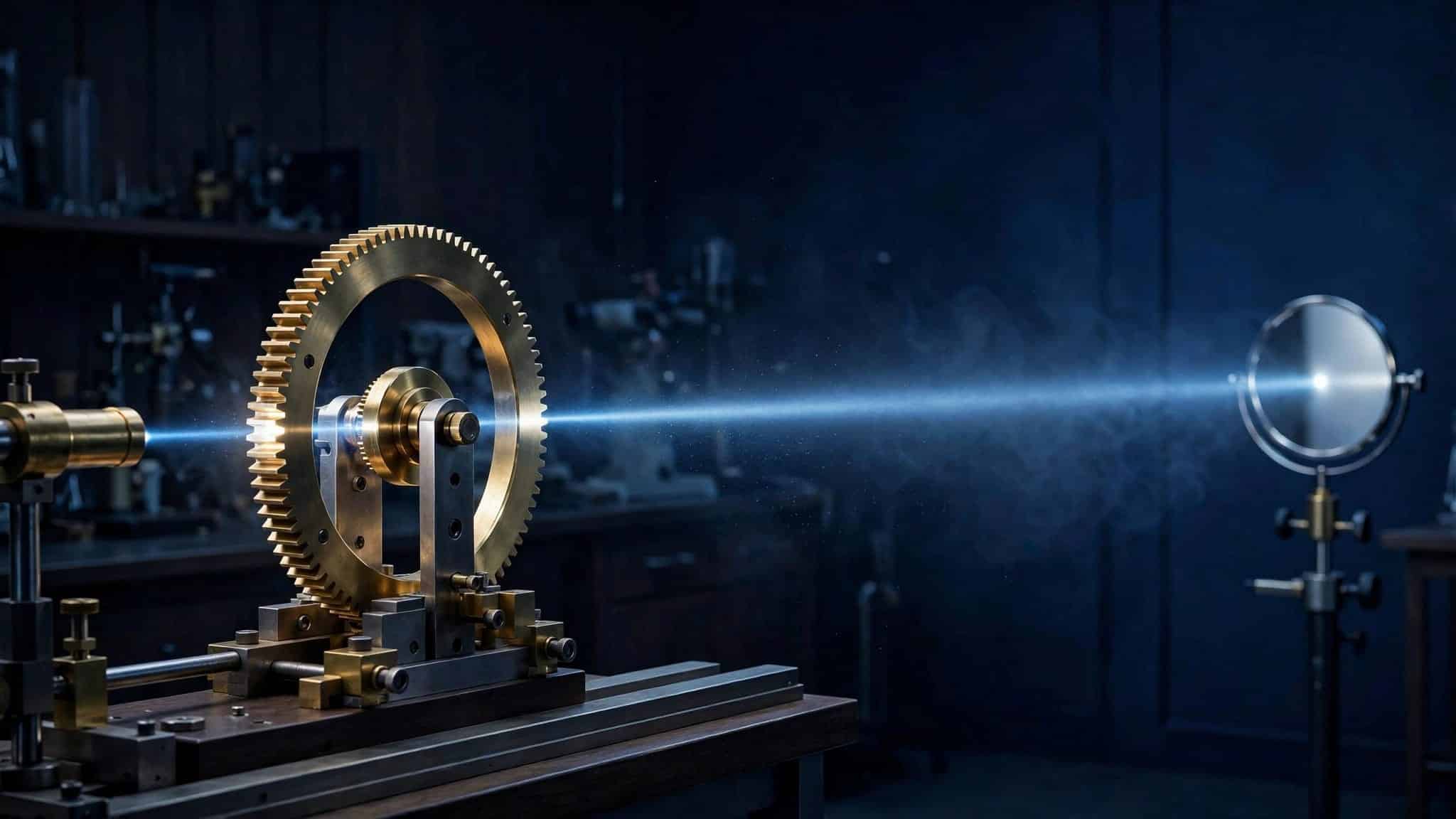
In 1849, Hippolyte Fizeau made the first successful terrestrial measurement using a spinning toothed wheel.
Light passed through a gap in the toothed wheel, traveled to a mirror about eight kilometers away, and returned. At the right rotation rate, a tooth blocked the returning beam.
The wheel’s known rotation rate revealed the round-trip time without a stopwatch. Dividing the total outward-and-back distance by that time gave the speed of light.
Fizeau’s result was roughly 315,000 km/s, about 5% high. The historical explanation hosted by DESY describes how mechanical arrangements made this measurement possible on Earth.
Foucault measured a small change in angle with rotating mirrors
In 1850, Foucault used rotating mirrors to show that light travels slower in water than in air.
During light’s journey, the mirror turned slightly, shifting the returning beam’s position. Understanding how mirrors reflect light helps explain why a small rotation produces a measurable displacement.
This approach allowed more sensitive measurements than watching a wheel extinguish a beam. Foucault’s 1862 measurement was about 298,000 km/s, roughly 0.6% low.
Albert Michelson refined rotating mirrors further. In 1926, Michelson’s California experiment used a baseline of about 35 kilometers, and the Michelson result was 299,796 km/s, only about 0.0012% high.
How Modern Laboratories Catch a Light Pulse
Modern time-of-flight experiments use fast electronics instead of moving machinery. A pulsed laser sends light toward a detector, while an oscilloscope records the signal’s arrival.
In a UNSW teaching experiment, the pulsed laser traveled an extra 20 centimeters along the optical path, producing a delay of about 0.67 nanoseconds. A nanosecond is one billionth of a second.
The oscilloscope reading gives the signal’s arrival time. Comparing it with the additional path length reveals the delay, without a hand-operated stopwatch.
The calculation is straightforward:
Speed = 0.20 meters / 0.00000000067 seconds ≈ 300 million meters per second.
Using the oscilloscope’s measured delay, that’s about 30 centimeters per nanosecond. The electronics handle a delay that would defeat any thumb-operated stopwatch.
A separate approach measures wavelength and frequency. In 1972, a National Bureau of Standards team in Boulder, Colorado, combined laser measurements with interferometry. NIST’s history of the meter reports a result of 299,792,456.2 ± 1.1 m/s, close to today’s defined value.
Interferometry compares overlapping light waves. Their patterns reveal tiny differences in optical distance, making the waves themselves useful measuring tools.
How to Measure Light’s Wavelength at Home
Prepare a simple microwave experiment
A microwave can estimate light speed without measuring travel time. Standing waves create hot spots in food, spaced about half a wavelength apart.
Place microwave-safe food, such as chocolate chips, in a single layer on a microwave-safe plate. Heat it briefly, following the appliance instructions.
Never operate the oven empty or put metal inside. Don’t disable safety features, and follow the appliance instructions.
Hot spots can be broad and uneven. A rotating plate can also blur their positions, so use an oven with a stationary plate only if its instructions allow it.
Measure the spacing of the hot spots
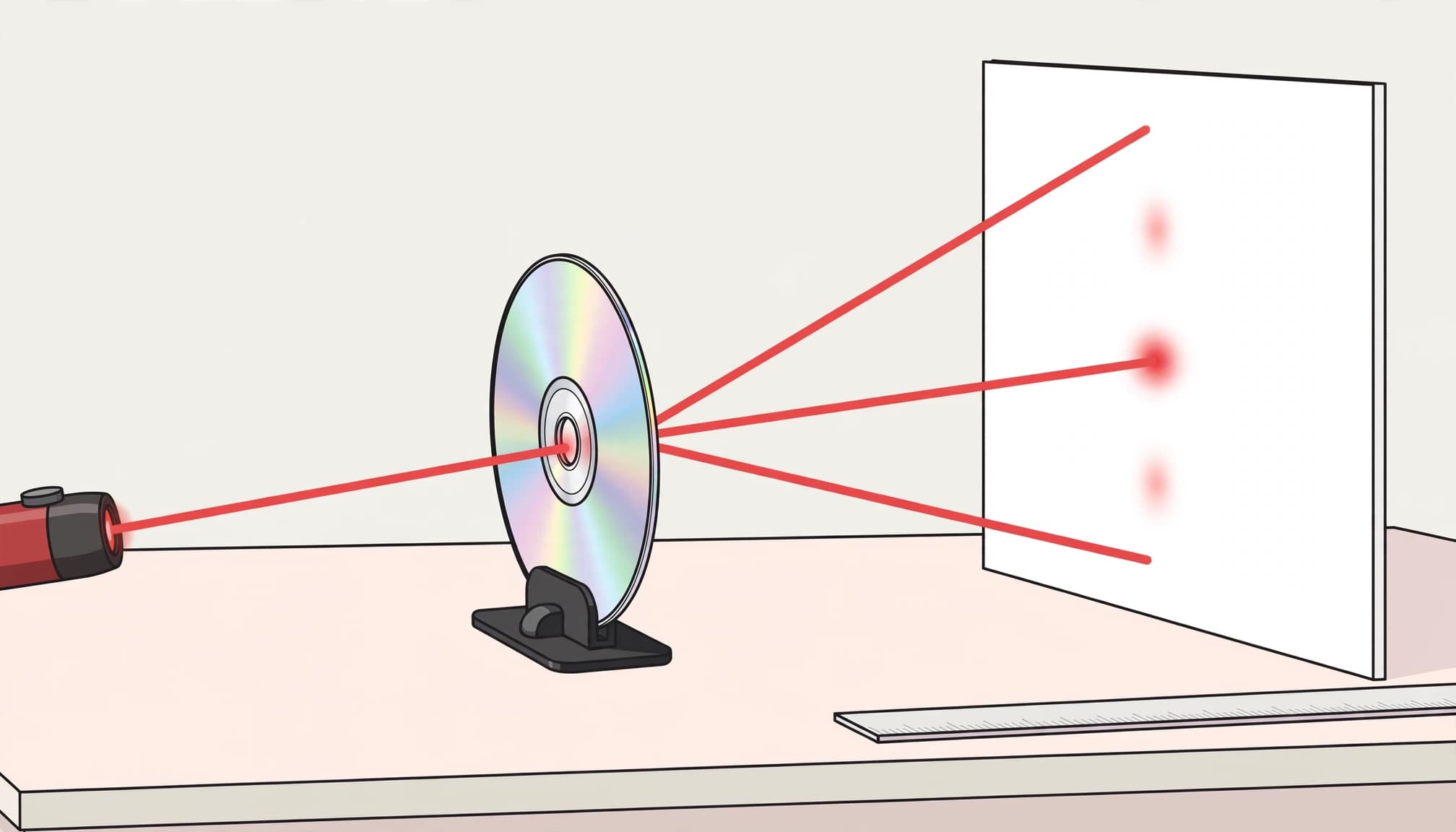
After heating, locate several neighboring hot spots in the food. Measure the distance across multiple gaps, then divide by the number of gaps to find their average spacing.
Double that average to estimate the wavelength. This demonstration helps measure speed of light indirectly, using the wavelength estimate and a known frequency.
Repeat the measurement if the hot spots are hard to locate. Their uneven shape limits the precision of the estimate.
Turning Wavelength Into an Estimate of Light Speed
Use microwave hot spots for a rough estimate
The relationship between wavelength and frequency is speed = wavelength × frequency. Measuring wavelength alone doesn’t supply both pieces.
If adjacent hot spots in a microwave are about 6.1 cm apart, the estimated wavelength is about 12.2 cm.
Assuming the oven runs at 2.45 GHz, multiplying 0.122 m by 2.45 × 10^9 hertz gives roughly 2.99 × 10^8 m/s.
Understand what limits the result
Hot-spot positions are hard to locate precisely, and the oven’s actual frequency may differ from the assumed 2.45 GHz. Treat this as a rough demonstration, not a precision measurement.
This experiment demonstrates a relationship more reliably than it measures a constant. A calibrated frequency measurement would improve it considerably.
Maxwell’s equations predicted electromagnetic waves at a speed close to measured values. That agreement helped establish that light is an electromagnetic wave.
Why One-Way Timing Is Tricky, and Today’s Value Is Exact
Two clocks create a synchronization problem
It seems reasonable to place one clock beside a light source and another beside a detector. Subtract the departure time from the arrival time, then divide distance by time.
The difficulty is clock synchronization between separated clocks.
The usual synchronization procedure exchanges light signals and assumes equal outward and return speeds. That assumption becomes part of the one-way measurement.
A round-trip measurement avoids this difficulty because one local clock can time the entire journey. This is why mirrors appear so often in light-speed experiments.
A round-trip measurement needs one clock. A one-way measurement also needs a convention for synchronizing distant clocks.
The meter now follows light
Since 1983, the definition of the meter has used light’s travel time. One meter is defined by the distance light travels in a vacuum during 1/299,792,458 of a second.
That makes the vacuum speed of light exactly 299,792,458 m/s by definition.
This doesn’t mean physicists stopped testing light’s behavior. It means the unit of length now follows a fixed constant rather than leaving that constant’s numerical value open to refinement.
A classroom measurement therefore tests your equipment and method against the defined value. An imperfect result usually reveals something about alignment, distance, electronics, or assumptions.
A Better Reference Than a Stopwatch
Measuring light’s brief journey requires a reliable reference, whether that’s an eclipse, a rotating mirror, or a light wave.
Useful measurements appeared centuries before electronics could catch a nanosecond. Light was always fast, but an observable reference made its brief journey measurable.


