
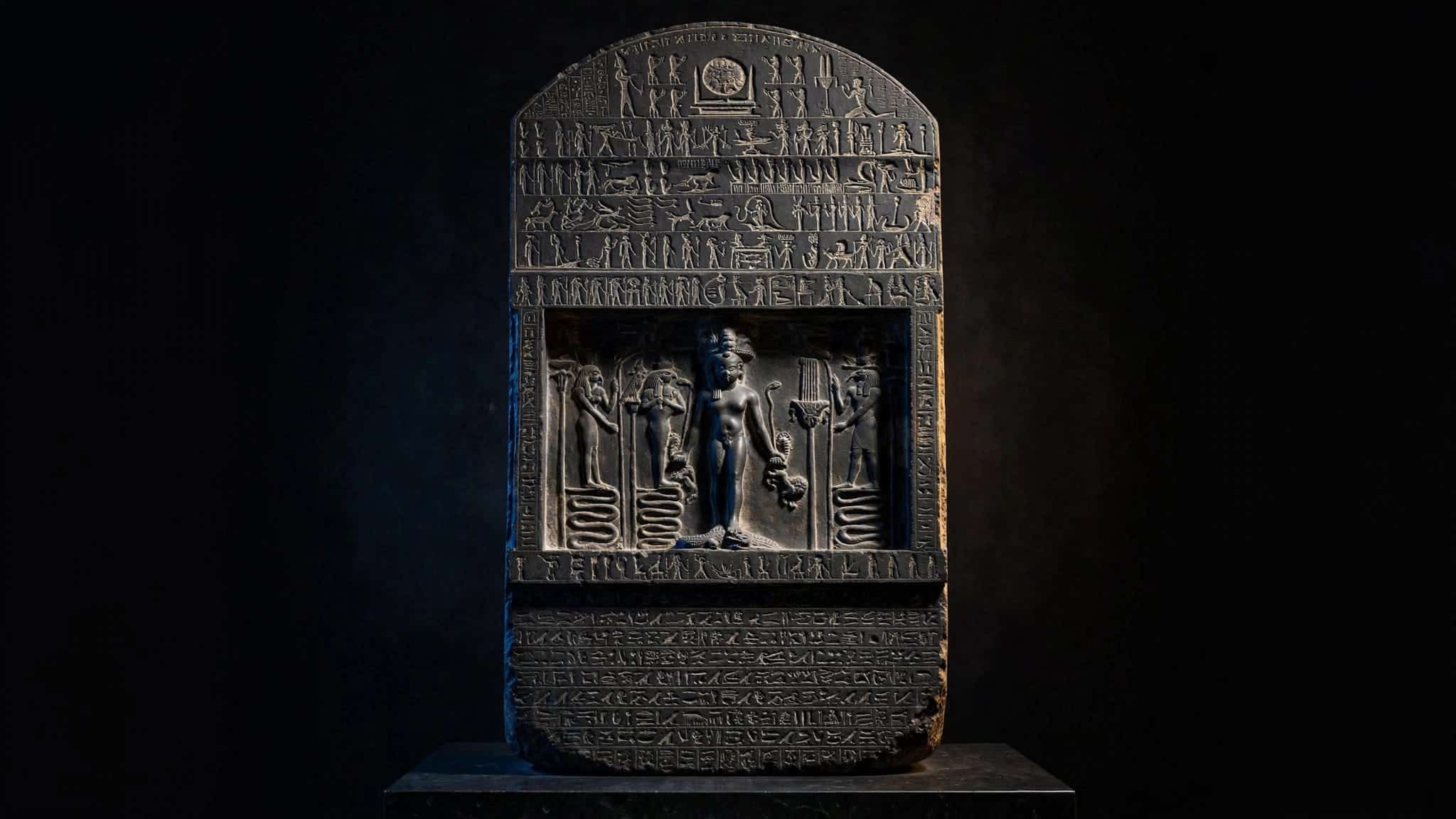
A stone covered in tiny figures and dense hieroglyphs can look like museum wallpaper at first. The Metternich Stela is nothing of the sort. It is an ancient Egyptian healing object built to deal with the sort of dangers that make a person panic fast: a scorpion sting, snakebite, poison, fever, and a child in pain.
Its carvings are busy because the stakes felt busy. Gods, myths, spoken words, water, and stone all had a job to do.
This post may contain affiliate links. If you make a purchase through these links, I may earn a small commission at no extra cost to you.
What the Metternich Stela is and why it mattered
The Metternich Stela is a graywacke magical-medical monument from Egypt’s Late Period. It is usually dated to the reign of Nectanebo II, the last native Egyptian pharaoh, around 360 to 343 BCE. Today, it is in the Metropolitan Museum of Art in New York.
It belongs to a group called Horus cippi, or “Horus-on-the-crocodiles” stelae. A stela is an upright carved slab. Cippus is a later Latin term often used for this particular Egyptian form.

The stone was not made as decoration for a wealthy person’s sitting room. It was a protective object. Its spells and images were meant to help people facing venomous animals and illnesses that could turn frightening without much warning.
A famous survivor from a much larger tradition
The Metternich Stela is the largest and most elaborate surviving example of its kind, but it was not a strange one-off. Smaller magical stelae appear in museum collections across the world. The Met’s magical stela with Horus the Child, for example, preserves the same broad idea: a carved stone where divine power, spoken spells, and healing meet.
That matters because it stops us treating the Metternich piece like an isolated treasure. It was part of a familiar solution to familiar fears. Ancient Egyptians lived beside crocodiles, encountered snakes, and knew scorpions were small creatures with an alarming amount of authority.
The Metternich Stela puts Horus in charge
The central image is bold enough to read even before you understand a single hieroglyph. Horus appears as a child standing on two crocodiles. He grips dangerous creatures, including snakes and scorpions. Above his head is the face of Bes, a fierce protective god often linked with childbirth, households, and the protection of children.
This is not an image of a child in danger. It is an image of a child who has already won.
Why Horus stands on crocodiles
Crocodiles, snakes, and scorpions were not abstract symbols in Egypt. They could kill people. Horus standing on them shows total control over creatures that normally inspire fear. The message is blunt, in the best possible way: danger has been pinned down.
Other divine figures gather around him. Isis, Horus’s mother, is there because she is central to the healing story behind the stela. The crowded composition can feel overwhelming, but that is part of its force. No threat gets to meet only one god.
A discussion of Horus-on-the-crocodiles stelae at Glencairn Museum shows how these objects paired protective imagery with practical treatment for venom and illness.
The carvings were active, not ornamental
The hieroglyphs do not merely label the gods. They preserve spells, myths, and instructions that gave the stela its use. Around the main image sit thirteen magical texts intended to counter poison and sickness.
To a modern eye, writing looks passive. You read it, close the book, and move on. Egyptian sacred writing could be treated as a source of power in itself. The words existed on the stone, ready to be spoken and put to work when a person needed help.
Isis, Thoth, and the poisoned child
At the base of the stela is part of a well-known Egyptian story. Isis hides in the marshes with her young son Horus after the murder of Osiris. While she is away, Horus is poisoned, often understood as a scorpion attack. She returns to find him sick or lifeless.
It is a horrible scene because it is so ordinary in emotional terms. A parent leaves a child for a moment. Something goes wrong. The panic is immediate.
A myth that gave patients a role
Isis calls for help, and Thoth, the god associated with writing, knowledge, and divine speech, restores Horus. The story does not stay neatly inside myth. A sick human could be treated as another Horus, and the healing words could place that person inside the same rescue.
The patient was not watching a distant god solve a problem. In the ritual logic of the stela, the patient could become Horus, the child who survived poison.
This is why the tale mattered on a healing object. It offered more than comfort. It set out a divine precedent. Horus was poisoned and cured, so poison did not have the final word for a human sufferer either.
Isis was more than a grieving mother
Isis is often introduced as the devoted wife of Osiris, which is true but incomplete. She was also a powerful healer and protector. Her speech, persistence, and knowledge were part of what made Horus safe.
On the Metternich Stela, Isis brings a mother’s urgency into a formal healing ritual. The stone is full of divine authority, but it does not lose sight of the frightened person at the center of the problem. That is probably why the story still feels less remote than many ancient myths.
How Egyptian magical stelae were used
The word “magic” can send modern readers in the wrong direction. It may suggest stage tricks, fantasy wands, or an attempt to avoid medicine altogether. Ancient Egyptian heka was not separate from religion and healing in that neat modern way.
A healer could recite the inscriptions over a patient. Water could also be poured over the carved surface, then collected and drunk. The water passed across sacred words and images, taking on their protective force before it reached the person in need.

Water made the stone portable
A large stela cannot follow someone home. Water can. This simple detail explains why such objects were useful in real life rather than only impressive in a temple.
The ritual also joined physical care to spoken words. A sting or bite needed attention, and Egyptians had remedies made from plants, minerals, and animal products. But a cure also needed protection against the harmful force behind the injury. For them, these were not competing ideas.
A British Museum description of a comparable cippus calls it a magical artefact, which gets close to the point. The object was made to do something.
The ritual had limits, as all medicine does
It would be comforting to imagine every treatment worked. It did not. A serious snakebite can overwhelm any society with limited medical options. Still, calling these practices irrational misses the human reality.
People used the knowledge, materials, stories, and religious support available to them. A treatment that addressed pain, fear, family distress, and the danger of death had a logic of its own. The Metternich Stela makes that logic visible.
Magic and medicine were not opposite camps
Ancient Egyptians did have practitioners who treated wounds, set bones, prepared remedies, and observed symptoms. They also used protective words and invoked gods. One did not cancel the other.
That distinction is easy to miss because modern readers often want to sort objects into labelled drawers: religion here, medicine there, magic in a third drawer with a slightly embarrassed cough. Egypt did not always use the drawers that way.
Protection was part of treatment
Venom and disease were physical problems. They could also be understood as hostile intrusions, divine punishments, or attacks by unseen forces. A sensible response, within that worldview, involved treating both the body and the danger’s supernatural side.
The Metternich Stela made protection visible. Horus crushed the threatening animals beneath his feet. Bes stared outward. Isis stood close. The inscribed spells supplied a voice for the ritual. It was a compact answer to a frightening question: what do we do now?
A stela named after a European prince
The object gets its modern name from Prince Klemens von Metternich, the Austrian statesman. Muhammad Ali Pasha presented the stela to him in 1828. It remained at Metternich’s castle at Kynzvart in Bohemia until the Metropolitan Museum acquired it in 1950.
The name can make the stone sound like a European possession with an Egyptian footnote. Its actual history runs the other way. The stela’s religious language, imagery, and purpose are entirely Egyptian. Metternich merely became attached to its recent collecting history.
Look past the label
Museum names are useful, but they can hide the people who made and used an object. The stela was carved in Egypt more than 2,300 years ago for a culture with its own sacred stories and urgent daily worries.
A concise overview of the Metternich Stela as a Horus cippus helps identify its main imagery, but the object is most interesting when viewed as a working healing device. It was not made to be admired at a distance. It was made for the moment when distance from danger had already disappeared.
The stone still has something to say
The Metternich Stela does not ask us to choose between a beautiful artwork and a useful object. It was both. Every figure, spell, and carved creature had a part in a serious attempt to protect a person from harm.
Its great lesson is disarmingly human: when illness or danger arrives, people want skill, stories, protection, and hope close at hand. The Metternich Stela held all four in one piece of stone.


