
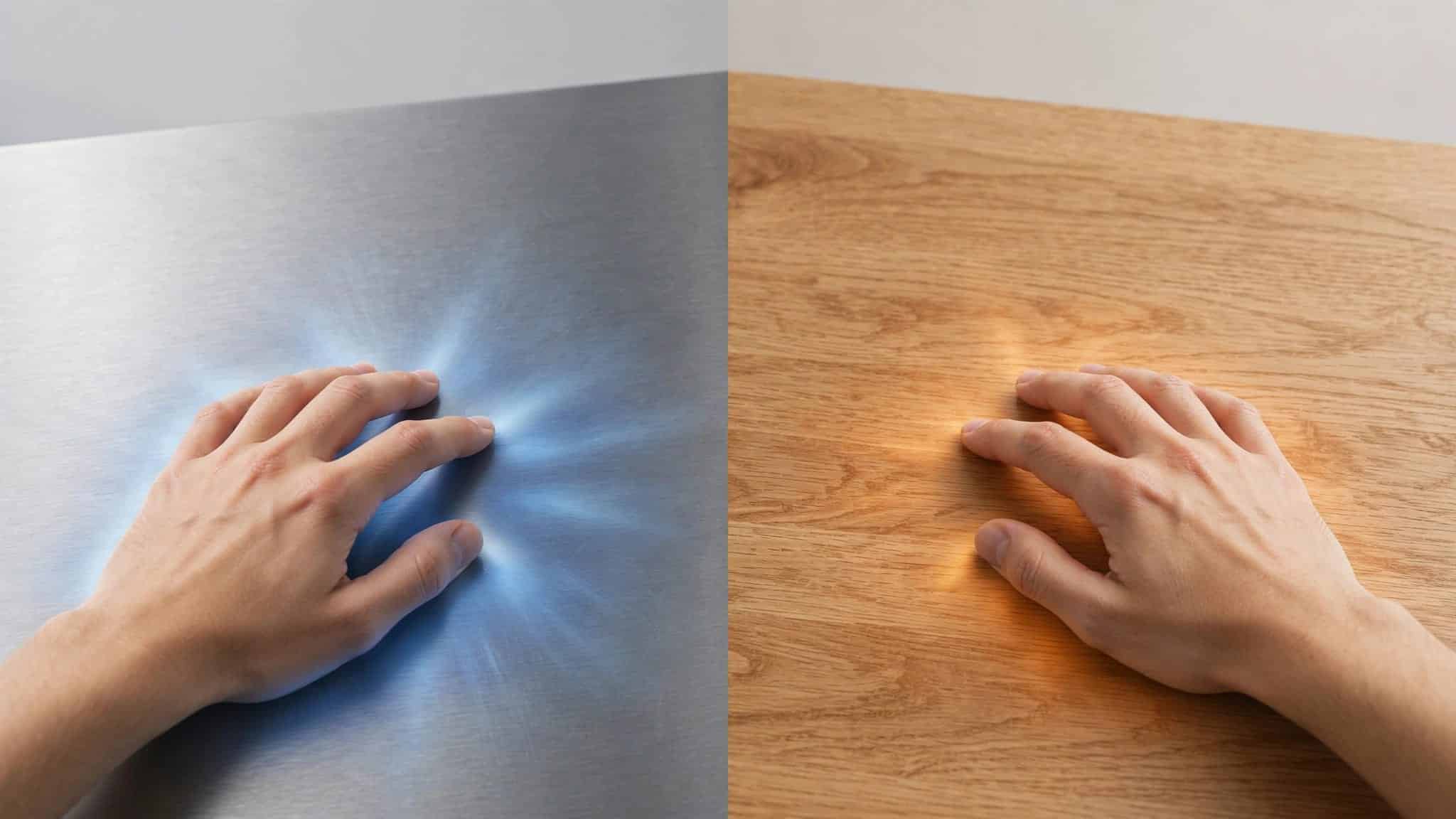
Metal can make a tabletop feel chilly because it pulls warmth from your skin faster than wood. Your hand responds to that heat loss, so an ordinary table can feel suspiciously chilly.
So how does one explain the difference without arguing with the thermometer? Start with heat flow, rather than the temperature reading alone.
This post may contain affiliate links. If you make a purchase through these links, I may earn a small commission at no extra cost to you.
Why Metal Feels Colder at the Same Temperature
Imagine a steel table and a table made of wood, both at 22°C. Your skin temperature is often around 32°C at the surface, though it varies by body location and conditions.
Heat moves from warmer skin into both surfaces. Steel carries energy away faster, so your fingertips cool more quickly; wood slows conduction, letting the surface beneath your fingers warm.

A steel spoon and a wooden spoon left side by side at the same temperature show the same effect. Metal isn’t inherently cold; wood at a sufficiently lower temperature can feel just as cold.
Your skin has temperature-sensitive nerves, but no built-in thermometer for an object’s temperature. Those nerves respond to the temperature of your skin and its changes.
Heat leaving your fingertips feels cold, while its return feels warm. At the same temperature as the body’s surface, an object initially causes no net heat flow.
Your resting body produces roughly 100 watts. Managing heat loss is part of how everyday energy transfers work.
How Materials Carry Heat Away
Thermal conductivity explains the first difference
Thermal conductivity measures how readily heat travels through a material and describes heat flow. Its units are watts per meter per kelvin, written W/(m·K).
These approximate values illustrate the differences described in Engineering ToolBox’s conductivity reference.
| Material | Conductivity, W/(m·K) |
|---|---|
| Carbon steel | 45 |
| Granite | 3.1 |
| Wood | 0.1 |
| Paper | 0.05 |
| Air | 0.025 |
The value for steel is about 45 ÷ 0.1 = 450 times wood’s. That comparison explains the direction of the effect, but your finger doesn’t necessarily lose heat 450 times faster.
Values vary with alloy, moisture, temperature, and grain direction. Stainless steel, for example, conducts less readily than typical carbon steel.
Effusivity gives a fuller explanation
A fuller comparison of materials’ thermal properties considers density and heat capacity, not just thermal conductivity.
Thermal diffusivity describes how quickly temperature changes spread within a material:
alpha = k / (rho × Cp)
Here, k is conductivity, rho is mass per volume, and Cp is specific heat capacity.
Thermal effusivity better describes the initial exchange when two surfaces touch:
effusivity = √(k × rho × c)
Here, c is Cp. High effusivity means a material exchanges substantial heat without its contact surface quickly changing temperature. That makes it a better predictor of initial coldness than conductivity alone.
Thickness, surface roughness, and contact pressure affect the experience too.
Try the Difference Without Fooling the Thermometer
Compare objects under the same conditions
Leave a block of wood and a substantial steel object indoors, away from sunlight and heaters, until both reach room temperature. Keep the room temperature steady during the test, and note the air temperature.
Measure each with a contact temperature probe, allowing its reading to settle.
Then touch each briefly with the same hand. Matching readings can accompany different sensations because your fingers respond to how quickly energy moves.
Avoid relying on an infrared thermometer aimed at shiny metal. Reflections and low emissivity can distort its reading.
Air also affects heat transfer. Solids touch skin across microscopic contact points, where conduction carries heat away faster; still air forms a poorly conducting boundary layer.
Change the hand instead
Consider a hand cooled in ice water until its skin reaches about 16°C. Water at 25°C would then feel warm because it warms the cooler hand.
There’s no need to reproduce that extreme cooling to understand the result. The same object can feel less cold after your hand cools because heat loss from your hand slows.
Skin temperature varies, so 32°C is an approximate reference, not a universal dividing line. Use a settled contact-probe reading to check the object’s actual temperature.
Key Takeaways
Touch tells you about heat exchange, so perceived temperature reflects heat flow, not temperature alone. At the same temperature, metal feels colder than wood because its higher thermal conductivity draws warmth from your skin faster; colder wood can feel just as cold.
Frequently Asked Questions
Can metal feel warmer than wood?
Yes. At 40°C, a metal bar transfers heat into cooler skin faster than wood does, so it feels warmer. The same property responsible for cold metal makes hot metal uncomfortable.
Wooden handles on some wood-burning stoves slow heat conduction toward the hand. They aren’t a guarantee against burns.
A swimming pool can also feel less cold after you’ve been in it briefly. Sensory adaptation and changes in skin temperature alter the experience, even though the water hasn’t warmed.
Can metal actually be colder than the surrounding air?
Yes, although conductivity alone doesn’t cause that difference. Outdoors, steel or a windshield can lose heat by radiation toward a clear night sky and cool below air temperature. That helps explain dew and frost.
Condensation requires a surface below the air’s dew point. Metal can conduct away the latent heat released as vapor becomes liquid, limiting local warming. It still needs somewhere cooler to send that heat.
An indoor object left undisturbed generally approaches room temperature unless another heating or cooling process intervenes.
What Your Hand Is Really Telling You
The thermometer and your fingers aren’t having a disagreement. It measures temperature, while your hand senses the cooling or warming of your skin.
Once you separate those ideas, a chilly metal table becomes much less mysterious.


