
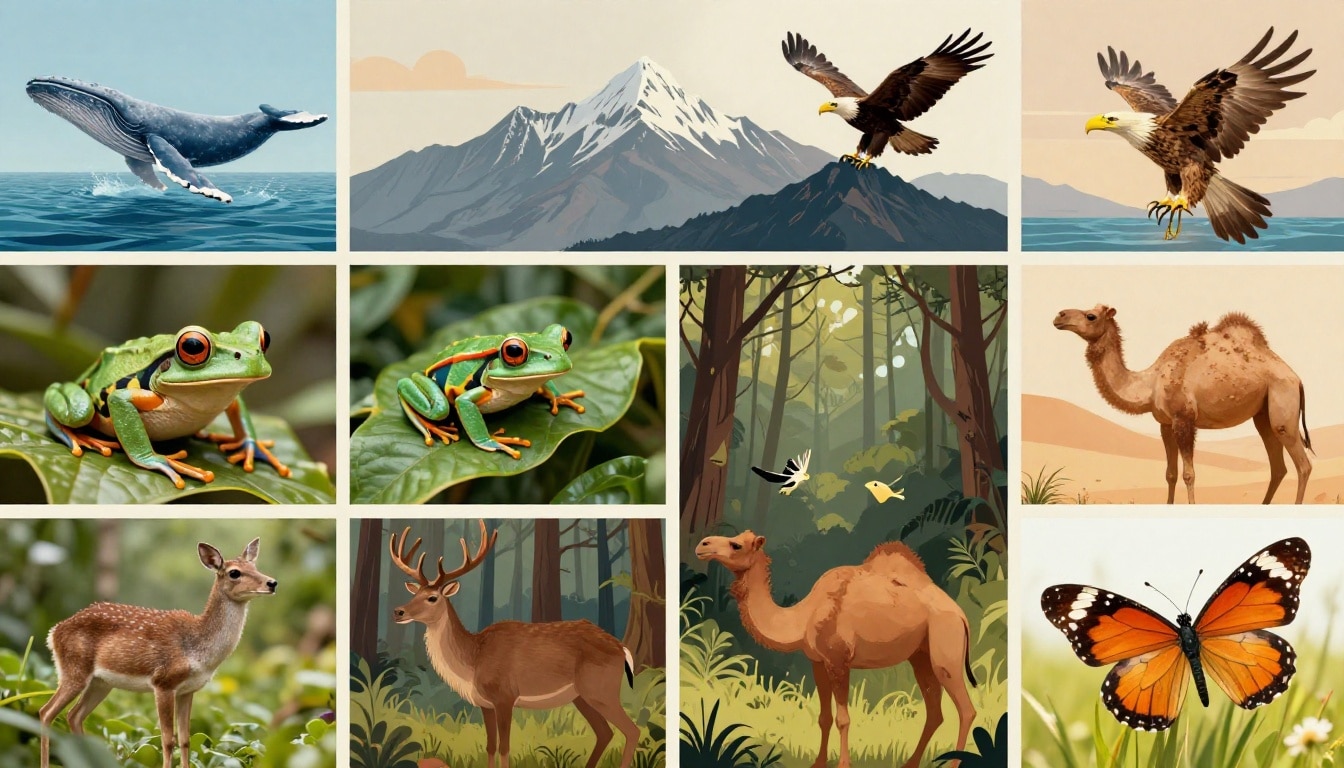
Animals, complex multicellular organisms in the kingdom Animalia, are everywhere, even when you don’t notice them. Some sing outside your window. Others work quietly under soil, in rivers, or far out at sea. Once you start paying attention, the world feels less like a backdrop and more like a busy neighborhood teeming with species.
The quickest way to make sense of animals is through animal classification, sorting them by body plan, home, and survival tricks. That sounds formal, but it’s really just three simple questions: What is it built like, where does it live, and how does it cope?
By the end, you’ll have a clear way to talk about types of animals, from tiny insects to whales, without memorizing a mountain of terms.
Start with the biggest split: vertebrates vs invertebrates
If animal classification were a closet, this is the first shelf. Many systems get detailed fast, but the backbone question stays helpful. Animals either have an internal backbone (vertebrates) or they don’t (invertebrates). Oxford’s museum-friendly explanation of how we divide the animal kingdom shows how scientists use taxonomy to build categories from shared traits like phylum, step by step.
Vertebrates include five major groups most students learn early: fish (cold-blooded), amphibians (cold-blooded), reptiles (cold-blooded), birds (warm-blooded), and mammals (warm-blooded). Each group comes with a “basic design,” then nature adds endless variations. Think of it like five main car styles, then millions of custom builds.

Invertebrates are the bigger crowd. They include insects, spiders, worms, jellyfish, corals, and many ocean animals. In fact, many educators estimate that most animal species are invertebrates. The Florida Museum’s butterfly group explains the core idea in plain language in invertebrates vs vertebrates, including why this split between vertebrates and invertebrates matters in ecosystems.

If you remember one thing, remember this: a backbone tells you a lot about how an animal moves, grows, and protects itself.
Once you can place an animal on the “backbone or no backbone” shelf, the rest gets less intimidating.
Think in habitats: an animal’s address shapes its life
After body plan, location is the next big clue. Habitats are more than scenery. They decide what’s easy, what’s hard, and what “normal” looks like for daily life for different species. A desert makes water feel like money. A coral reef makes hiding spots feel like gold.
A simple starting map is three habitat types: land (terrestrial), freshwater, and marine (saltwater). If you want examples that match each habitat, Active Wild has a student-friendly guide to terrestrial, freshwater, and marine habitats with pictures and clear definitions.
Here’s a quick way to compare what habitats demand:
| Habitat type | Main challenge | Typical animal solutions |
|---|---|---|
| Terrestrial (land) | Dry air, gravity | Water-saving skin in reptiles, sturdy limbs and warm-blooded regulation in mammals, feathers for insulation in birds, burrows |
| Freshwater (rivers, lakes) | Changing flow, low salt | Streamlined bodies with gills and scales in fish, special adaptations in amphibians like frogs, spawning timing |
| Marine (oceans) | Salt balance, pressure | Salt-handling organs, buoyancy control, schooling in fish species with scales |
The takeaway is simple: habitat pressures shape traits for each species. That’s why amphibians like frogs often stay near water, why fish rely on gills and scales instead of legs, and why birds use feathers to build nests off the ground. Habitats also influence diet based on available food, turning species into carnivores that hunt prey, herbivores that graze on plants, or omnivores that eat both.
It also explains why animals in your home are still “habitat animals.” A dog, as a mammal, may live indoors, yet it still needs movement, scent time, and rest. Domestic animals adjust, but their bodies still reflect their wild history.

Photo by 土豆 地雷
In other words, when you study habitats, you’re also studying needs. That’s a useful lens for everything from pet care to wildlife protection.
Notice adaptations: the “tools” animals carry, and why conservation matters
Adaptations are built-in tools and habits that help animals in the animal kingdom survive. Some are obvious, like wings on birds or thick fur on mammals. Others are subtle, like how a fox times its hunt, or how a snake saves energy by staying still with its scales.
A helpful way to think about adaptations is to group them by job: staying warm or cool, finding food or a mate to reproduce, avoiding predators, and raising young. The same job can have wildly different solutions. A polar bear, a mammal, solves cold with thick fur and fat. A camel, another mammal, solves heat and thirst with water-saving features. A chameleon buys time with color change and careful movement. Physical tools like feathers, scales, or gills show up across the animal kingdom too.

Adaptations can feel like superpowers, but they come with limits. When habitats change too fast, the “tools” don’t always keep up. That’s where conservation becomes more than a poster slogan, especially for endangered species. NASA’s classroom-ready book, Understanding Earth: Biodiversity & Ecological Conservation, explains how scientists track environmental changes on a large scale, including with satellite data to monitor endangered species.
If you want a calm, practical routine for learning (and helping) without getting overwhelmed, try this:
- Pick one local species: Choose something you can see often (a squirrel, pigeon, ant trail, pond arthropod like an insect or crustacean, or mollusk). Familiarity builds faster than trivia.
- Write down “backbone or not”: That single note narrows the phylum and types of animals quickly (backbone for phylum Chordata, or not for others like arthropods), and it keeps you from guessing at random.
- Match it to a habitat need: Ask what the animal must find daily (water, shelter, food) in the animal kingdom. Then look for the body feature that helps, whether it has a backbone or not.
Small habits add up. They also make science feel personal, because you’re not studying “animals” in general. You’re studying neighbors.
Conclusion
Understanding types of animals in the animal kingdom doesn’t require perfect memory. Start with backbone or no backbone to sort vertebrates like mammals, birds, reptiles, amphibians, and fish from others, then connect the animal to its habitat. After that, adaptations usually make sense because they solve real problems. Every species has a unique backbone, if applicable, or adaptation to thrive. Pick one animal you see this week, learn its group, and notice one survival tool it uses. The world will look more alive, and a little more understandable, every time you do.


