
Most people don’t quit working out because they’re “lazy.” They quit because their beginner workout plan is confusing, too hard, or takes too long. Even a workout plan for beginners often misses the mark. Then life does what life does, work runs late, dinner needs cooking, and the workout routine fades into the background.
A good workout routine feels more like brushing your teeth than training for a movie role. It’s regular, it’s realistic, and it fits into the day you actually have. A solid routine is essential for weight management and meeting long-term fitness goals.
The goal here is simple: build a safe, repeatable routine that incorporates strength training to improve strength and cardio in 20 to 45 minutes, at home or in a gym.
Start with the routine you can repeat on a bad week
A workout routine doesn’t need perfect variety. It needs a clear shape that fosters consistency. When you remove guesswork, you remove friction.
First, decide what “success” means right now. For beginners, success is showing up and leaving with a little energy left. For intermediates, success is steady progress without aches that linger for days.
Next, keep your routine a full-body workout most of the time. Full-body workout sessions give you more practice with key moves for strength training and functional fitness, and they work well on 3 days per week. They also help when you miss a day, because you didn’t skip “leg day” for two weeks straight.
Strength training and cardio don’t have to compete. You can build both in the same session by pairing a strength training block with a short cardio finisher. That’s the sweet spot for limited time.
Form matters more than fancy exercises, so begin with mobility exercises to prepare the body. If a move hurts in a sharp or pinchy way, swap it to minimize injury risk. If you’re unsure about safe technique, start with reliable demonstrations and slow reps. Verywell Fit’s breakdown of a 20-minute full-body workout structure is a solid example of how simple a session can look.
The best routine isn’t the one that looks impressive. It’s the one you’ll still be doing eight weeks from now.
Use a simple 20 to 45 minute home workout routine template (home or gym)
Think of your session like a short playlist. You want a warm-up track, a main track, then something that raises your heart rate, and a calm finish.
Here’s a clean workout routine template you can reuse for years:
| Part of session | Time | What you’re aiming for |
|---|---|---|
| Warm-up | 4 to 6 min | Joints feel warm, breathing slightly faster |
| Strength block | 15 to 25 min | Muscles work hard, form stays steady |
| Cardiovascular exercise finisher | 4 to 10 min | Improves heart health, still in control |
| Cool-down | 2 to 4 min | Breathing slows, tension drops |
The main decision is equipment. At home, bodyweight exercises are a valid starting point alongside a resistance band or one pair of dumbbells. Resistance training supports improved muscle mass and bone density. In a gym, machines can be a gift, especially when you’re learning and want stability.

Photo by Victor Freitas
Frequency is your next lever. Three days per week works for most people because recovery is easier to manage. A scheduled rest day is important for full recovery. If you want four days, keep two days lighter (more walking, easier cardio, or fewer sets).
If you like follow-alongs, use them like training wheels, not like a forever requirement. On days when decision fatigue hits, a guided session can save the workout. This 20-minute beginner dumbbell workout is a good example of a time-boxed, no-drama format.
A beginner-friendly 30-minute workout routine you can do today
This routine fits the template above. It’s full-body, joint-friendly, and easy to scale. Use dumbbells if you have them, or stick with bodyweight exercises.
Warm-up (5 minutes): mobility exercises such as marching in place, arm circles, hip hinges, easy bodyweight squats, then a few slow push-ups against a wall or counter.

Strength block (about 20 minutes): move through these strength training exercises at a steady pace, resting when you need it. They target different muscle groups. Aim for 2 rounds. If you’re newer, do 1 round and call that a win.
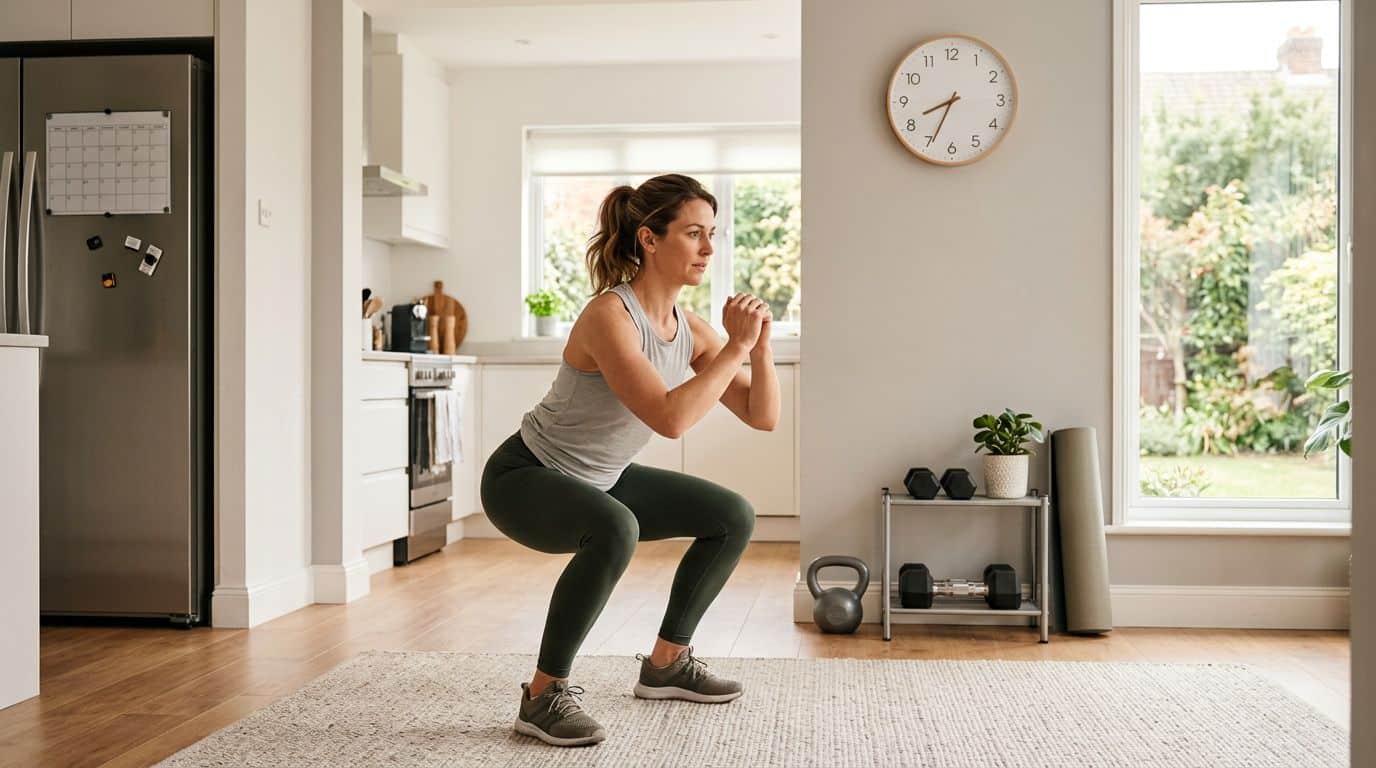
- Squats (or sit-to-stand, lunges): 8 to 12 reps. Keep your feet planted, and drive up through mid-foot.
- Push-ups (wall, incline, or floor): 6 to 10 reps. Stop a rep early if your shoulders shrug up.
- Row (dumbbells or band): 8 to 12 reps. Pull elbows toward your back pockets.
- Hip hinge (Romanian deadlift or glute bridge, lunges): 8 to 12 reps. Hips move back, spine stays long.
- Overhead press (dumbbells) or pike press (bodyweight): 6 to 10 reps. Ribs stay down, don’t lean back.
- Carry or plank: 30 to 45 seconds. Choose the option that lets you breathe calmly.
Cardio finisher (5 minutes): pick one, brisk walk, bike, step-ups, or a low-impact circuit structured as high-intensity interval training or HIIT (marching high knees, fast shadowboxing, or stair laps). Keep it challenging but not chaotic to boost heart health.
Cool-down (2 to 3 minutes): slow breathing, flexibility training with a gentle hamstring stretch, mobility exercises, and an easy chest opener.
If your form turns sloppy fast or range of motion suffers, the weight is too heavy today. Lower it and keep the rhythm.
To progress, change one thing at a time through resistance training. Add 1 to 2 reps per set, or add a little weight with dumbbells, or add a second round that hits more muscle groups. Don’t upgrade all three in the same week. If you want another simple at-home home workout routine structure, this 20-minute full-body home routine shows how to keep sessions short without making them random.
Conclusion
A balanced workout routine that includes both weightlifting and aerobic activity sticks when it’s clear, repeatable, and sized for real life. Start with three days per week, use the same session template, and focus on steady progress over perfect workouts. If you miss a day, opt for active recovery on a rest day to keep the momentum going without overtraining. Consistency is the key to reaching your fitness goals. After all, the goal isn’t a heroic week, it’s a healthier year.


