
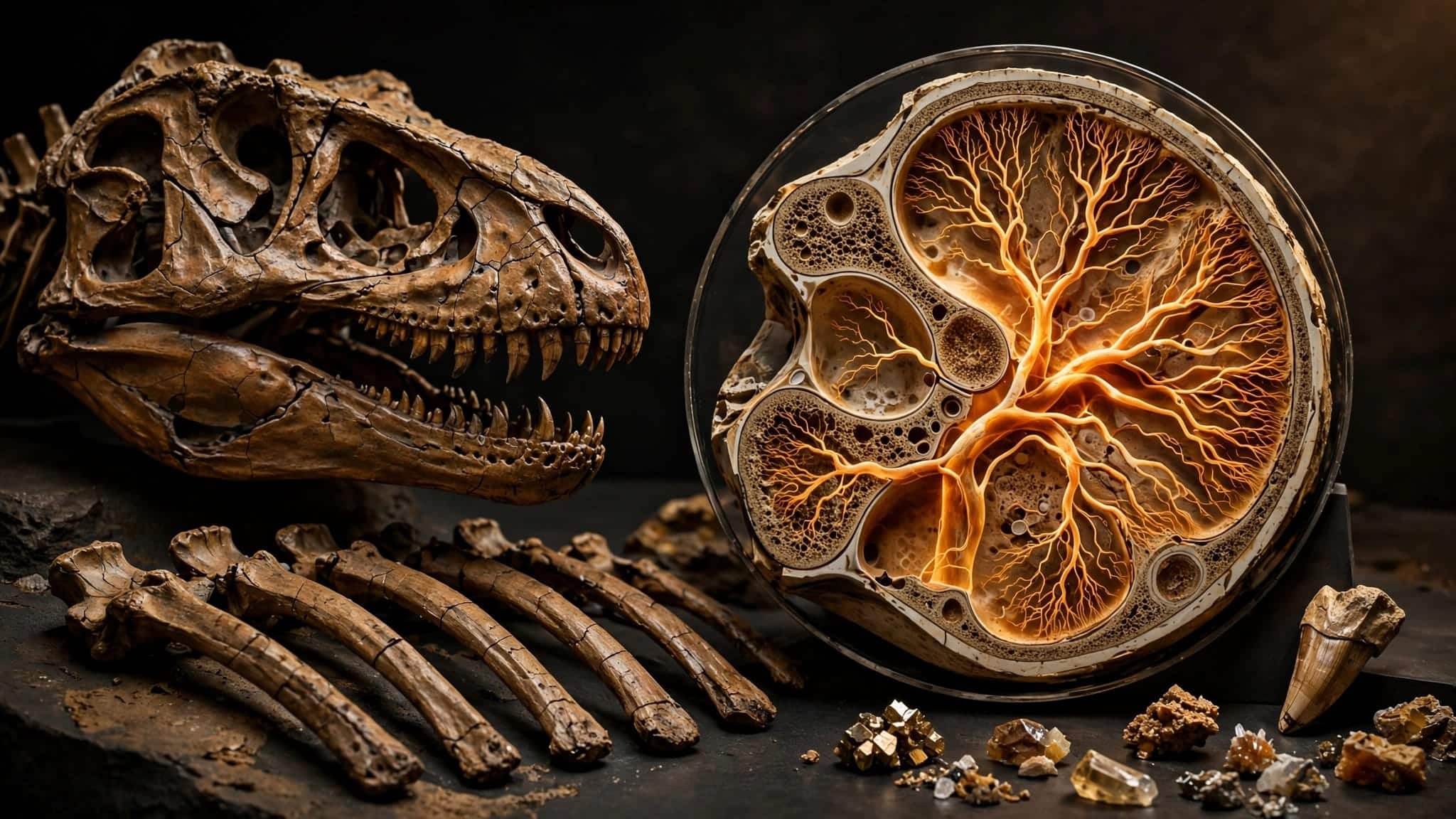
Scientists infer whether a dinosaur was warm-blooded by combining bone growth, tooth chemistry, ancient climates, and evolutionary relationships. Each clue answers a different question, and agreement between independent clues makes the conclusion stronger.
If you’ve wondered how anyone can take the temperature of an animal that died millions of years ago, no stable internal thermometer survives in a fossil. Researchers instead use preserved clues, including tooth chemistry. Understanding what those measurements mean begins with a distinction: being warm and producing your own warmth aren’t quite the same thing.
This post may contain affiliate links. If you make a purchase through these links, I may earn a small commission at no extra cost to you.
What Makes a Dinosaur Warm-Blooded?
Producing heat and keeping a steady temperature
Warm-blooded creatures, including humans and birds, generate substantial heat through metabolism, the chemical processes that keep them alive. They generally regulate body temperature within a fairly stable range despite changing surroundings. Scientists call this internal heat production endothermy.
Cold-blooded animals, such as snakes and lizards, depend more heavily on environmental heat. They regulate their temperature by basking, seeking shade, or changing their activity. The technical term is ectothermy. A sunbathing lizard can become quite warm, so “cold-blooded” doesn’t mean its blood is always cold.
Why a large animal can stay warm differently
Body size complicates the comparison. Large animals have less surface area relative to their volume, so they lose heat more slowly.
A huge sauropod such as Brontosaurus could therefore retain warmth through gigantothermy, the stabilizing effect of a massive body. Its temperature might remain high without the metabolic intensity of a bird.
That gives scientists two separate questions: How warm was the dinosaur, and how did it maintain that warmth? A temperature estimate alone can’t fully answer both.
How Bones Record a Dinosaur’s Growth
Looking inside the bone
A fossilized bone preserves more than its outer shape. Researchers can cut thin sections and examine patterns left by blood vessels and growing tissue.
Rapidly deposited bone with a substantial blood supply indicates fast growth. Growth marks can reveal interruptions, rather like rings in a tree, although interpreting them requires care.
By comparing these structures with those of living animals, scientists reconstruct how quickly a dinosaur grew. Fast growth generally requires considerable energy, which makes it useful evidence when investigating metabolism. It still doesn’t provide a direct measurement of heat production.
Why growth suggested an intermediate metabolism
In 2014, John Grady and colleagues compared growth rates and body sizes across living and extinct animals. Their analysis placed dinosaurs between typical modern reptiles and mammals.
The proposed category was mesothermy: generating internal heat without regulating temperature as tightly as many birds and mammals. The 2014 growth-rate findings helped popularize the idea that dinosaurs occupied a middle ground.
That interpretation remains debated. Growth also depends on food, age, and seasonal conditions. Converting growth into metabolic rate requires assumptions, so bone tissue works best alongside other evidence.
What Tooth Chemistry Reveals About Body Temperature

Reading a chemical thermometer
Tooth enamel contains small amounts of carbonate, which includes carbon and oxygen. Some atoms are heavier versions, called isotopes.
The tendency of particular heavy isotopes to bond together changes with temperature. Scientists measure those patterns using clumped-isotope thermometry to estimate the temperature at which enamel formed.
These isotopes aren’t functioning as radioactive clocks. They’re preserving a temperature-dependent chemical arrangement. Researchers must also assess whether burial or later heating altered that arrangement, because a precise measurement is useful only if the original signal survived.
What Tyrannosaurus rex teeth revealed
A September 2026 study in Science Advances analyzed three T. rex teeth from the Hell Creek Formation. The researchers reported an average temperature of 36.3°C, about 97.3°F, with a standard error of 2.5°C.
That places the sampled animals close to normal human body temperature. Crocodilian teeth from the same formation produced a lower average, about 30.9°C.
The T. rex tooth-enamel study also compared the results with reconstructed environmental temperatures. Together, those comparisons support an internally maintained, elevated temperature.
Three teeth, however, can’t establish the physiology of every T. rex, much less every dinosaur.
What Colder Habitats Tell Us About Warm-Blooded Dinosaurs

Reconstructing where dinosaurs could live
A 2024 Current Biology study combined over 1,000 fossils with climate models and dinosaur family trees. It suggested warm-blooded traits appeared in some lineages around 180 million years ago, during the Early Jurassic.
Over evolutionary time, theropod and ornithischian lineages migrated to chillier areas as their ranges expanded. This describes lineage expansion, not seasonal migration by individual dinosaurs. These groups later included T. rex and Velociraptor, and Triceratops and its relatives, respectively. Those familiar species weren’t themselves around during the Early Jurassic.
Sauropodomorphs, the group containing Brontosaurus, remained more closely associated with warmer climates. The study’s geographic findings suggest different groups followed different physiological paths.
Why the location needs context
Ancient geography can’t be read directly from a modern map. Researchers reconstruct where continents sat and what local climates were like when each animal lived.
That also requires reliable ages. Understanding how fossils are dated explains why nearby rocks and geological relationships matter when placing a specimen within a climate reconstruction.
Alfio Alessandro Chiarenza of University College London argues that Arctic or very cold environments require some way to stay warm. Cold conditions can favor adaptations that help keep body temperature constant, but that clue doesn’t identify the mechanism. Seasonal movement, body size, insulation, and behavior also deserve consideration.
Why Estimates Differ by 70 Million Years
The 180-million-year estimate isn’t a settled date for the invention of warm-bloodedness.
Jasmina Wiemann, associated with Chicago’s Field Museum, has argued for a much earlier origin, around 250 million years ago. Because that predates the first recognized dinosaurs, this interpretation places relevant traits in their ancestral lineage.
The reporting on the competing estimates also describes her objection to treating geographic distribution alone as sufficient evidence. Body temperature and diet help build a fuller account.
Wiemann’s metabolic analysis examines fossil molecular traces associated with oxygen use and metabolic activity. The geographic approach instead asks when dinosaur groups expanded into climates where internal heating would have been useful.
Those methods needn’t identify exactly the same event. A lineage could possess substantial internal heat production before expanding into colder habitats. Its descendants might also increase, reduce, or otherwise modify that capacity.
Diet adds another constraint because sustained heat production requires fuel. Teeth and feeding adaptations help reconstruct what animals ate, although diet alone doesn’t reveal metabolic rate. A meat-eating dinosaur wasn’t automatically warm-blooded, and a plant-eater wasn’t automatically cold-blooded.
Why Different Dinosaur Groups Give Different Answers
Theropods provide strong evidence for substantial internal heat production. This group includes T. rex, velociraptors, and birds. Birds are living dinosaurs, and their warm-blooded physiology gives researchers an important comparison. It doesn’t mean every extinct theropod operated exactly like a sparrow.
Ornithischians present a less tidy picture. The 2024 geographic analysis associated their expansion into colder regions with endothermy. Yet Wiemann’s team’s chemical investigation of dinosaur metabolism inferred lower metabolic rates in some members of this group, including Stegosaurus and Triceratops. These findings leave room for physiological changes within the lineage and differences between methods.
Sauropods add another complication. Their immense size could stabilize temperature through gigantothermy, but that doesn’t establish that they had sluggish metabolisms. Some chemical evidence points toward high metabolic activity in sauropods as well.
The practical lesson is to compare particular animals and measurements rather than assign one label to the entire dinosaur family. Dinosaurs existed for roughly 165 million years before the extinction of their non-bird members. That’s plenty of time for different solutions to the heating problem.
Those differences affect estimates of food requirements, growth, endurance, and the environments each animal could occupy.
Key Takeaways From the Fossil Evidence
The strongest conclusions connect a measurement to the question it can answer. Bone tissue informs growth estimates. Enamel chemistry estimates temperature during tooth formation. Geographic distribution reveals climatic limits.
Confidence rises when these independent observations agree. When they conflict, researchers must examine preservation, sampling, and assumptions rather than simply favoring the most impressive-looking number.
A warm body temperature is evidence about an animal’s condition. Establishing warm-bloodedness also requires evidence about how that temperature was maintained.
That distinction explains why dinosaur metabolism remains an active research question despite increasingly sophisticated measurements.
Frequently Asked Questions
Were all dinosaurs cold-blooded?
No. Birds are warm-blooded dinosaurs alive today, and several kinds of fossil evidence support substantial internal heat production in extinct dinosaurs.
The remaining disagreement concerns how widespread that capacity was, how strongly different animals regulated temperature, and when those traits appeared. Some dinosaurs may have occupied an intermediate position, while others relied more heavily on environmental heat or the temperature-stabilizing effects of large size.
Can feathers prove that a dinosaur was warm-blooded?
Feathers can strengthen the case because insulation slows heat loss. Insulation is particularly useful when an animal generates heat internally, rather like a coat helps you retain your own warmth.
However, feathers also had other functions, including display and flight. Their presence doesn’t measure metabolic rate. Researchers therefore consider feather evidence alongside growth patterns, body size, chemistry, and the animal’s evolutionary relationships.
The Answer Comes From Clues That Agree
You can infer whether a dinosaur was warm-blooded by comparing independent clues. A tooth, bone, habitat, and family tree each help researchers interpret the others.
Fossils don’t preserve a stable internal thermometer, but they do preserve evidence researchers can compare. The strongest answer is specific to the animal and the evidence, since each fossil records only part of its heating system.


