
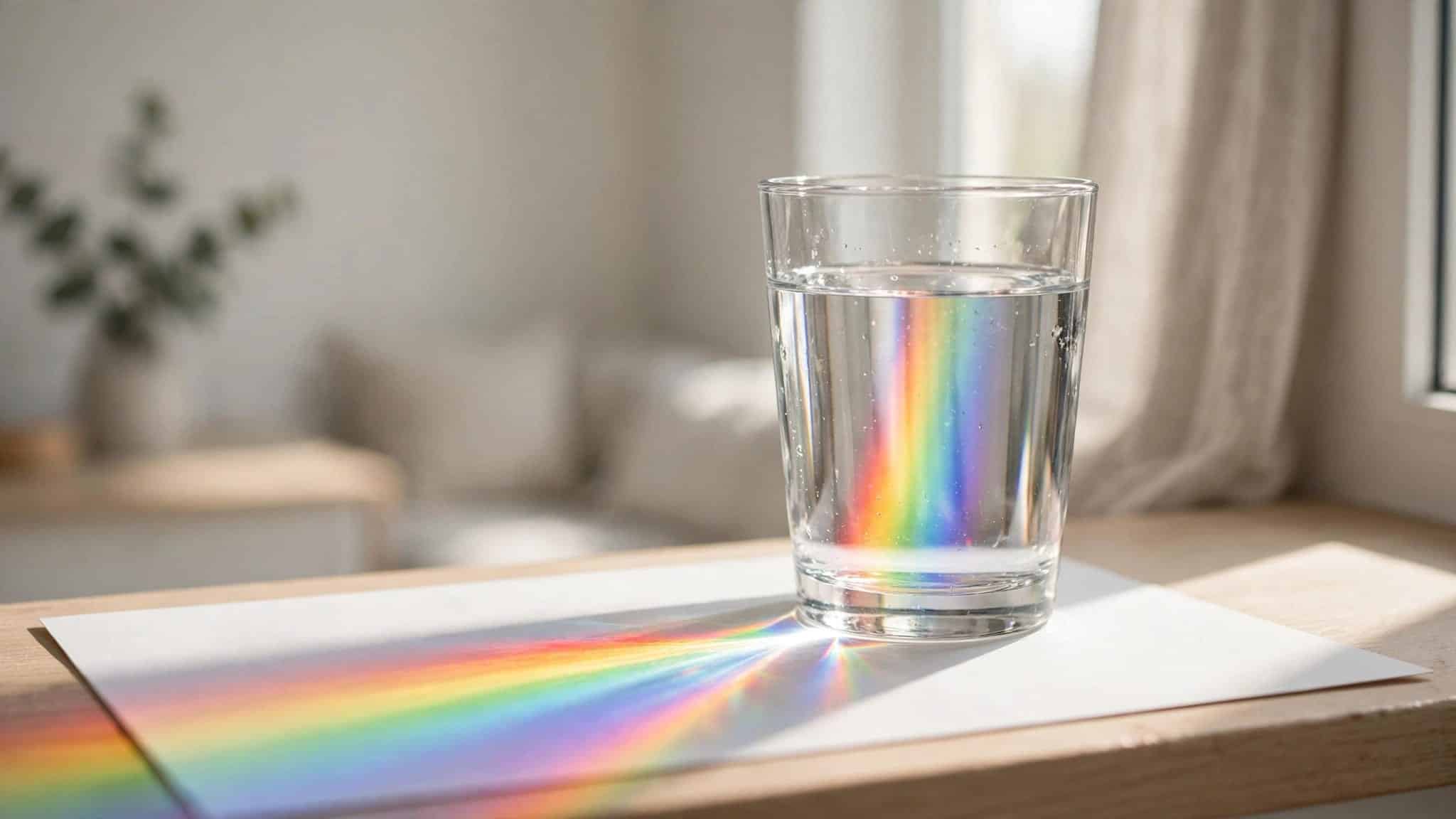
You can make an indoor rainbow with a glass of water, a white beam, and a sheet of paper, without waiting for rain. The colors are already present in the beam; your setup separates them so you can see them.
A sunny window and a glass are enough to begin. If direct sun isn’t available, a reflective glass surface and flashlight offer another approach, with a little patience over where the beam lands.
This post may contain affiliate links. If you make a purchase through these links, I may earn a small commission at no extra cost to you.
Two Ways to Make an Indoor Rainbow
Choose the glass method when the sun reaches your window. The mirror method works with a flashlight in a darkened room, so you don’t have to plan around the weather.

Use a Glass of Water in Sunlight
You’ll need a clear drinking glass, white paper, and direct sun. Fill the glass with clear liquid and set it on the paper beside a sunny window. Let the sunbeam pass through, then look for colors on the paper.
If the spectrum doesn’t appear immediately, gently lift or tilt the glass within the beam. Move slowly so you can notice a small colored patch when it appears.
The Weather Wiz Kids rainbow experiment uses these same everyday materials. A bright room alone isn’t enough; the glass needs direct sun.
Use a Mirror, Water, and a Flashlight
For this version, gather a bowl or bucket filled with clear liquid, a small mirror, a flashlight, and white paper. Set the mirror at an angle against the container’s edge, with part of it submerged.
Aim the flashlight at its submerged section. Keep electrical equipment dry, and never shine the flashlight into anyone’s eyes. Hold the paper where the beam lands, then darken the room while leaving the flashlight on. The darker surroundings make the colors easier to distinguish.
Optics4Kids’ indoor rainbow activity describes this approach. The angled surface redirects the beam, as our explanation of how mirrors reflect light describes. The liquid gives the colors room to separate.
Why Water Makes the Colors Visible
Refraction Changes the Light’s Direction
A white beam contains a range of colors. As it crosses from air into water at an angle, it refracts. Refraction changes the beam’s direction, creating bent light, and explains why a straw looks bent where it enters the liquid.
Different wavelengths bend by different amounts. Their separation is called dispersion, which spreads the colors into a visible spectrum.
Think of the liquid as a giant rain drop and the beam as a sunbeam. The shapes differ, but the comparison helps explain the basic process.
The familiar mnemonic Roy G Biv names red, orange, yellow, green, blue, indigo, and violet. These are convenient names within a continuous spectrum, rather than seven sharply divided compartments.
Outdoor Rainbows Also Depend on Your Position
A natural rainbow is a meteorological phenomenon involving a beam, droplets, and the right viewing geometry. The beam bends as it enters a droplet, reflects inside, and bends again as it leaves.
As NOAA’s explanation of rainbows describes, a rainbow is an optical phenomenon rather than an object sitting at a particular location. Its appearance depends on the relationship between the source, droplets, and viewer.
Your experiment usually produces a colored patch or strip on paper. An outdoor bow’s arc comes from beams reaching your eyes through many droplets at suitable angles.
The same processes explain how moonbows form, although their beam first reflects off the Moon.
An Indoor Rainbow Made from Thread
Some indoor rainbows come from an artist’s design rather than an experiment. Gabriel Dawe’s Plexus no. 35 was a textile installation in the Toledo Museum of Art’s Great Gallery. At the art museum, different shades of thread created the impression of a rainbow descending into the room.
From a distance, the colors could look like a trick of the eye, glowing as if they were painted in the air.
The distinction is useful: Dawe arranged colored thread to create a visual illusion. Your water experiment separates colors in sunlight. Both invite a closer look at something your eyes initially make seem simple.
Key Takeaways
The practical ingredients are the liquid, a suitable source of illumination, and a white surface where the colors become visible. A piece of reflective glass is useful for the flashlight version, but unnecessary for the sunny-window method.
Expect a small spectrum rather than a room-sized arch. A modest patch of color is still a successful result.
Frequently Asked Questions
Can a Rainbow Appear Without Rain?
Yes. Outdoor rainbows can form in waterfall spray or mist when sunlight and your viewing position line up. Your indoor experiment uses contained liquid instead of airborne droplets, so a rain shower has no part in the setup.
What Other Objects Can Produce Rainbow Colors?
A glass prism can separate a white beam through refraction and dispersion. CDs and DVDs also show rainbow colors, but their closely spaced tracks separate light through diffraction. Similar colors don’t always mean the same physical process is responsible.
Bringing the Rainbow Within Reach
A simple experiment begins by giving light a suitable path through water and somewhere to land. The most useful adjustment is often a gentle change in the glass’s position.
Once the colors appear, the ordinary-looking beam is easier to appreciate. Those colors were present before you arranged the experiment; now you can see them separately.


