
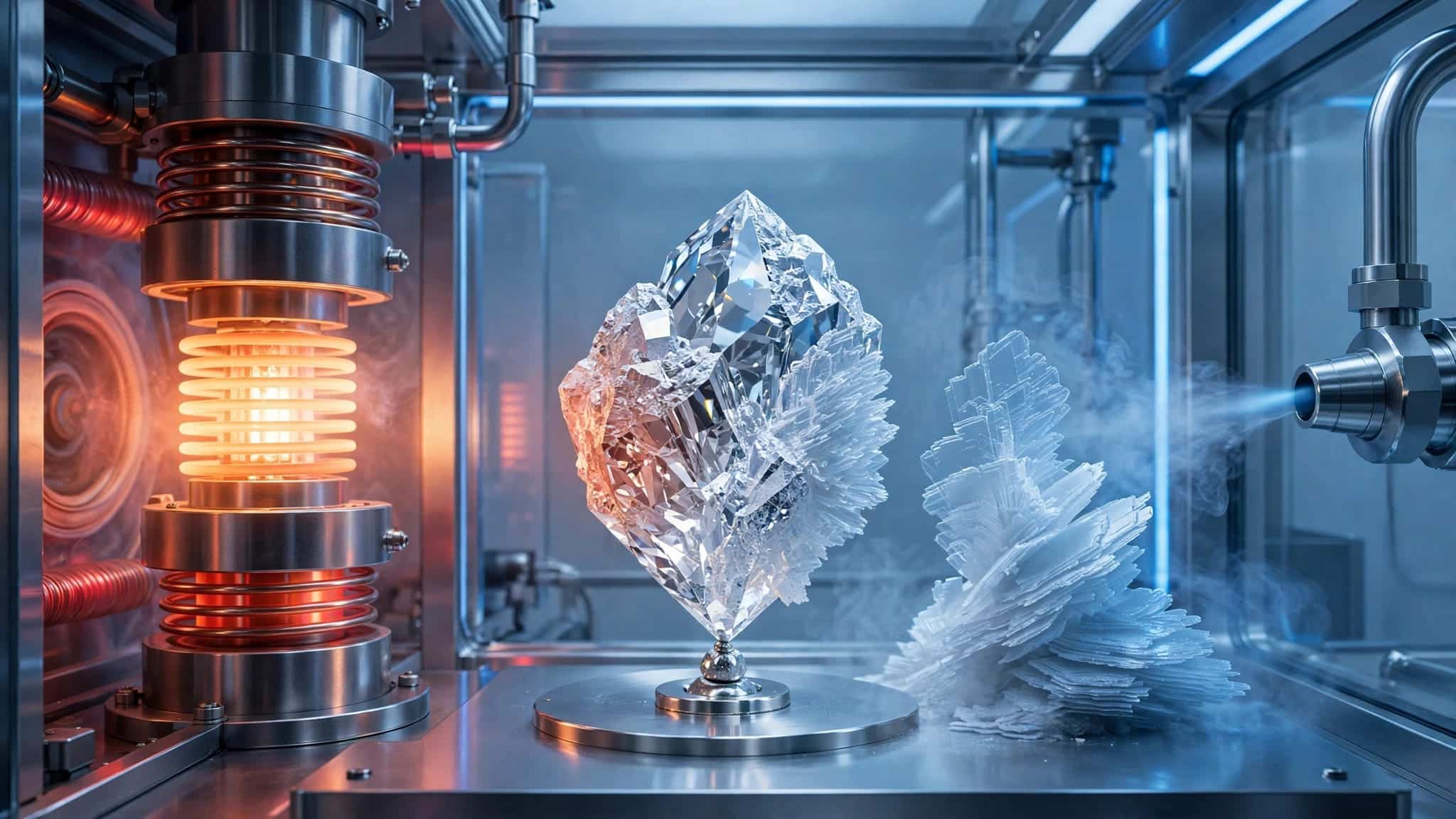
A laboratory can grow a real diamond because carbon follows the same rules of chemistry wherever it happens to be. Manufacturers produce lab-grown diamonds using either intense heat and pressure or carbon-rich gas that builds a crystal layer by layer.
Both methods begin with a tiny diamond seed, but they give carbon very different routes to the same destination. The fascinating part is how carefully those routes must be controlled.
This post may contain affiliate links. If you make a purchase through these links, I may earn a small commission at no extra cost to you.
What Makes Lab-Grown Diamonds Real Diamonds?
The atoms have the same arrangement
Lab-grown diamonds and natural diamonds have the same chemical composition, crystal structure, optical properties, and hardness of 10 on the Mohs scale. A lab-grown vs natural comparison is ultimately about origin, although individual stones vary in color, clarity, and quality.
The FTC’s 2018 jewelry guidance revisions recognized that diamonds don’t have to originate underground. Sellers must still disclose laboratory origin.
As with how pearls form and are cultivated, the term “lab diamonds” describes a diamond’s origin, not an imitation.
Their origin leaves clues
You generally can’t distinguish a polished laboratory-grown diamond from a mined one by looking at it. An ordinary diamond tester won’t reliably separate them, either.
Specialized instruments examine growth patterns, fluorescence, and atomic defects. Spectroscopy studies how a stone interacts with light, revealing clues invisible to your eyes. GIA discusses these techniques in its research on laboratory-grown diamond identification.
Visually identical doesn’t mean scientifically indistinguishable.
How HPHT Grows a Diamond Under Pressure
Recreating conditions beneath Earth
HPHT stands for high pressure, high temperature. A small diamond seed sits inside a press alongside a carbon source, often graphite, and a metal solvent-catalyst.
The machine typically reaches roughly 1,300 to 1,600°C and pressures around 5 to 6 gigapascals. That’s approximately 50,000 to 60,000 times atmospheric pressure.
Under these conditions, carbon dissolves in the molten metal and crystallizes on the seed. The seed provides an existing diamond structure for incoming atoms to follow.

Keeping growth under control
The difficult part is maintaining suitable conditions throughout growth. Temperature differences guide carbon toward the seed, while careful control limits unwanted crystals and trapped metal inclusions.
This is more precise than simply squeezing graphite until something sparkles. The arrangement of carbon atoms must change into diamond’s crystal structure.
Growth takes days or weeks, depending on the process and desired stone. After cooling, the rough crystal is recovered, examined, and prepared for cutting.
How CVD Grows a Diamond Layer by Layer
Turning gas into a solid crystal
CVD means chemical vapor deposition. Instead of applying enormous pressure, manufacturers place a thin diamond seed in a low-pressure chamber.
They introduce gases, usually hydrogen with a smaller proportion of methane. Microwaves or another energy source create a plasma, an energized gas whose molecules can break apart.
Carbon-containing particles reach the heated seed and join its crystal structure. Hydrogen helps suppress unwanted forms of carbon. Temperatures commonly reach around 800 to 1,200°C, although operating conditions vary.

Building thickness, then revealing the gem
The diamond grows layer by layer across the seed. Gas composition, temperature, and growth speed affect its color and clarity.
Some CVD diamonds receive additional treatment after growth, including HPHT processing to improve color. That doesn’t make the diamond less real, but relevant treatments belong in its documentation.
A reactor produces rough lab-grown diamonds, not finished gems. Cutting and polishing give each stone its final appearance. Its sparkle depends heavily on the work at the cutting wheel.
How Did Laboratory Diamond Growth Begin?
General Electric produced proven synthetic diamonds in 1954 through Project Superpressure. These early successes were useful industrial materials, rather than the large, clear stones associated with jewelry.
GE announced gem-quality laboratory-created diamonds in 1971. The International Gem Society’s diamond history traces the research behind that transition.
Commercial acceptance took longer than the initial scientific breakthrough. GIA began issuing reports for laboratory-grown diamonds in 2007. In July 2019, following changes to FTC guidance, GIA updated its terminology to “laboratory-grown.” Consumers may also encounter the term “lab-created diamonds.”
That timeline helps explain today’s market. Growing diamond was one achievement. Growing attractive stones consistently, grading them, and producing them economically required decades of further work.
What Do Lab-Grown Diamonds Cost?
Lab-grown diamonds commonly cost 30% to 90% less than natural diamonds, depending on size and specifications. Larger stones can show particularly large differences.
Rare Carat’s inventory comparison provides these median loose-stone prices.
| Carat weight | Lab-grown median | Natural median |
|---|---|---|
| 1 carat | $555 | $2,390 |
| 2 carats | $1,580 | $12,500 |
Those figures illustrate a market comparison, not identical pricing across every shape, grade, or retailer. Prices for natural diamonds also vary with these factors.
The price-per-carat calculation reveals something useful. At those medians, the lab stone rises from $555 per carat to $790 per carat. The natural stone rises from $2,390 to $6,250 per carat. Doubling weight doesn’t simply double price.
Production has also become cheaper. The International Gem Society cites estimates of about $4,000 per stone in 2008, falling to roughly $200 to $300 in the later period it describes. Production cost isn’t retail price; cutting, grading, distribution, and seller margins remain.
Greater manufacturing capacity helps explain lower prices. A lower price doesn’t mean the carbon atoms are doing a cheaper version of being a diamond.
How to Choose a Stone Without Paying for the Wrong Things
Start with cut and visible quality
Prioritize an Excellent or Ideal cut where that grade applies. Cut controls how effectively a diamond returns light, so a larger stone with poor proportions can look disappointing.
G or H color and VS1 to SI1 clarity can offer good value. However, clarity grades don’t tell you everything about an inclusion’s location or visibility. SI1 deserves particular attention in high-resolution images.
The familiar 4Cs are cut, color, clarity, and carat weight. IGI and GCAL use these measures for laboratory-grown stones. GIA also evaluates diamond quality, but its newer lab-grown service uses Premium and Standard assessments rather than traditional individual color and clarity grades.
Match the report, stone, and purchase terms
An IGI diamond grading report identifies origin and records quality characteristics. IGI grades about 95% of Rare Carat’s lab-grown inventory in the comparison discussed here.
Start with an independent report. Enter the grading report number in the issuing laboratory’s lookup tool, then match the recorded measurements and grades to the listing. Where present, the microscopic laser inscription on the stone’s girdle should match that report number.
Next, view HD or 360-degree footage of the actual stone, rather than a representative image.
Check the seller’s return policy for a written return window, free resizing where the setting allows it, and a warranty with clear coverage. A report describes the diamond. Those purchase terms describe your options if the engagement ring doesn’t suit you.
Are Laboratory Diamonds More Sustainable or Better Investments?
Environmental claims need more than a label
Growing diamonds avoids extracting them through mining, but reactors still consume energy. Their environmental impact depends on electricity sources, production efficiency, and other manufacturing inputs.
“Lab-grown” alone doesn’t establish a low carbon footprint or responsible labor conditions. Meaningful sustainability claims need information about the producer and its operations.
Natural diamonds have their own sourcing limitations, so ethical sourcing claims still need scrutiny. The Kimberley Process addresses trade in rough conflict diamonds under a defined framework. It isn’t a blanket guarantee covering every environmental or labor issue.
Resale is different from sentimental value
Mined diamonds can lose 20% to 50% of their retail price on resale, so their resale value may be much lower than the original purchase price. Laboratory-grown stones often face weaker resale demand, particularly when newly manufactured stones keep becoming cheaper.
Neither category is a dependable investment when bought at ordinary retail prices. An insurance appraisal also isn’t an offer from someone willing to buy your ring.
You can reasonably prefer a natural diamond’s geological history or a laboratory diamond’s lower purchase price. The sensible distinction is between buying something you’ll enjoy and expecting it to fund your retirement.
Frequently Asked Questions About Growing Diamonds
Is CVD better than HPHT?
Neither method automatically produces a better finished diamond. Both can yield attractive, high-quality stones, and both can produce stones with undesirable color or inclusions.
Judge the actual diamond’s appearance, cut, documentation, and price. The growth method helps explain its history, but it doesn’t replace an assessment of the finished stone.
Can you grow a diamond at home?
Growing a gem-quality diamond requires specialized industrial equipment, controlled conditions, and substantial technical knowledge. HPHT involves extreme pressure; CVD requires vacuum equipment, high temperatures, and controlled gases.
Home crystal-growing kits produce other materials. A diamond reactor is a rather ambitious upgrade from a kitchen science experiment.
Key Takeaways: The Same Crystal, a Different Beginning
Growing a diamond means giving carbon the conditions and a seed it needs to form a diamond crystal. HPHT does this through heat and pressure; CVD builds the structure using carbon-rich gas.
Both routes produce real diamonds. When choosing one, the finished stone’s quality and documentation matter more than which machine gave it its beginning.


