
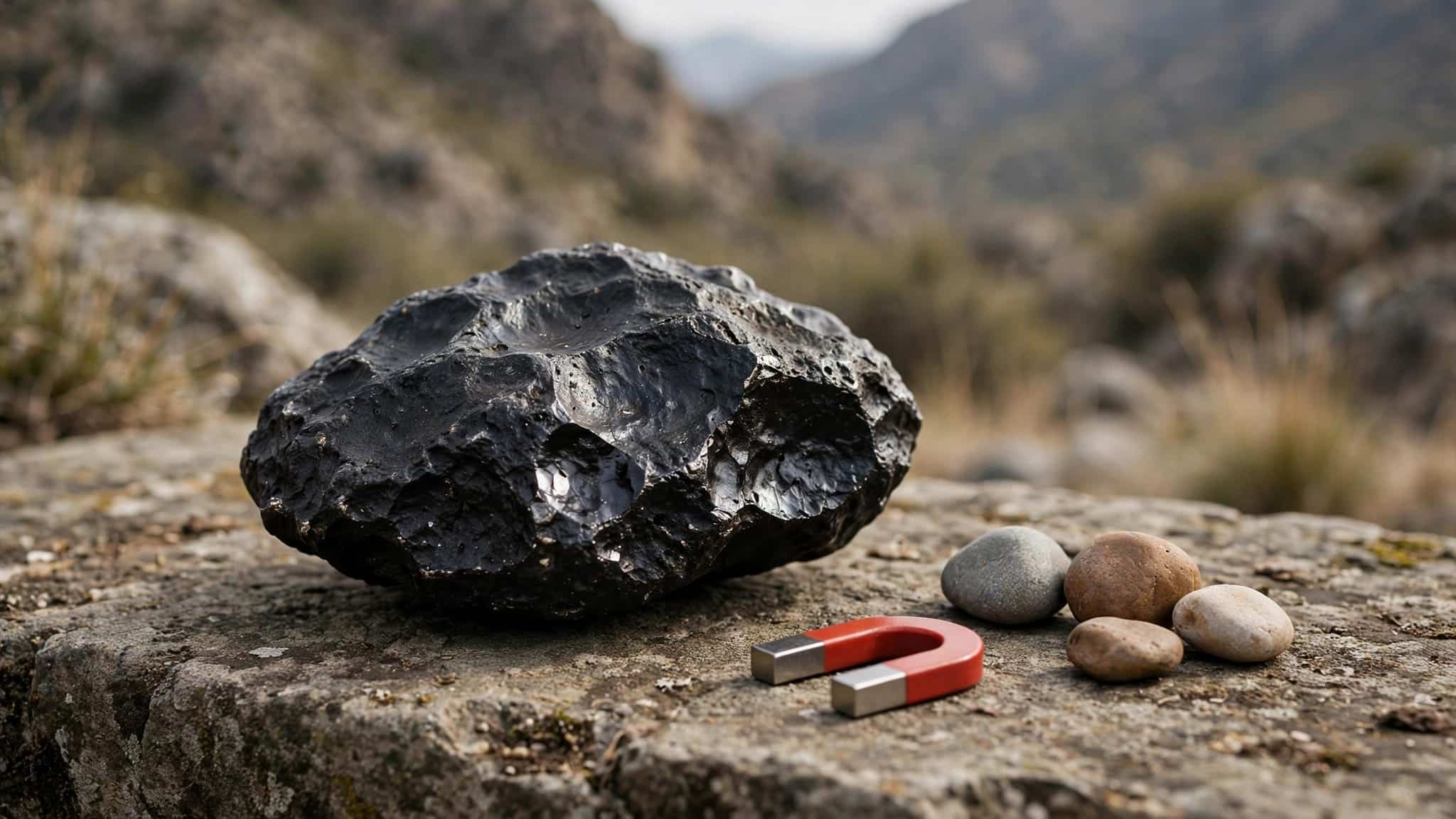
You pick up a dark, heavy stone, and suddenly an ordinary walk has the beginnings of a space story. How does one tell a meteorite from an ordinary rock when both can look equally unremarkable?
Meteorite identification depends on several clues agreeing, rather than one impressive feature. A dark surface, unusual weight, or attraction to a magnet can justify closer inspection, but each has familiar Earth-bound explanations.
Start with what you can observe without damaging the specimen, then consider whether its features make sense together.
This post may contain affiliate links. If you make a purchase through these links, I may earn a small commission at no extra cost to you.
Key Takeaways
A possible meteorite may have a thin fusion crust, an unusually dense feel, and metal that responds to a magnet. None of these features proves that it came from space, and some genuine meteorites lack an obvious magnetic response.
Common impostors include magnetite, hematite, and industrial slag. Numerous bubble holes usually point toward a terrestrial origin.
The most useful approach is to preserve the specimen, document where you found it, and seek informed assessment when several promising features appear together.
Understand What Kind of Meteorite You Might Have
Before examining your find, it’s helpful to understand that meteorites aren’t all chunks of solid metal. They fall into three broad groups: stony meteorites, iron meteorites, and stony-iron meteorites.
Stony meteorites are the most common. Many contain small amounts of iron-nickel metal mixed through rocky minerals. They can resemble ordinary stones, particularly after weathering has altered their surfaces.
Iron meteorites contain abundant iron-nickel metal. They generally feel much heavier than a similarly sized ordinary rock. Stony-iron meteorites contain substantial amounts of both metal and silicate minerals, the mineral family that makes up much of Earth’s rocky crust.
Many iron meteorites originated in bodies where metal separated from rock early in solar system history. They provide evidence that metallic cores formed elsewhere, rather than being samples of Earth’s own core.
That background explains why meteorites don’t share one universal appearance. Expecting every specimen to look like a black, sculpted lump of iron would mean overlooking many genuine examples. Your task is to recognize a convincing combination of features, while allowing for different compositions and years of weathering.
Read the Surface Before Testing Anything
The outside of a suspected meteorite records two different histories: its passage through the atmosphere and its time on Earth. Recognizing which process produced a feature prevents some understandable mistakes.

Look for a Thin Fusion Crust
During atmospheric entry, intense heating melts the outermost surface while material is stripped away. A thin layer of that melt can remain as fusion crust.
The Utah Geological Survey’s meteorite guide describes this crust as paper-thin and dark brown to fresh black. Its appearance can be glassy, although meteorite surfaces aren’t always shiny.
Look for a thin coating that differs from the rock beneath it, especially along an existing broken edge. A thick, uniformly black rock isn’t automatically displaying fusion crust.
Weathering can stain, crack, or remove the coating. Its absence on an old find is therefore less informative than its absence on a newly witnessed fall.
Distinguish Thumbprints From Bubble Holes
Some meteorites have shallow depressions called regmaglypts, which can resemble thumb impressions pressed into clay. These develop as material is removed during atmospheric entry.
Their presence is interesting, but they’re neither universal nor proof of extraterrestrial origin. Earth rocks can also become pitted through erosion.
Pay attention to the shape of the cavities. Smooth, broad depressions differ from numerous small, rounded holes that look like bubbles frozen inside the rock. Those bubble cavities are common in volcanic rocks and industrial slag.
A cratered-looking surface may feel appropriately space-themed. Unfortunately, appearance doesn’t owe us that level of cooperation.
Use Density and Magnetism With Care
Once you’ve examined the surface, consider physical properties. These checks can help narrow the possibilities, provided you understand what they can and can’t establish.

Compare Weight Without Mistaking It for Proof
A meteorite containing substantial metal often feels heavy for its size. Compare your specimen with an ordinary rock of similar dimensions, rather than comparing a large stone with a small one.
Density describes how much mass fits into a given volume. Many common surface rocks have densities around 2.7 to 3.3 grams per cubic centimeter. Iron-rich meteorites can be considerably denser.
However, magnetite and other terrestrial materials can also feel unusually heavy. Your hand provides a useful first impression, not a reliable measurement.
Avoid dunking a promising specimen in water simply to calculate its volume. Moisture can encourage corrosion in metal-bearing material, and there’s little reason to take that risk before obtaining advice.
Treat Magnetic Attraction as One Clue
Many meteorites respond to a magnet because they contain iron-nickel metal. The University of Arizona’s meteorite physical characteristics guide explains that iron-nickel meteorites attract magnets strongly, while some meteorites aren’t noticeably magnetic.
That distinction matters. Strong attraction doesn’t confirm a meteorite, and weak attraction doesn’t automatically exclude one.
There is also a preservation issue: strong magnets can alter a specimen’s natural magnetic record, which may interest researchers. Avoid pressing a powerful magnet against a promising find.
If you’ve already tested it, record what you used and how the stone responded. Repeating the test won’t make the answer more extraterrestrial.
Recognize the Ordinary Rocks That Cause Confusion
Some terrestrial materials share several meteorite-like features at once. Understanding these impostors is often more useful than searching for an exotic characteristic.
Magnetite and Hematite Can Look Persuasive
Magnetite can be dark, dense, and strongly magnetic. That gives it an impressive collection of misleading credentials. Hematite can also feel heavy and may have a dark or metallic-looking surface.
A streak test examines the powder a mineral leaves when rubbed across unglazed porcelain. According to USGS guidance on suspected meteorites, a dense specimen leaving a black or red streak probably contains magnetite or hematite, respectively.
However, streak testing removes material. Don’t scratch a promising specimen merely to complete a checklist.
Existing chips and loose grains may offer useful observations without creating fresh damage. If the specimen has convincing features, preserve it and seek advice before taking the next step.
Industrial Slag Often Looks More Alien Than Meteorites
Slag is a byproduct of metal processing. It can be dark, heavy, glassy, and magnetic, depending on its ingredients.
It also commonly contains bubbles, irregular cavities, and mixed textures. A surface that looks melted can therefore reflect a furnace rather than atmospheric entry.
Consider the surroundings. Material found near railway ballast, former industrial sites, or dumped construction waste has a plausible human-made explanation.
That location doesn’t settle the question by itself. It changes which explanation deserves attention first, much as finding a seashell on a beach differs from finding one in a kitchen drawer.
Preserve the Find and Seek Informed Assessment
If several features remain promising, resist the urge to polish the mystery away. A specimen’s surface, interior, and discovery location all provide information.
Record the Context Before Changing the Stone
Photograph the specimen in place if possible. Record the location, discovery date, surroundings, dimensions, and weight. Include a ruler in later photographs so someone assessing them can judge scale.
A remembered location such as “somewhere beyond the second hill” becomes less useful surprisingly quickly. Precise notes preserve information that photographs of the stone alone can’t recover.
Keep the specimen dry and separate from other finds. Avoid washing it, coating it with oil, applying acid, or cutting it open without advice. Those actions can obscure surface features or introduce contamination.
Also check the rules governing collection. Permission to enter land doesn’t necessarily include permission to remove geological specimens.
Understand What Closer Examination Can Establish
Contact a natural history museum, university geology department, or specialist who handles meteorites. Check their submission requirements before mailing anything. The Monnig Meteorite Gallery at Texas Christian University provides meteorite testing information as a starting point.
Photographs can reveal obvious inconsistencies, but they can’t establish everything about a stone’s composition. Further examination may involve mineral textures, metal chemistry, or a carefully prepared sample.
Nickel in metal is useful evidence, although industrial alloys can contain nickel too. Again, the surrounding evidence matters.
Specialists may also examine thin rock slices under polarized light. Understanding polarizing microscopy for crystal analysis helps explain how mineral relationships become visible beyond what a hand lens reveals.
No promised shortcut should replace a careful comparison of independent observations.
Frequently Asked Questions
Does Every Meteorite Make a Crater?
Small meteorites can reach the ground without creating a conspicuous crater. Atmospheric entry slows many small fragments substantially, so finding a stone sitting on the surface isn’t unusual.
Large impacts are a different matter. Their destructive effects make memorable photographs, but those photographs aren’t a useful model for every meteorite arrival.
Likewise, a circular patch of disturbed soil doesn’t identify the nearby stone. Excavation, erosion, and animal activity can produce depressions that have nothing to do with space.
Is Every Meteorite Valuable?
A meteorite can have scientific importance without commanding an extraordinary sale price. Commercial value varies with its classification, rarity, condition, size, and documented history.
A specimen associated with a recorded fall has different context from an undocumented stone. Researchers may care about features a casual collector would overlook, including weathering and mineral textures.
Avoid assuming that a suspected meteorite is valuable before it has been assessed. Paying for elaborate cutting or polishing at that stage can damage useful evidence without resolving its identity.
Let the Evidence Keep the Space Story Honest
The dark stone that interrupted your walk deserves curiosity, but it also deserves careful observation. Surface features, density, composition, and discovery context are strongest when they support one another.
Preserve promising finds before pursuing more invasive checks. An ordinary rock can reveal an interesting geological history, while a genuine meteorite needs evidence stronger than an unusual appearance.
The pleasure of the search is that either outcome leaves you understanding the stone better than when you picked it up.


