
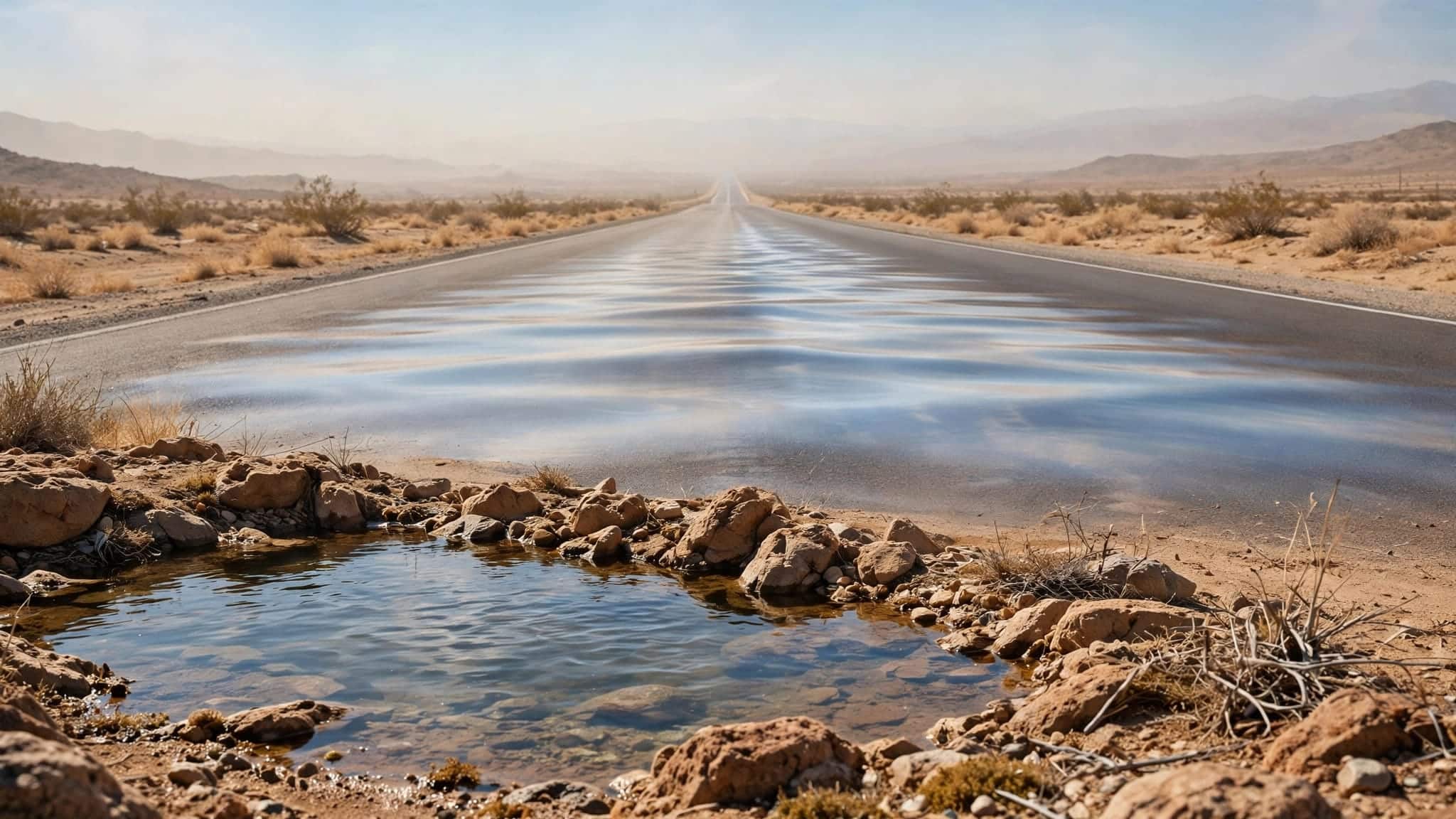
You can usually tell a mirage from an actual pool by watching whether the apparent pool stays attached to the same ground. A water-like mirage shifts or disappears as your viewing angle changes, while a real pool has a fixed shoreline.
A mirage is an optical phenomenon, and it can show the sky just as a real pool can. A convincing reflection alone doesn’t prove there’s water. Start with how the scene behaves, then look for physical features that belong to actual water.
This post may contain affiliate links. If you make a purchase through these links, I may earn a small commission at no extra cost to you.
Mirage vs Real Water: What to Look For
A shimmering surface is a clue, but it isn’t a verdict. Heat can distort your view of genuine water, too.
Watch what happens as you move
From a safe position, notice whether the apparent pool remains beside the same rocks, road markings, or other landmarks. A highway mirage often seems to retreat as you approach, leaving dry asphalt where the puddle appeared.
This happens because the image depends on your viewing angle. As your position changes, different light rays reach your eyes. The patch that looked wet may disappear while another appears farther ahead.
Changing your eye height can also alter the image. You don’t need to chase it across a road to investigate.
Look for a fixed shoreline
Real water occupies a definite depression or channel. Its edges stay connected to the surrounding ground, even when ripples change its appearance.
Binoculars may help you distinguish a shoreline, vegetation, or exposed banks. However, distant trees alone don’t prove that the apparent pool is real. Mirages can distort images of genuine objects, including vegetation.
In a desert, don’t leave a safe route or spend limited energy pursuing a distant shimmering patch. An optical clue is a poor substitute for a known water source.
Why a Hot Road Looks Wet

Hot air bends the path of light
The familiar highway puddle is an inferior mirage. “Inferior” means the displaced image appears below the object producing it.
Sunlight heats the asphalt, which warms the hot air immediately above it. This temperature gradient makes the air near the road less dense than the cooler air higher up. Light changes direction as it travels through these layers, a process called refraction.
Rather than following a straight path, light from the sky curves upward toward your eyes. Research on road-surface mirages describes this effect through the changing refractive index above heated ground.
Your brain supplies the water
Your visual system normally assumes that light arrives along straight paths. It traces those curved rays backward and places an inverted image of the sky near the ground.
That bright, smooth-looking patch resembles something familiar: sky reflected in water. The interpretation is understandable, even though no pool is present.
Turbulent air makes the image shimmer and break apart, which can resemble small ripples. The sky is doing a fairly convincing impression of a puddle, with no water involved.
The Numbers Behind a Highway Mirage
Air’s refractive index describes how light travels through it. The value is close to 1.000, and it decreases slightly as air heats up.
Near a hot surface, the difference between the air at ground level and one metre above can be about 0.00002 to 0.00005. This temperature gradient changes the air’s refractive index. Across a long, nearly horizontal light path, it can produce a visible distortion.
Consider the worked example in this explanation of mirage physics: asphalt reaches 60°C while the air one metre above is 30°C. That temperature difference corresponds to roughly 30,000°C per kilometre over that shallow layer.
The illustrative estimate gives a horizontal ray a bending rate of about 1.4 degrees per kilometre. This describes a thin region near the surface, not a temperature change extending a kilometre upward.
In representative conditions, the critical angle is about 0.4 to 0.5 degrees above the road, so rays at a smaller grazing angle curve back upward. The critical angle depends on viewing conditions and is typically under one degree.
This helps explain why an inferior mirage appears far ahead, often roughly 200 to 600 metres away. Those distances aren’t universal. Eye height, surface temperature, and the shape of the temperature profile all matter.
As you approach the apparent puddle, that shallow viewing geometry changes. There was never a wet patch waiting at its apparent location.
How a Mirage Differs From an Oasis
An oasis is a real place where groundwater supports life in an otherwise dry region. As National Geographic’s oasis explanation describes, a freshwater supply makes the land fertile.
The distinction becomes clearer when you compare what each requires.
| Feature | Water-like mirage | Oasis |
|---|---|---|
| Water supply | No water required | Springs, wells, or groundwater |
| Vegetation | May show distorted distant plants | Can support plants such as date palms |
| Position | Apparent patch shifts with viewing geometry | Occupies a fixed place |
| Duration | May change within minutes | Can persist for seasons or years |
An oasis doesn’t have to contain an open, postcard-sized pool. Groundwater may reach the surface through a spring or be accessed through a well.
Likewise, green plants don’t guarantee exposed water suitable for drinking. They indicate access to moisture, which is a different claim.
The useful distinction is physical persistence. An oasis remains connected to its terrain as you approach. A water-like mirage can vanish or distort. An oasis can change or dry out over time, but it doesn’t retreat because you walked toward it.
Superior Mirages and Fata Morgana
Mirages don’t require desert heat. Cold seas and polar regions can produce dramatic examples through a different arrangement of air temperatures.

When distant objects appear higher
A superior mirage forms during a temperature inversion: cold air lies near the surface, with warmer air above it. This arrangement can occur over cold water or ice.
Light bends downward through the atmosphere, allowing distant ships or coastlines to appear higher than their geometric positions. Sometimes objects hidden below the ordinary horizon become visible.
For an observer whose eyes are two metres above the shoreline, the geometric horizon is about five kilometres away. Under a strong inversion, the refracted horizon can extend to nearly 14 kilometres. That requires particular conditions; it isn’t the usual view from every beach.
When the atmosphere stacks images
A Fata Morgana is a complex superior mirage produced by a layered temperature structure. It can stretch objects and stack distorted upright and inverted images.
A distant coastline may resemble towers, while a ship can appear strangely tall or broken into sections. These shapes can change quickly as the air layers change.
The name comes from Morgan le Fay, the enchantress of Arthurian legend. Given what these images can do to an ordinary horizon, the association is understandable.
When Refraction Changes the Sky
Another optical phenomenon can change when the Sun becomes visible. The Novaya Zemlya effect is a polar superior mirage caused by strong atmospheric refraction. It can make the Sun appear above the horizon days before its geometric return.
A sunset green flash involves a different detail: wavelengths bend by different amounts. Blue and green light refract more than red. Under exceptional conditions, a green edge becomes briefly visible as the Sun disappears, often for about a second.
Mirage conditions can strengthen this separation, a connection examined in research on polar mirages and sunsets.
Refraction also affects radio waves. In atmospheric ducting, temperature and humidity structures can trap radio energy within layers. Signals then travel well beyond the normal radio horizon.
These effects share an important lesson: the atmosphere changes the path of incoming light and other electromagnetic waves. A clear view doesn’t always give you a geometrically straightforward one.
Key Takeaways
A mirage is a real optical image, but the apparent water doesn’t occupy a pool on the ground. Its appearance depends on the atmosphere and your position.
For a practical distinction, watch its relationship to fixed landmarks. Stable banks and shorelines support the case for real water; a retreating, changing sky image points toward a mirage. Neither observation makes unknown water safe to drink.
Frequently Asked Questions
Is a mirage a hallucination?
No. A mirage isn’t a hallucination; it comes from real light traveling through the atmosphere, so a camera can record it. Other observers with suitable viewpoints can see it too.
Calling it an illusion refers to the mistaken interpretation, such as seeing water where there’s an inverted sky image. The light reaching your eyes is real.
Is a mirage the same as a reflection?
A water reflection redirects light at a surface. A mirage redirects light through changing air layers.
The distinction resembles the difference between how mirrors reflect light and how a lens bends it. Both can form images, but a road mirage needs no reflective pool or solid mirror.
Does the atmosphere cause every visual illusion?
No. Some illusions arise mainly through perception rather than a changed light path. The Moon illusion, for example, concerns why the Moon appears larger near the horizon.
A mirage involves measurable atmospheric refraction. Your interpretation adds the impression of water, but the atmosphere has already altered the image.
The Puddle That Depends on Your Position
The strongest clue is whether the apparent water stays put. Real water has a physical boundary; a water-like mirage depends on a changing arrangement of light, air, and viewpoint.
Once you understand that distinction, the disappearing highway puddle becomes easier to interpret. You’re seeing the sky along a curved path, and the atmosphere has made it look surprisingly close to the ground.


