
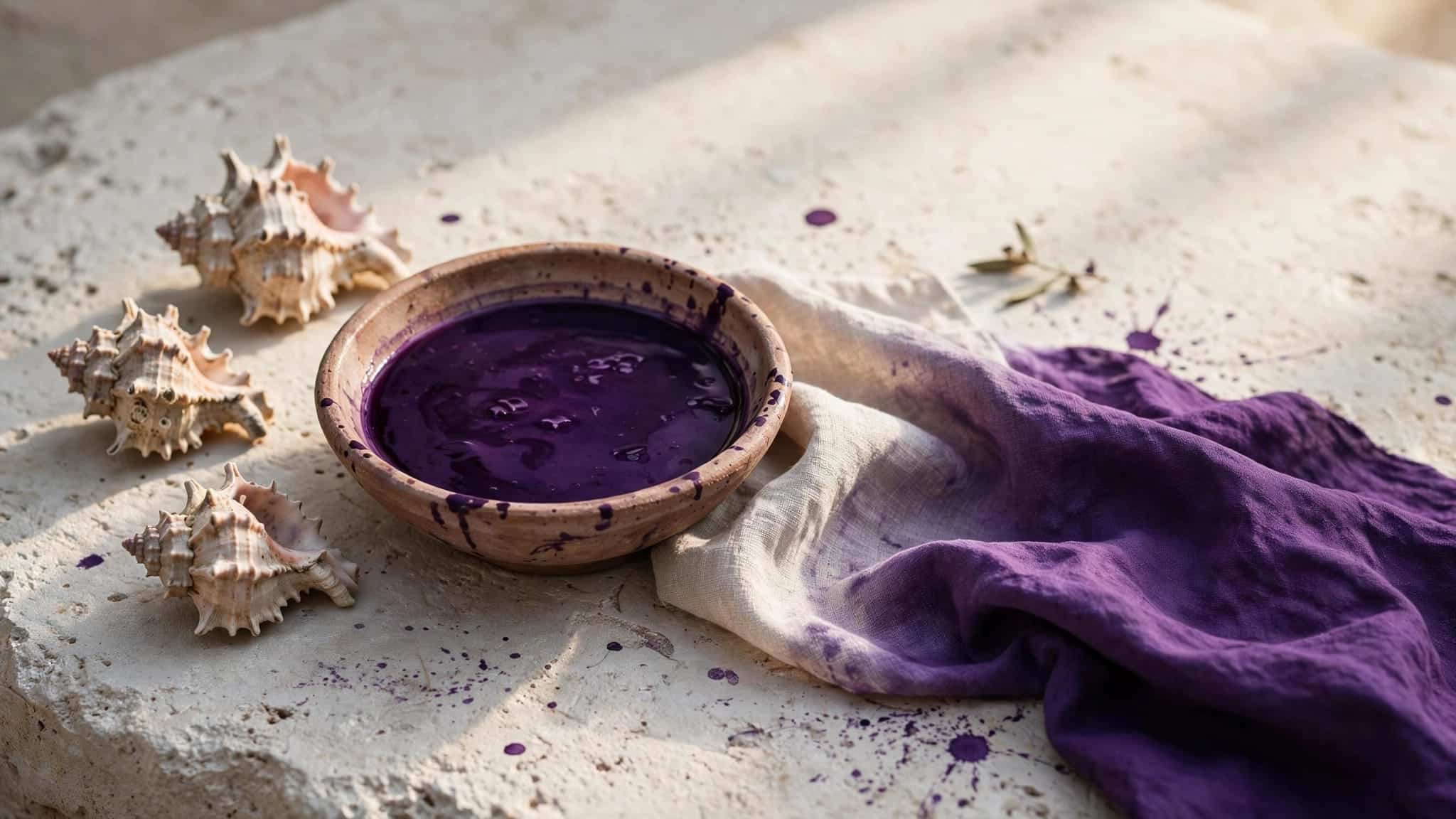
Tyrian purple dye begins with a pale secretion inside a sea snail, which dyers process into a lasting textile color. The purple develops through chemical reactions, rather than emerging ready-made like ink from a bottle.
That helps explain how an unpromising piece of shellfish became the foundation of a luxury industry. Making the color required careful extraction, a workable dye bath, and considerable patience with something that smelled far less impressive than it looked. Understanding the process starts with the snail itself.
This post may contain affiliate links. If you make a purchase through these links, I may earn a small commission at no extra cost to you.
What makes Tyrian purple dye different?
The color begins inside a gland
The useful material comes from the snail’s hypobranchial gland, which sits beneath its mantle, the tissue covering much of its body. This gland produces secretions containing the chemical starting materials for purple pigment.
The shell provides protection, but it isn’t the source of the dye. Grinding an empty shell won’t produce royal purple, however determined you are.
The distinction matters because producing the color involved working with soft tissue that yielded very little usable material. A basket of snails might look generous. The amount of dye it could provide was another matter.
Different snails produce different shades
Mediterranean species associated with purple production include Hexaplex trunculus, Bolinus brandaris, and Stramonita haemastoma. Older accounts often use different scientific names, which can make the subject seem more complicated than it needs to be.
The BBC’s account of the snails behind Tyrian purple explains that different species yield different colors.
The finished result could therefore vary. Species, mixtures, and processing conditions all influenced whether a textile leaned toward reddish purple, violet, or blue. “Tyrian purple” describes a historical dye tradition, rather than one perfectly standardized paint sample.
How dyers collected the color-making material
The first task was obtaining suitable marine snails. Ancient producers harvested them around Mediterranean coastlines, where access to shellfish supported coastal dye industries.
Next came the less glamorous work of reaching the gland. Larger shells could be broken open so the relevant tissue could be removed. Ancient descriptions also mention crushing smaller shellfish during preparation.
The Royal Society of Chemistry’s account of purple production from marine snails describes how breaking the shell and piercing the hypobranchial gland initiates pigment formation.
This was skilled, repetitive work. Producers needed to recover a small quantity of useful secretion without treating every part of the animal as equally valuable.
Shell heaps found around ancient production sites help explain the scale of the task. They are the discarded packaging of the industry, although that packaging once housed living animals.
The familiar historical methods were generally destructive to the snails. Describing the process as simply “milking” them gives a rather gentle impression of work that commonly involved breaking shells and removing tissue.
At this stage, however, the dyer still hadn’t produced a usable purple bath.
How a pale secretion becomes purple

The snail supplies chemical starting materials
Inside the gland are precursor compounds, meaning substances that can change into the final pigment. When the tissue is disrupted, enzymes and subsequent reactions begin that transformation.
The material can pass through several colors as the reactions proceed. A pale or yellowish secretion can develop greenish, blue, and purple appearances under suitable conditions.
One major component of the finished color is 6,6′-dibromoindigo. As described in a chemical study of Tyrian purple, it belongs to a group of compounds related to indigo, the familiar blue dye associated with denim.
Two bromine atoms distinguish this molecule from ordinary indigo. That small structural difference helps produce its different color.
Air and light influence the transformation
Oxygen participates in the reactions that develop the pigment. Light can also affect the chemistry and the shades produced.
Observations of extracted snail glands exposed to sunlight show visible color changes. This helps explain why a fresh secretion can look so different from the eventual dye.
It also helps to distinguish pigment color from the shimmer of a pearl or shell. Nacre’s layered structure affects how light behaves. Purple dye molecules absorb particular wavelengths of light.
Both effects can look beautiful. They get there through different physical processes.
How the purple gets into wool
Making purple pigment and dyeing a garment are separate problems. The finished pigment doesn’t readily dissolve in water, so putting it in a pot with wool won’t reliably color the fibers throughout.
Preparing a usable dye bath
A dyer needs the pigment in a form that can enter the textile. This is where vat dyeing becomes important.
Under suitable conditions, the pigment undergoes reduction, a chemical change in which it gains electrons. Its reduced form is more soluble and can move into the fibers.
Historical reconstructions include fermentation-based approaches to creating the necessary conditions. Temperature, alkalinity, and oxygen availability influence whether a vat works.
The practical challenge is maintaining a bath that makes the dye available to the cloth without prematurely converting everything back into insoluble pigment. An impressive purple surface on a vat doesn’t necessarily mean the textile underneath is being dyed successfully.
Allowing the color to return
Once the wool has absorbed the reduced dye, it is removed and exposed to air. Oxygen reverses the reduction, and the insoluble colored pigment forms within the fibers.
This is why a textile can change color after leaving a dye bath. Its appearance while submerged may be quite different from the finished purple.
Repeated dipping can build a deeper shade, depending on the process and desired result. The cloth is then washed to remove material that hasn’t become securely retained.
The essential trick is making the pigment soluble long enough to enter the fibers, then allowing it to become insoluble again.
That sequence explains how a substance reluctant to dissolve can still become a durable textile color.
Why royal purple demanded so much labor

The main difficulty was the tiny yield from each animal. The University of Chicago Library’s account of Tyrian purple’s production demands gives an estimate of up to 12,000 mollusks for one gram of dye.
That figure is an estimate, rather than a fixed conversion rule. Yields differ with the animals and methods involved. Even with that qualification, the underlying problem is clear: considerable harvesting produced very little pigment.
The cost also included collecting the snails, opening them, processing the tissue, maintaining the vats, and dyeing the textiles. Each stage required labor before anyone had a finished garment to sell.
Then there was the smell. Processing shellfish tissue, particularly through fermentation-based methods, made this an odorous trade. A purple robe could communicate refined taste while concealing a decidedly unrefined production process.
Scarcity and labor helped make the color expensive. Its association with rulers and high status added social value, while restrictions on its use reinforced that association in some periods.
The famous reputation grew around both the material and the people permitted to wear it.
What ancient dyers understood without modern chemistry
The name “Tyrian” comes from Tyre, the Phoenician city in what is now Lebanon. Purple production became closely associated with Phoenician coastal trade, although shellfish dyeing also existed elsewhere in the Mediterranean.
Ancient practitioners didn’t need to know the molecular structure of dibromoindigo to recognize a successful batch. They could observe changes in color, judge the behavior of a vat, and learn which conditions produced useful results.
Pliny the Elder discussed shellfish purple in his first-century Natural History. Such descriptions sit alongside archaeological evidence, including broken shells and production installations.
Together, these help reconstruct the work, although practices varied between places and periods. There wasn’t necessarily one universal recipe followed by every workshop.
That relationship between observation and skilled material processing appears in other ancient technologies. Our explanation of ancient Egyptian blue faience beads follows another route to vivid color, using mineral ingredients and heat.
Purple dyers worked with animal secretions instead. In both cases, experience allowed makers to manage transformations they couldn’t describe in modern chemical language.
Knowing what to look for could be as useful as knowing what to call it.
Common questions about sea-snail purple
Could you use an ordinary garden snail?
Garden snails don’t supply the same dye-producing compounds as the marine species associated with Tyrian purple. Choosing the right animal is part of the chemistry.
Purple-colored shells aren’t a reliable guide either. A shell’s appearance doesn’t tell you whether its inhabitant contains the necessary precursors.
The term “murex” often appears in historical discussions as a convenient name for these dye-producing sea snails. Modern scientific names are more precise, which is why older books and newer research may label the same animal differently.
Is every purple fabric made with shellfish dye?
Purple describes a color, not a single ingredient. Textiles can be made purple using other natural colorants, combinations of dyes, or synthetic dyes.
Even in historical objects, appearance alone can’t establish that shellfish purple was used. Chemical analysis can identify characteristic compounds and provide stronger evidence.
Modern chemistry can also produce dibromoindigo without extracting it from snails. A matching molecule doesn’t mean the manufacturing process followed the ancient route.
This distinction helps separate three questions: what color something is, which molecules produce that color, and how those molecules were obtained.
Key takeaways: a color built through chemistry
Making Tyrian purple dye meant extracting gland material, developing the pigment, and preparing it for a dye bath. The lasting color depended on controlled chemical changes, as well as a substantial amount of labor.
The snail supplied the starting materials. Human observation made them useful on cloth, through a process that was demanding, unpleasant, and surprisingly sophisticated.
A finished purple textile hid all of that work. Its color was the visible result of a much longer story involving shellfish, fermentation, oxygen, and people who learned to make those things cooperate.


