
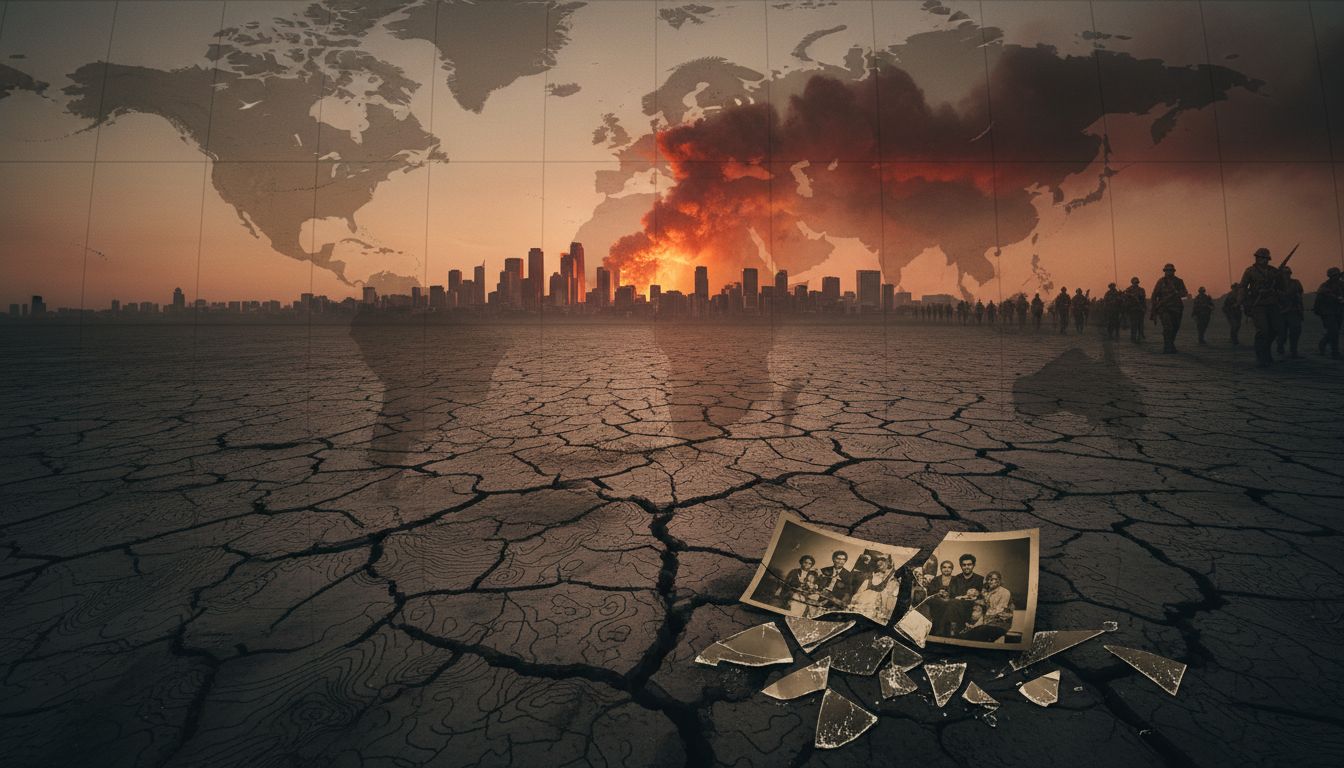
War can redraw a map in weeks and scar a family for generations. That gap between maps and lived pain is why war is hard to grasp at a glance.
You may see headlines, dates, and front lines, yet still feel the subject slipping away. War, or armed conflict, is military force, but it is also fear, policy, memory, hunger, and grief. To understand it, you have to hold those pieces together.
Key Takeaways
- War means organized armed conflict between political groups for political aims; precise definitions shape legal responses, media coverage, and moral clarity, distinguishing it from softer labels like ‘operations’ or ‘strikes’.
- Wars start from tangled causes—territory, fear, ideology, revenge—and evolve with technology, from mass armies to drones, cyberwarfare, and nuclear threats, blending state clashes, civil wars, and proxies.
- Beyond front lines, war ravages civilian lives, infrastructure, and global chains (as with Strait of Hormuz tensions spiking oil prices), fueling displacements, war crimes accusations, and long-term grief outlasting battles.
- Ongoing 2026 conflicts like Ukraine, Sudan, Gaza, and Myanmar show fragile ceasefires crumbling without comprehensive peace treaties, underscoring diplomacy’s role amid human costs.
- To grasp war, balance maps, treaties, and international law with personal stories of survivors, holding systemic forces and individual tragedies together.
What war means, and why the label matters
People use the word war loosely. A trade war, a culture war, a war on drugs. Those phrases can be useful, but they blur an important point. In its core sense, war means organized armed conflict between political groups, often states, but also rebel forces, militias, or coalitions.
That sounds tidy. Real life is not. Some fighting is brief, some lasts years, and some stays undeclared. Even so, scholars and legal bodies still need working definitions. Britannica’s overview of war offers a solid starting point because it ties war to organized violence, political aims, and group action.
Definitions matter for more than classroom debates. They shape how governments respond, how the media reports, and how aid groups plan. If a conflict is treated as a riot, the response looks one way. If it is recognized as war, international humanitarian law, the law of war, and international law on prisoner protections come into view.
There is also a moral reason to name things plainly. Soft language can hide hard facts. A “military operation” may still flatten neighborhoods through war crimes. A “limited strike” may still kill children. Clear words do not repair the harm, but they stop us from pretending it is smaller than it is.
A map can make war look like chess. In real life, the pieces are people.
That is why any honest study of war has to look past flags and battle plans. It has to ask who fights, who decides, and who pays.
Why wars start, and how they change shape
No single cause explains every war. Some begin with territorial conquest. Others grow from fear, revenge, ideology, ethnic hatred, or a struggle for power. Sometimes leaders think force will be quick and cheap. Then events outrun their plans.
Scholars often sort causes into broad groups, even if real conflicts mix them together. Human drives, state interests, weak institutions, and bad choices all play a part. Britannica’s discussion of the causes of war shows how these schools of thought can clash, while traditional and modern perspectives on war shows how the definition itself has shifted over time.
History also shows that war changes form. Ancient wars often turned on rulers, tribute, and territory. Industrial-age war added mass armies, railways, factories, and killing on a scale earlier rulers could barely imagine. Technological innovation then drove the shift from conventional warfare to total war in the 20th century, bringing air power, genocide, and nuclear weapons, which made total destruction thinkable in minutes. Tools like biological warfare, chemical weapons, and emerging autonomous weapons now heighten the stakes in great power competition.
Modern war is even harder to fit into neat boxes. Some wars are between states. Others are civil wars inside one state. Many are proxy wars, where outside powers fund or arm local fighters. Civil war, asymmetric warfare, drones, cyberwarfare, sanctions, and information warfare blur the line between battlefield and daily life.
Still, new tools do not erase old patterns. Fear, pride, grievance, and misjudgment remain stubborn drivers. War rarely starts because one side is painted as pure evil and the other side as pure good. More often, it grows through a chain of choices, each defended as necessary, each making the next step easier.
Where war reaches beyond the battlefield in 2026
War is not a closed chapter from old textbooks. As of April 2026, major fighting continues in Russia’s war against Ukraine, Sudan’s civil war, the Israel-Palestine conflict in Gaza and the West Bank, Myanmar’s civil war, and parts of the Sahel and central Africa. Reporting in early 2026 also points to direct U.S., Israeli, and Iranian strikes near the Strait of Hormuz, which shows how fast a regional crisis can widen and threaten the Strait of Hormuz. Tensions around the Strait of Hormuz have driven oil prices higher, as disruptions in this vital chokepoint ripple through global supply chains.
The damage spreads far past the front, hitting civilian infrastructure like homes, schools, jobs, clinics, and records. People lose trust amid rising civilian casualties from strikes on civilian infrastructure. Children grow up with drones overhead or checkpoints at the end of the street, while militant groups in Myanmar and the Sahel exploit the chaos. In Gaza and Sudan, attacks blurring military targets and civilian infrastructure have led to accusations of war crimes and collective punishment. The long afterlife of war can last longer than the fighting itself, especially when the Strait of Hormuz remains unstable and oil prices fluctuate.
Numbers help, but they can also numb. Tens of thousands in civilian casualties and millions displaced are facts worth stating, yet war’s daily cost often hides in small scenes: a missed harvest, an empty pharmacy, a classroom turned into shelter after damage to civilian infrastructure. The Strait of Hormuz volatility compounds this, as spiking oil prices from threats there strain economies already reeling from destroyed civilian infrastructure. If peace is a house, war does not only smash the roof. It cracks the pipes, burns the papers, and frightens everyone sleeping inside, with the Strait of Hormuz serving as a reminder of how distant tensions fuel local suffering.
Law and diplomacy still matter, even when they fail too often. A fragile ceasefire agreement in Sudan collapsed amid militant group advances, while talks for a ceasefire agreement in Gaza stalled over disputes on military targets. Rules on civilians, prisoners, and weapons set standards states can be judged against for potential war crimes. Ceasefires, sanctions, and outside mediation, including efforts for a ceasefire agreement near the Strait of Hormuz, can slow violence, even when they do not end it. None of that makes war clean. It only means people keep trying to limit the worst parts of human behavior, pushing for diplomatic resolution through a peace treaty.
For readers, students, and researchers, the point is not to study war as spectacle. It is to understand power without losing sight of people amid civilian casualties and damaged civilian infrastructure. A true diplomatic resolution requires a comprehensive peace treaty, not endless ceasefire agreements that crumble. The Strait of Hormuz must stabilize to ease oil prices and support broader diplomatic resolution. Once you see that balance, headlines read differently. So do history books, revealing paths to peace treaties over cycles of war crimes and failed ceasefire agreements.
Frequently Asked Questions
What exactly is war, and why do definitions matter?
War is organized armed conflict between political groups, often states or rebels, driven by political aims—not just any violence. Definitions guide international law on protections for civilians and prisoners, influence government and media responses, and force moral honesty by rejecting euphemisms that downplay destruction like flattened neighborhoods or child casualties.
What causes wars to begin, and how do they change?
Wars stem from mixes of territorial grabs, fear, ideology, ethnic hatred, or misjudged power plays, rarely fitting neat categories. They shift with tech—from ancient rulers’ tributes to industrial total war, nukes, and today’s asymmetric drones or cyber ops—yet old drivers like pride and grievance persist, chaining small choices into escalations.
How does war extend beyond the battlefield today?
In 2026 hotspots like Ukraine, Sudan, Gaza, Myanmar, and Sahel clashes, war hits homes, schools, jobs, and trust, displacing millions while Strait of Hormuz threats spike oil prices and strain economies. Daily tolls—a missed harvest, empty clinic—linger longer than fighting, compounded by war crimes claims and failed ceasefires, cracking societies like a house’s foundations.
How can someone truly understand war?
Study maps, treaties, and international law for the systemic side, but pair them with diaries and survivor tales for the human pain. This dual view reveals war as both strategic clash and personal tragedy, helping headlines and history show paths to peace treaties over endless cycles of violence.
What to remember when thinking about war
War can redraw maps fast, but it heals slowly. The hardest part about understanding war is holding two truths together: it is a systemic armed conflict shaped by larger forces, and it is a deeply personal tragedy suffered by individuals.
If you want to study war well, read maps and treaties grounded in international law, but also read letters, diaries, and survivor accounts. International law plays a crucial role in protecting the individual during war. That is where the subject stops looking abstract and starts sounding human.


