
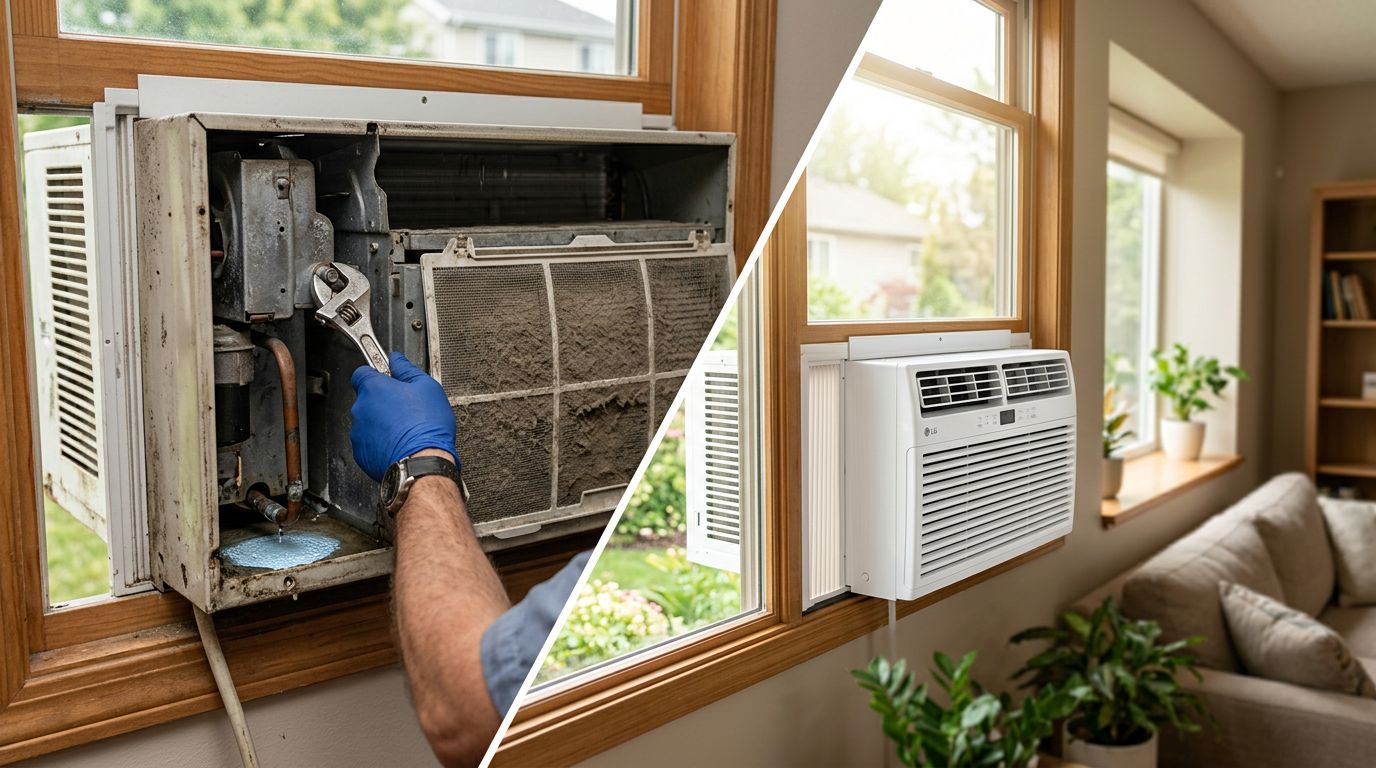
Your window AC never seems to fail on a pleasant day. It waits for the first sticky night, then starts buzzing, dripping, or blowing air that feels more optimistic than cold.
The decision is usually less mysterious than it feels. If the unit is fairly young and the issue is small, window AC repair often makes sense. However, when evaluating the replace vs repair dilemma, you will find that if it is old, loud, inefficient, or asking for expensive parts, replacement is usually the cleaner answer.
The trick is reading the signs in the right order, instead of guessing while you sweat.
Key Takeaways
- A newer unit with a dirty filter, loose mount, or drainage issue is often worth fixing.
- Once a window AC is around 8 to 10 years old, age starts to matter almost as much as the symptom.
- Weak cooling, loud noises, bad smells, a persistent water leak, and breaker trips usually point toward replacement.
- If the repair quote feels too close to the price of a new unit, a new unit usually wins.
- Renters should check the lease first, then document the problem before spending their own money.
Read the age and the symptoms together
Start with the basics, because minor oversights cause a shocking number of “broken” air conditioners. A dirty air filter, a dust-packed front grille, or a unit shoved slightly off-level can lead to airflow issues that make cooling performance drop fast.
Effective troubleshooting begins here. Pull the air filter and wash or replace it if needed. Vacuum visible dust from the intake and check whether the unit is tilted slightly outward so condensation drains outside, not into your room or wall. Following these simple maintenance tips can often restore performance without a costly service call.
Then check the age. Most window units do not age like cast-iron pans or leather boots; they age like small appliances that have spent years vibrating in heat. If yours is pushing 8 to 10 years, age belongs in the conversation right away. NHSaves on older AC units makes the same point, and it is a practical one.

Look at the label on the side or back if you still have it. The model number and manufacture date can settle a lot of arguments. A four-year-old unit with a dirty coil is one story, but an eleven-year-old unit with weak cooling is another.
Pay attention to the sound, too. A normal window AC hums, clicks, and whooshes a bit. Grinding, squealing, scraping, or sharp banging is different. So is a burnt smell, a sour odor, or water showing up where it shouldn’t. CNET’s replacement warning signs line up with what many owners notice first: bad noise, poor cooling, and a unit that suddenly seems angrier than usual.
One bad symptom does not always mean the end, but a cluster of them often does. That is the part people miss. They focus on the leak or the noise, when the real story is that the machine has started failing in several small ways at once.
When window AC repair is still worth it
A repair makes sense when the unit still has some life in it and the problem is narrow, not systemic. Think of it as a single issue rather than a slow motion collapse.
If your air conditioner is fairly new, repair is often the smart move. The same goes for mid range or premium models from brands like LG, Midea, Frigidaire, and GE, where the unit was not cheap to begin with and replacement parts may still be available. A loose fan blade, a faulty fan motor, a failing control board, a dirty evaporator coil, or a worn seal can be annoying without being fatal.
Performance matters more than pride. If the unit still cools well once cleaned, turns on consistently, and does not smell burnt, a repair can buy you more summers at a reasonable cost. Sometimes the repair is just simple maintenance, such as cleaning the condenser coils, which you should have done in May but forgot in June. No shame there. Summer has a way of exposing everyone’s shortcuts.
This is also where context matters. A bedroom unit used only at night ages differently from a living room unit that runs ten hours a day from June through September. Heavy use wears down motors, fans, and switches faster.
A small repair also makes sense when the problem is related to your window unit installation. Rattling can come from loose side panels or a shaky bracket. Minor leaks can come from poor tilt or blocked drainage. Warm air can come from a filthy filter choking the airflow. Those issues are frustrating, but they do not automatically mean the unit is finished.
If you are at the point of calling for service, ask a simple question: Is this a small fix, or is the unit starting to fail in multiple places? That answer matters more than any sales pitch.
When replacement stops being optional
Some units are telling you, plainly, that they are done. People often try to bargain with them, but the unit rarely bargains back.
A failed compressor is the classic example. In a central system, a compressor repair can be worth weighing, but in an older window unit, it usually is not. The same applies to a refrigerant leak, heavy rust, serious corrosion around the case, or an electrical failure that consistently trips your breaker.
If your AC is old, noisy, and barely cooling, hope is not a repair plan.
Water is another clear warning sign. A little condensation is normal, but water dripping into the room, staining the sill, or dampening the wall is not. Once moisture starts compromising your wood, drywall, or trim, the cost of keeping the old unit around spreads far beyond the appliance itself.
Noise often becomes background chatter until you simply cannot ignore it any longer. If it sounds like a shopping cart full of bolts every time the compressor kicks on, replacement is the better choice. End-of-life window AC symptoms often show up exactly this way: weak air, strange odors, loud operation, and frequent repair needs.
Energy use matters, too. An older, non-inverter unit can cool unevenly, cycle hard, and run longer than a modern model. Newer window ACs, including inverter-style models from Midea, LG, Frigidaire, and GE Profile, offer superior cooling efficiency and hold temperature more steadily. When shopping for a replacement, remember to check the BTU rating to ensure it perfectly matches your room size. While not every old unit is wasteful, an aging one has to earn its spot in your window.
Safety should end the debate immediately. If the plug feels hot, the cord looks damaged, or the unit sparks, stop using it until it is inspected by a professional. A cheap air conditioner is never more valuable than the cost of preventing an electrical fire.
Let cost, comfort, and timing settle the argument
Once you have evaluated the age and symptoms of your unit, the financial decision becomes clearer. While it is never an easy choice, getting a professional diagnosis from an HVAC professional can help you weigh your options before making a final commitment.
A repair quote only makes sense in relation to the replacement cost, the expected remaining lifespan of the unit, and how urgently you need cooling. In July, a five-day wait for parts can feel like a month. A technically repairable unit may still be the wrong choice if the components are backordered and your bedroom turns into a toaster by 10 p.m.
This quick grid helps when the room is hot and your patience is thin:
| Situation | Lean repair | Lean replace |
|---|---|---|
| Unit is under 6 years old | Usually yes | Only if damage is major |
| Unit is 8 to 10 years old or older | Sometimes | Often yes |
| Problem is a filter, drainage, mount, or control issue | Usually yes | Rarely |
| Problem is compressor, refrigerant, rust, or repeated electrical trouble | Rarely | Usually yes |
If two or three boxes land on the replace side, the answer is usually staring at you already.
There is also the comfort factor, which people often talk themselves out of. If your current unit cools only one corner of the room, wakes you up, and runs all afternoon, replacing it is not vanity. It is simply fixing a machine that no longer does the job.
Availability also matters in the summer. Big retailers like Home Depot, Lowe’s, Best Buy, local appliance stores, and direct brand sites often have faster pickup or delivery than a repair appointment has parts. That factor may not always decide the issue, but in the middle of a heat wave, it certainly can.
If you are renting, your first move is different
Renters have one extra layer to think through. You must determine if the window unit belongs to you or if it came with the property.
If the landlord provided the unit, check the lease before spending your own money. Take photos of leaks, frost buildup, damage, or the thermostat reading to document the issue. Then, send one clear message explaining the problem, when it started, and what basic troubleshooting steps you have already attempted. One calm email usually works better than six frantic texts.
If you live in a building that uses units built into the wall, keep in mind that PTAC repair may involve different building policies than a standard window unit, so check your lease carefully. If the unit is yours, the math is more personal. A small repair on a newer unit may be worth it, especially if you expect to move with it. If the unit is old, bulky, and unreliable, replacement is often easier than dragging the same cooling problem into your next apartment.
Frequently Asked Questions
How can I tell if my window AC is worth repairing or just old and tired?
If your unit is less than six years old and experiencing a minor issue like a dirty filter or a loose mount, repair is usually the best path. Once a unit hits the eight to ten-year mark, however, multiple failing parts or persistent cooling issues usually signal that it is time to upgrade to a more efficient model.
What are the most dangerous signs that an air conditioner needs immediate replacement?
If your unit consistently trips your circuit breaker, the power cord feels hot, or you see signs of sparking, you should stop using it immediately to avoid a fire hazard. Serious electrical issues, alongside deep rust or a failed compressor, are safety red flags that make replacement the only responsible choice.
Why does my window AC leak water inside my room?
Minor leaking often happens because the unit is not tilted slightly outward, preventing the condensation from draining properly. However, if the water is staining your walls or if internal components are corroded, it suggests the drainage system has failed and the unit may be reaching the end of its functional life.
Should I fix my air conditioner myself or call a professional?
You can safely handle routine maintenance like cleaning filters, clearing debris from the intake, and checking the unit’s tilt. For internal electrical or mechanical issues, especially those involving the compressor or refrigerant, always call a licensed professional to avoid personal injury or voiding your warranty.
Final Thoughts
A window AC unit does not need your loyalty. It simply needs to cool your room safely, efficiently, and without making strange noises at 2 a.m.
If your unit is relatively young and the problem is minor, opting for a professional window AC repair is a sensible and cost effective call. However, if the machine is aging, noisy, leaking, or struggling to maintain temperature, moving toward a total replacement is usually the smartest use of your money.
Before you make your final decision, remember to clean the air filter, check the age label on the unit, and obtain at least one honest repair quote. Taking these three simple steps will usually resolve your dilemma much faster than wishful thinking ever will.
This post may contain affiliate links. If you make a purchase through these links, I may earn a small commission at no extra cost to you.


