
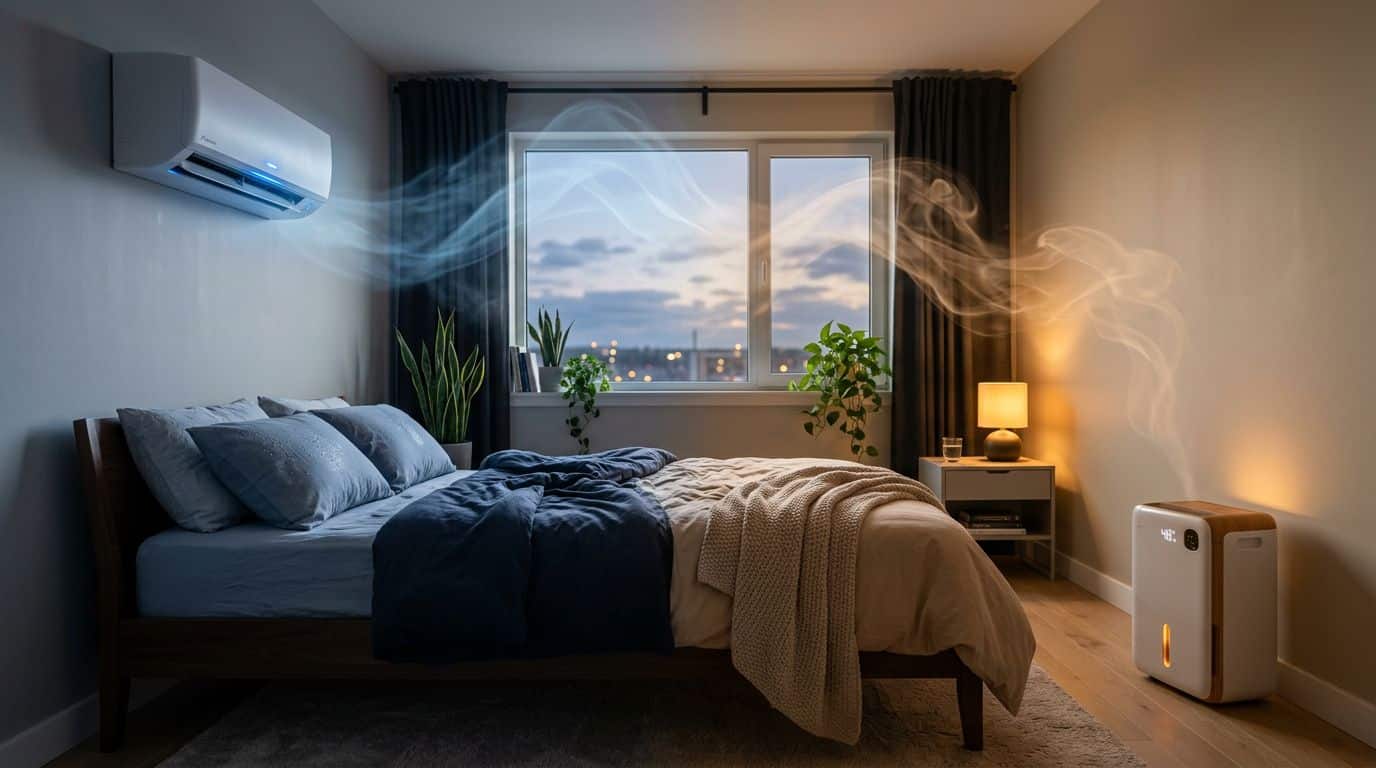
Some summer bedrooms manage to feel sticky even when the thermostat looks fine. The thermostat says 74 degrees, yet your pillow feels like a swamp.
That is where the dehumidifier vs ac debate gets messy. If the room is hot and humid, the air conditioner is the first machine to trust. If the temperature on your thermostat is tolerable but the air feels wet, a dehumidifier can be the better fix.
The trick is knowing which problem is ruining your sleep. Once you separate heat from humidity, the choice gets much easier.
If the room is sweltering, an air conditioner is the obvious pick. But if the room temperature is tolerable and the air still feels wet, the answer may be simpler than you think. Your thermostat tells only half the story, and the other half is humidity.
Key Takeaways
- Identify the primary culprit: Choose an air conditioner if the room is hot, and a dehumidifier if the room is at a comfortable temperature but feels sticky or damp.
- Understand mechanical differences: Air conditioners remove heat and moisture by venting heat outside, while dehumidifiers extract moisture but return slightly warmer air to the room.
- Prioritize the right tool: An air conditioner is essential for high temperatures, whereas a dehumidifier is best for maintaining ideal humidity levels (30–50%) without overcooling the space.
- Monitor your environment: Use a simple hygrometer to confirm humidity levels before purchasing, ensuring you address the actual source of your discomfort rather than guessing.
What a dehumidifier and an AC are actually doing
Mechanically, a dehumidifier and an air conditioner are close relatives. Both systems function similarly to a heat pump, relying on refrigerant, coils, and a compressor to regulate the indoor environment. Both devices pull moisture from the air by cooling it below its dew point, which causes water to condense.
The functionality diverges immediately after that process. An air conditioner is designed to move captured heat outside, whether you are using a portable air conditioner, a window unit, a mini-split, or a central system. The resulting air pushed back into your bedroom is both cooler and drier.
In contrast, a dehumidifier keeps the entire process contained within one box. It pulls excess water out of the air and then reheats that air before circulating it back into the room. Consequently, the air feels drier, but it also feels slightly warmer.
For a plain-English comparison, Ideal Home’s guide to air conditioners and dehumidifiers lands on the same basic point. A dehumidifier excels at managing moisture, but it is not a direct replacement for cooling.
The hardware difference is easier to see than to explain.

That one design choice changes everything at night. An air conditioner lowers the room temperature and trims humidity as part of its primary function. A dehumidifier removes moisture effectively, often more aggressively than an air conditioner, but it adds a small amount of warmth to the space while doing so.
This is why people sometimes talk past each other when comparing these machines. One person might have an 82 degree bedroom and want immediate relief from the heat. Another person might have a 75 degree bedroom that feels like a laundry room because of high humidity. Those are not the same problem, and they do not require the same machine.
Why a humid bedroom feels worse than the thermostat says
Sleep is where high humidity levels get rude. Your body cools itself by evaporating sweat, but when the air is already holding a lot of moisture, that evaporation slows down. This makes you feel sticky even when the room temperature is not particularly high.
That is why a bedroom at 74°F can still feel miserable. The temperature is fine on paper, but your body cannot unload heat efficiently. Because relative humidity is too high, the room feels heavy, sheets cling to your skin, and the air seems stale.
A bedroom usually feels best when indoor humidity levels stay between 30 and 50 percent. Once relative humidity pushes past 60 percent, many people notice the change immediately. Musty smells become more apparent, windows often collect condensation, and these conditions are ideal for mold prevention, as high moisture creates a friendlier environment for spores to thrive.
This is the best argument for using a dehumidifier in a bedroom that is already close to a comfortable temperature. If the room is 75°F and clammy, the moisture removal provided by a dehumidifier can make the space feel more breathable within an hour or two. The number on the thermostat may not move much, but your skin will notice the difference.
An air conditioner also handles moisture removal, but only while its cooling mode is running. When the thermostat is satisfied, the compressor backs off or shuts down, and the drying process slows down significantly. This is why some bedrooms feel cool yet damp, especially when using oversized central systems that struggle with energy efficiency because they cool the room too quickly without sufficiently drying the air.
Some air conditioners try to split the difference. If your unit has a dry mode, the effect can be useful for light humidity. However, this is often only enough for a mildly muggy evening, rather than for a bedroom that is chronically damp. If you want to watch the difference explained side by side, this video comparison of dehumidifier and AC efficiency is a helpful visual. If your AC is running in cooling mode for long periods without success, it might be time to consider a dedicated unit to stabilize your environment.
When the dehumidifier wins, and when the AC has to lead
A quick comparison makes the bedroom choice less dramatic.
| Bedroom situation | Better first choice | Why |
|---|---|---|
| The room is hot and sticky at bedtime | Portable air conditioner | It removes heat and some moisture effectively |
| The room feels cool enough but clammy | Dehumidifier | It dries the air without overcooling the space |
| Your central AC hits the set temperature fast, but the room still feels damp | Dehumidifier, used with an air conditioner | It helps when humidity lingers after the cooling mode finishes |
| You notice musty smells, window condensation, or damp closet corners | Dehumidifier | Persistent moisture is the primary issue |
| You rent and cannot install a window unit | Dehumidifier | It is an easy solution, though it will not truly cool the room |
The takeaway is simple. If the bedroom is hot, the air conditioner has to lead. Heat must leave the room, and a dehumidifier cannot do that.
If your bedroom is hot, an air conditioner fixes the cause. A dehumidifier only makes the heat less offensive.
This is the part people hate hearing, because a dehumidifier can seem like the cheaper, easier answer. It often is easier. You plug it in, empty the bucket, and the air feels less swampy. But during a real heat wave, the hot air exhaust from a dehumidifier becomes hard to ignore.
On the other hand, a dehumidifier can be brilliant in a room that is already near the right temperature. That happens a lot in apartments with central air, upstairs bedrooms that never quite balance out, or homes where the air conditioner cools fast but leaves humidity behind. In those cases, the dehumidifier is not replacing your climate control system. It is cleaning up what the cooling mode did not finish.
There is also the sleep issue. Many portable dehumidifiers are not silent, and neither are portable air conditioner units. If you are a light sleeper, noise matters almost as much as moisture removal. A machine that solves one discomfort but hums like a refrigerator beside your bed is not a clean win. Before choosing between a dehumidifier and an air conditioner, consider the noise levels of the specific model you intend to buy.
How to choose without wasting money
Start with the room, not the product page. Spend two or three nights paying attention to both the room temperature and humidity levels. A cheap hygrometer can tell you more about your actual thermostat reading than guesswork ever will.
If the bedroom is under about 76 degrees Fahrenheit at bedtime but the humidity stays above 55 or 60 percent, a dehumidifier is usually the sharper move. If the room temperature is pushing into the high 70s or 80s, prioritize cooling first. If both numbers are high, buy the air conditioner first and worry about extra moisture control only if the room still feels damp after that.
Shopping gets easier once you know what to measure. Dehumidifiers are rated by how much water they remove in a day, which directly impacts their power consumption and operating costs. For a bedroom, noise and drainage options matter just as much as capacity, as emptying a heavy water bucket every morning gets old fast. Always look for a model that allows for continuous drainage to save yourself the daily hassle.
When shopping for an air conditioner, the focus shifts. The question is not how much water it can collect, but how effectively it can move heat out of the bedroom while maintaining energy efficiency. Window units and mini-splits are the gold standard for this, as portable models are often less efficient and take up more floor space.
If you already own an air conditioner and still wake up feeling sticky, then a dehumidifier starts to make sense as a second step. Just remember the trade-off. A dehumidifier adds heat back into the room, so the air conditioner has to work harder to remove that heat later. Sometimes this compromise is worth it to lower humidity levels, but it can increase your overall energy costs.
The real-world arguments in this Reddit discussion from people living through sticky summers are useful for one reason. The people who love a dehumidifier are often dealing with clammy air, while those who prefer an air conditioner are battling high heat. It is the same basic comparison, just addressing a different source of misery.
Frequently Asked Questions
Can a dehumidifier replace an air conditioner?
No, a dehumidifier cannot replace an air conditioner because it lacks the ability to remove heat from the room. While it effectively extracts moisture, the process actually releases a small amount of heat, which can make a hot room feel even warmer.
Is a dehumidifier better than an air conditioner for saving energy?
It depends on your goal; if your room is already at a comfortable temperature, a dehumidifier uses less energy to remove excess moisture than an air conditioner would. However, if the room is hot, a dehumidifier will not solve the heat problem, potentially leading to increased energy use as you try to combat both warmth and humidity.
Why does my room feel damp even with the AC running?
This often happens if your air conditioner cools the room too quickly before it has enough time to extract the moisture from the air. This is a common issue with oversized central air systems that satisfy the thermostat reading without successfully dehumidifying the surrounding space.
Should I run a dehumidifier and an AC at the same time?
Yes, you can run them together if your air conditioner successfully lowers the temperature but fails to remove enough humidity to prevent a clammy feeling. Just keep in mind that the dehumidifier will add a small amount of heat, forcing your air conditioner to work slightly harder to maintain your target temperature.
Final thoughts
Solving the sticky-sheet problem becomes much simpler once you identify the main culprit. If the room is sweltering, your priority should be an air conditioner. However, if the temperature is tolerable but the air feels heavy and wet, a dehumidifier can make the bedroom feel far more comfortable than its compact size suggests.
Ultimately, most summer bedrooms do not need a complicated debate regarding dehumidifier vs ac. They simply require you to separate the challenge of managing hot air from the need to reduce moisture. Once you distinguish between the two, you can confidently pick the right air conditioner or dehumidifier to create the perfect sleeping environment.
This post may contain affiliate links. If you make a purchase through these links, I may earn a small commission at no extra cost to you.


