
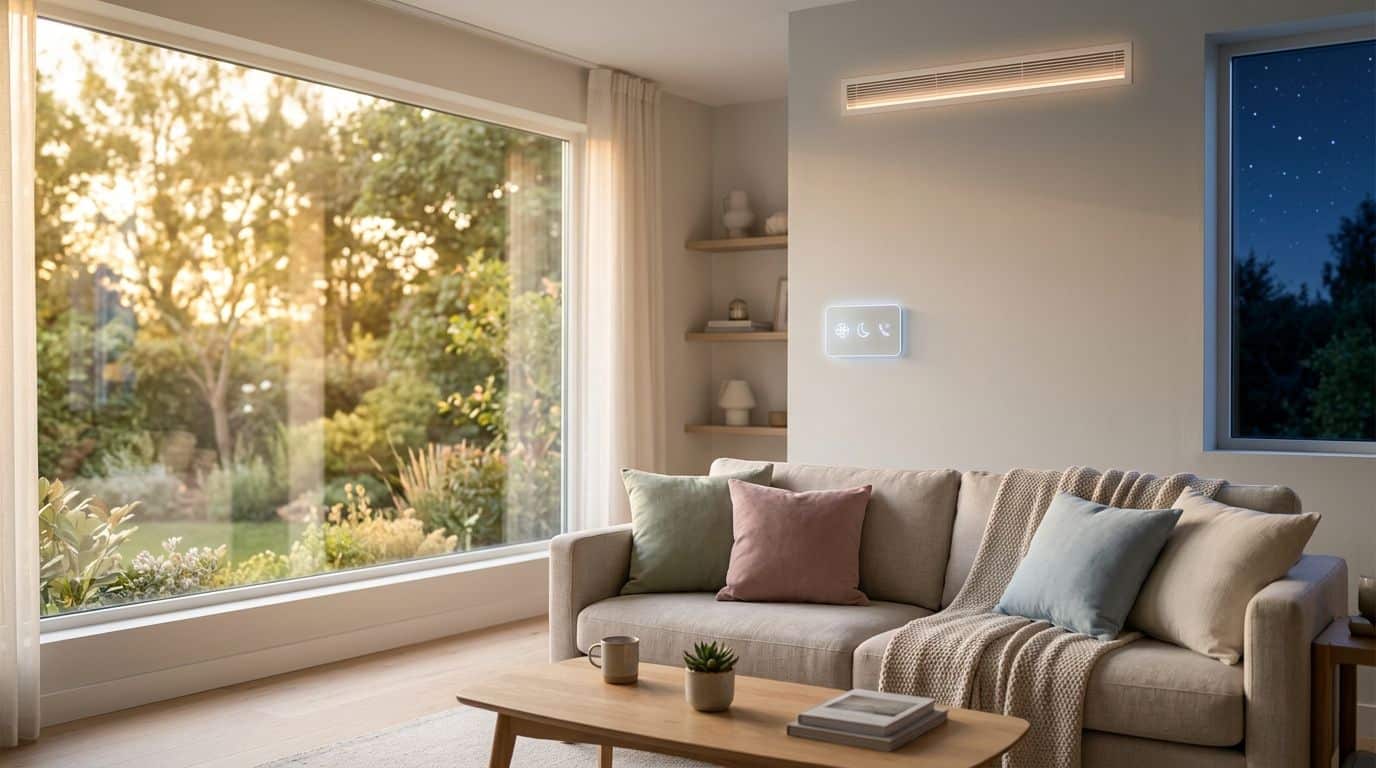
If your house feels sticky at lunch and too warm to sleep by 11, you are not imagining it. Good summer thermostat settings usually are not one perfect number. For many homes, a smart starting point is 78 F while you are home, a few degrees warmer when you are away, and a few degrees cooler at night.
That sounds simple, but real houses are complex. Factors like sun exposure, humidity levels, and home insulation all play a significant role in how your HVAC system performs. By balancing these variables, you can master energy-efficient cooling to maintain a comfortable environment while you save money on energy throughout the season. Start with the common baseline, then adjust your settings to find the balance that best fits your daily life.
Key Takeaways
- Use a tiered temperature strategy: Start with 78 F while home, bump it up to 80–82 F when away, and lower it to 74–76 F for sleeping to balance comfort and energy efficiency.
- Adjust for local conditions: Humidity, sun exposure, and home age significantly impact how a temperature setting feels; don’t be afraid to deviate from the 78-degree baseline if your specific environment requires it.
- Prioritize sleep quality: If you cannot sleep at standard efficiency settings, it is worth lowering the temperature a few degrees to ensure proper rest, as sleep quality is more important than achieving a perfect utility bill.
- Focus on consistency: Avoid treating the thermostat like a gas pedal by setting it to extreme temperatures, and make small, one-degree adjustments while allowing a few days for your HVAC system to acclimate.
- Manage humidity and airflow: Utilize ceiling fans, blackout curtains, and exhaust fans to keep the house cool, and consider using room sensors if your home has inconsistent hot spots.
Start with a daytime setting that your AC can sustain
The famous 78 degrees advice did not appear out of nowhere. It comes from long-running recommendations by the U.S. Department of Energy, and Trane’s explanation of the 78-degree rule gives the short version. For a lot of homes, 78 degrees is the point where comfort and electric use stop fighting quite so hard.
That said, 78 degrees is a starting line, not a personality test. If your place gets hammered by afternoon sun, or if the air feels damp enough to wear, 78 can feel warmer than the number suggests. A dry 78 is one thing, but a humid 78 is a different animal. It is worth noting that a high-efficiency air conditioner with a high SEER2 rating may be better equipped to manage these indoor temperature levels, keeping your home feeling crisp even when the thermostat is set higher.
A practical daytime range for most people is 76 to 78 degrees when the house is occupied. If you already know you run warm, start at 77 degrees instead of pretending 78 degrees will become charming by force of will. If you are comfortable at 78 degrees, leave it there and enjoy the smaller bill.
A good first test is 78 degrees when you’re home, 80 to 82 degrees when you’re out, and 74 to 76 degrees for sleep.
Try to judge the setting during the hardest part of the day, not at 8 a.m. when the house still feels merciful. The true test comes in late afternoon, when walls, windows, and ceilings have been collecting heat for hours. If the system can hold your target then, you are close to a workable setting.
There is one more wrinkle. If your AC is older, undersized, or dealing with a heat wave, the number on the thermostat may not match how the rooms feel. That does not always mean the thermostat is wrong. Sometimes it means the system is doing its best and your house has hot spots that need their own fix.
Nighttime comfort and the best thermostat settings for sleep
Your body wants to cool down before sleep. That is why a room that feels fine at dinner can feel stuffy by midnight. Blankets, mattresses, body heat, and closed bedroom doors trap warmth, and your skin does not care what the hallway thermostat says.

This is where many people get annoyed with blanket advice. They hear that 78 F is the standard daytime recommendation, then lie awake feeling like a potato wrapped in a duvet. If that sounds familiar, lower the overnight setting a degree or two and give it a few nights. Sleep quality matters. A technically efficient setting is not much use if you are staring at the ceiling at 2 a.m.
For many households, the best nighttime temperature lands around 74 F to 76 F. Some people sleep well at 72 F. Others are happy at 77 F with a ceiling fan. You can see a similar set of starting points in this summer thermostat guide, which separates daytime, nighttime, and away settings instead of pretending one number fits every hour.
Fans help, but they are not sorcery. A ceiling fan can make a warmer room feel better because moving air helps sweat evaporate. To maximize this, set your ceiling fan to spin counterclockwise to create a cooling downdraft. However, it does not actually lower the room temperature, so turn it off when the room is empty because the dresser does not need a breeze.
Bedding matters more than people admit. Heavy comforters, memory foam mattresses, and closed blinds that trap stale air can make an average bedroom feel hotter than the rest of the house. Before you slash the thermostat, try lighter sheets, better airflow, or cracking the bedroom door if that improves circulation.
A scheduled nighttime drop usually works better than keeping the whole house cold all day. Consider using a smart thermostat to automate a nighttime temperature drop. Let the temperature ride a bit higher during the afternoon, then have your smart thermostat cool the house before you head to bed. That approach is kinder to your energy bill, and it often feels better by bedtime than simply sticking to the 78 degrees recommended for daytime efficiency.
What to set when nobody is home
Away temperature settings are where significant energy savings usually show up. If the house will be empty for most of the day, adjust your thermostat to between 80 F and 82 F. Whether you are using a standard central unit or a modern heat pump, these settings reduce how long your system runs without letting the house turn into a kiln. Utilizing a programmable thermostat is the most effective way to manage these shifts, helping you lower your monthly electricity costs and keep your total energy bill under control.
The exact number depends on how long you are gone. If you leave for nine hours, adjusting the thermostat makes sense. If you are simply running out for groceries, it probably does not. An air conditioner is not a light switch for comfort, and small absences rarely justify big temperature swings.
In humid climates, do not get too ambitious. A house that sits at 84 F all day can come back feeling swampy, even if the thermostat number looks fine. In those homes, 79 F or 80 F while away may feel better than pushing higher. It is a smaller savings, yes, but comfort when you return counts too.
Pets also change the math. Most healthy cats and dogs can tolerate warmer indoor temperatures than people prefer, but tolerate is not the same as comfortable. If you have a senior pet, a flat-faced dog, or any animal with health concerns, use more caution. Savings are nice, but a panting bulldog is not.
If you have a programmable thermostat, this process is straightforward. Set the warmer temperature to begin shortly after everyone leaves, then schedule the cool-down period for shortly before the first person arrives home. That way, the house is not spending money on empty air, and you are not walking into a heat pocket at 6 p.m.
When the standard numbers stop working
Some homes follow the rulebook. Many do not. Top-floor apartments, older rentals, rooms with west-facing windows, and homes with window units live by their own weather.
Upstairs bedrooms and apartment reality
If your thermostat is downstairs and your bedroom is upstairs, the bedroom can stay several degrees warmer than the reading on the wall. In that case, chasing a perfect whole-house number gets silly fast. The sensor is reporting one part of the house, but your body is sleeping in another.

Photo by Ramon Karolan
Renters know this routine well. Window AC units cool unevenly, hallways trap heat, and older buildings leak cool air like a screen door on a submarine. If that is your setup, focus on the room you actually use. Close blinds before the afternoon sun arrives, seal obvious drafts around the unit, and keep doors arranged for better airflow instead of trying to force perfect balance from an imperfect system.
If you own the place and want a cleaner fix, room sensors can help. A smart thermostat from brands like Ecobee, Google Nest, and Honeywell Home can follow schedules more precisely, and some models use remote sensors to determine the optimal thermostat setting based on temperatures in occupied rooms instead of one central hallway. This technology makes nighttime settings far more sensible in multi-story homes.
Humidity changes everything
Humidity can wreck comfort. A room at 78 F with sticky air can feel worse than a drier room at 80 F. If the house feels clammy, the issue may be moisture removal, a dirty filter, poor airflow, or an AC system that turns on and off too quickly to dehumidify well.
That is why the best thermostat setting sometimes feels like a trick question. The number matters, but it is not the whole story. A cooler house with damp air can still feel bad, while a slightly warmer house with effective humidity control can feel perfectly comfortable. If your AC system struggles to manage moisture levels, adding a standalone dehumidifier to your space can make a significant difference in how the temperature actually feels.
People matter too. Someone who runs hot, takes certain medications, is pregnant, is older, or has a health condition may need a cooler room. So might a thick-coated dog stretched out on the floor looking personally betrayed by July. Comfort and safety beat a blanket target every time.
Small habits make summer settings work better
The fastest way to find your ideal temperature is boring, but that is exactly why it works. Adjust your thermostat by one degree at a time, then leave it alone for two or three days. One scorching afternoon is not a fair test, and neither is one rainy, cool one. Incorporating consistent HVAC maintenance into your routine is the best way to ensure your system performs reliably.
Thermostats are not gas pedals. Setting your system to 68 F does not make the house cool any faster. It only tells the system to keep running until it reaches that temperature, which may take a long while on a brutal day. If you want the place comfortable by bedtime, program the lower temperature to kick in well before you head to sleep.
A few side habits help more than people expect when it comes to lowering your cooling costs. Keep curtains or blinds closed on sun-heavy windows to block out heat. Regularly checking your air filter is one of the most effective ways to boost energy efficiency and reduce energy usage, as a clean filter allows your system to breathe easier. Use kitchen and bathroom exhaust fans after cooking or showers so that heat and moisture leave the house instead of lingering like unwanted guests.
Try not to fight a single hot room by punishing the entire home. If one bedroom is always warmer, look at your airflow, use blackout curtains, check your door position, or consider adding a room sensor. Constantly changing the whole-house setting because one room feels off is a good way to annoy yourself and inflate your electric bill at the same time.
The sweet spot usually feels almost boring. The house is comfortable enough in the daytime, sleep comes easier at night, and the thermostat is no longer something you argue with twice a day.
Frequently Asked Questions
Why does my house still feel warm even when the thermostat is set to 78 degrees?
Temperature is only one part of comfort; high humidity levels can make a room feel much warmer and stickier than the thermometer suggests. Additionally, if your home has poor insulation, west-facing windows, or an undersized AC unit, it may struggle to maintain the target temperature during the hottest parts of the day.
Should I turn the air conditioner off completely when I leave for work?
It is generally more efficient to raise the temperature by a few degrees rather than shutting the system off entirely. Turning it off can cause the house to heat up significantly, forcing your AC to work much harder and run for longer periods to bring the temperature back down when you return.
Can I use ceiling fans to lower my electricity bill?
Ceiling fans create a wind-chill effect that helps you feel cooler, which allows you to keep your thermostat at a higher, more efficient setting. Just remember that fans cool people, not rooms, so they should be turned off when nobody is in the room to save energy.
Is it worth upgrading to a smart thermostat for the summer?
A smart thermostat is highly recommended because it allows you to automate temperature schedules so your home is cooled right before you arrive or go to sleep. Many models also offer remote sensors that help balance temperatures in multi-story homes or rooms that typically feel warmer than the hallway.
The setting that works is the one you can live with
Developing effective summer thermostat settings comes down to dividing your day strategically. You should keep the house warmer when it is empty, cooler when you need quality sleep, and flexible when your home deals with specific hot spots or humidity issues. By balancing these needs, you create a schedule that manages your environment throughout the season.
If 78 degrees feels comfortable for you during the day, that is a fantastic baseline for efficiency. However, if 75 degrees is the magic number that allows you to sleep well without sending your utility bill into orbit, that can be the right answer too. The goal is not to win a debate with a number on the wall. Instead, the goal is to maintain a house that feels steady and reasonable. By finding the right balance for your lifestyle, you can effectively lower your cooling costs while ensuring your home remains a liveable sanctuary all summer long.
This post may contain affiliate links. If you make a purchase through these links, I may earn a small commission at no extra cost to you.


