
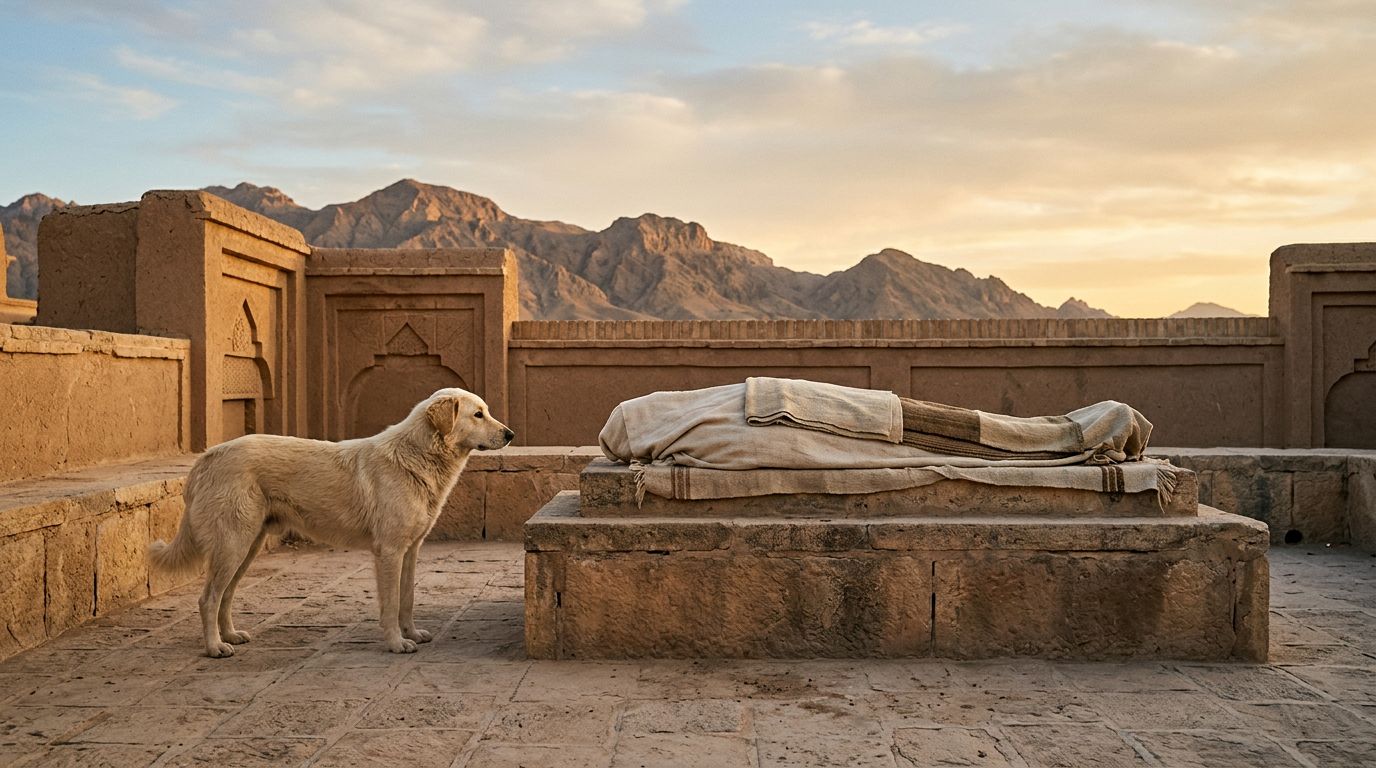
A dog is the last visitor many people expect at a funeral. Yet in ancient Zoroastrian custom, the dog’s presence was part of a serious, carefully ordered response to death.
Zoroastrian Sagdid is often reduced to a strange fact for trivia nights. Look closer, though, and it opens onto a larger religious system about purity, grief, care for the living, and the soul’s fate after death.
The rite may feel unfamiliar, but its underlying questions are not. How do we know death has occurred? How should a community treat a body with dignity? What happens next?
This post may contain affiliate links. If you make a purchase through these links, I may earn a small commission at no extra cost to you.
What Zoroastrian Sagdid Means
Sagdid is usually translated as “seen by a dog,” “dog sight,” or “the glance of the dog.” The term comes from Middle Persian words for dog, sag, and seeing, did.
In Zoroastrian Sagdid, a dog was brought before a recently deceased person so that it could look upon the body. It was not a pet’s farewell in the modern sense. Nor was it a theatrical attempt to frighten mourners. It was a formal rite within a strict set of rules about death and contamination.
A short overview of Sagdid captures the basic act, but the meaning sits in the wider funeral tradition. The dog was thought to have a ritual ability to expose and drive away harmful corpse pollution.
The dog’s glance was the act
The point was the dog’s gaze, not physical contact with the dead person. A handler led the animal near the body, and the dog looked at it. The rite could be repeated at important moments while the funeral procedures continued.

That distinction matters. Sagdid did not turn a dog into a priest in a fur coat. The animal had a defined role in a religious response to death, then the wider rites continued around it.
The Vendidad and the fear of Druj Nasu
The main textual source for the Sagdid ritual is the Vendidad, also called the Videvdad. This Avestan work contains rules about purity, pollution, illness, animals, and the handling of corpses.
Its funeral passages describe death as more than a physical event. When life leaves the body, the text says that Druj Nasu, the demon or force of corpse pollution, rushes toward it. The danger was not moral blame attached to the dead person. It was a ritual condition that demanded care.
A demon described as a fly
In the Vendidad, the dog’s presence makes Druj Nasu flee northward, sometimes described in English translations as a raging fly. It is vivid imagery, and it can sound odd to modern ears. Yet it made the danger visible in a world where unseen contamination had religious force.
The text calls for a yellow “four-eyed” dog, or a white dog with yellow ears, in certain rites. Avesta.org’s funeral-ceremony account preserves detailed discussions of these customs and their later interpretation.
Zoroastrian ritual rules treated the corpse as a source of pollution because death disrupted a divinely ordered world. Sagdid was one early step in restoring order.
Why a Four-Eyed Dog Was Preferred
The famous four-eyed dog did not have four literal eyes. It was a dog with two pale markings above its real eyes, giving the impression of another pair. In Persian religious language, it could be called a chathru chasham, meaning four-eyed.
Those markings made the dog ritually suitable in the older textual tradition. A description of the four-eyed dog explains that the phrase refers to these eye-like spots, not a rare or supernatural breed.
Dogs had duties and protections
Dogs held an unusually respected place in Zoroastrian teaching. They guarded homes and herds, warned people of danger, and shared daily life with humans. Religious texts also set duties for feeding and protecting them.
That status helps explain why a dog could appear in a funeral rite without being treated as an object or a prop. Zoroastrian teachings about dogs place Sagdid within a broader ethical view of animal care.
The choice of animal also had a practical edge. Dogs notice scents, movement, and sounds that people may miss. Ancient ritual often joined religious meaning with close observation of the natural world.
Could Sagdid Help Confirm Death?
One modern explanation of Sagdid is both plain and compelling. A dog’s senses may have helped people notice whether someone was truly dead before the body was moved or funeral rites began.
Ancient communities had no stethoscopes, monitors, or reliable clinical tests. Coma, fainting, severe illness, and shallow breathing could create terrible uncertainty. Asking a dog to inspect the body may have offered an added check when mistakes carried enormous consequences.
The Vendidad presents Sagdid as protection against corpse pollution, not as a medical examination. Its practical value is a later interpretation, not a replacement for the rite’s religious meaning.
Sanitation without a germ theory
It is tempting to call the whole system early hygiene and leave it there. That misses the point. Zoroastrian purity rules came from theology, not modern public health language.
Still, the rules could limit unnecessary contact with a corpse. They set apart those who handled the dead, encouraged prompt procedures, and guarded water, earth, and fire against contamination. In practice, that created a disciplined approach to death at a time when infection and decomposition posed real risks.
The religious explanation and the practical effect can both be true. One does not cancel the other.
Sagdid, Corpse Purity, and the Towers of Silence
Sagdid belonged to a chain of funeral customs, not a single isolated scene. After death, the body was handled by designated corpse-bearers, often called nasasalaars in Parsi usage. Their work was surrounded by rules intended to protect other people and the sacred elements.
Earth, water, and fire had special purity in Zoroastrian thought. Burying a corpse could pollute the earth. Cremation could pollute fire. Placing a body in a river would contaminate water. The community therefore sought another route.
Exposure at a dakhma
The best-known answer was exposure in a dakhma, widely called a Tower of Silence. Bodies were placed on a raised circular structure where sun and scavenging birds completed the process. It was not meant as punishment or abandonment. It was a way to avoid polluting the elements while allowing the body to return to nature.

Sagdid came before exposure. The dog’s glance addressed the immediate spiritual danger of Nasu, while the dakhma addressed what should happen to the body afterward.
Towers of Silence are often treated as the entire Zoroastrian funeral story. They are only one part of it. Prayer, separation, designated handlers, the movement of the body, and care for mourners all mattered too.
The Soul’s Three Nights and the Chinwad Bridge
While the body required careful ritual handling, the soul was believed to begin a different journey. In traditional teaching, it remained near the body for three nights. Prayers were offered during this time, including prayers associated with Sraosha, the divine figure linked with obedience and protection.
On the fourth day, the soul approached the Chinwad Bridge, the bridge of judgment between this life and the next. A person’s good thoughts, good words, and good deeds mattered more than funeral wealth or social position.
The body and soul had separate paths
This split is easy to miss when Sagdid is told as a curious dog story. The body was treated as vulnerable to Nasu, while the soul was judged by the life it had lived.
The rites were not thought to purchase a better afterlife. They gave the dead proper care and helped the living fulfill religious duties during an unsettled time.
What survives in modern practice
Zoroastrian communities are not frozen in antiquity. As of 2026, funeral customs vary across Parsis in India, Iranian Zoroastrians, and diaspora communities. Burial, cremation, and exposure practices differ according to location, family choice, religious interpretation, and local law.
Traditional Sagdid is still remembered and practiced in some settings, but it is not universal. Some communities no longer have access to the conditions that supported older rites. Others follow adapted ceremonies that preserve prayers and respect for the dead without every historical procedure.
Zoroastrian Sagdid is therefore best understood as an important inherited rite, not a rule followed in exactly the same way by every Zoroastrian family.
A Dog at the Threshold of Death
Sagdid makes more sense when it is placed back in its original setting. It was a response to death’s uncertainty, not a strange footnote designed to shock later readers.
The dog’s glance, the concern for purity, the Tower of Silence, and the Chinwad Bridge all belonged to one moral picture. Death required care, and the way a community handled it mattered for both the living and the dead.


