
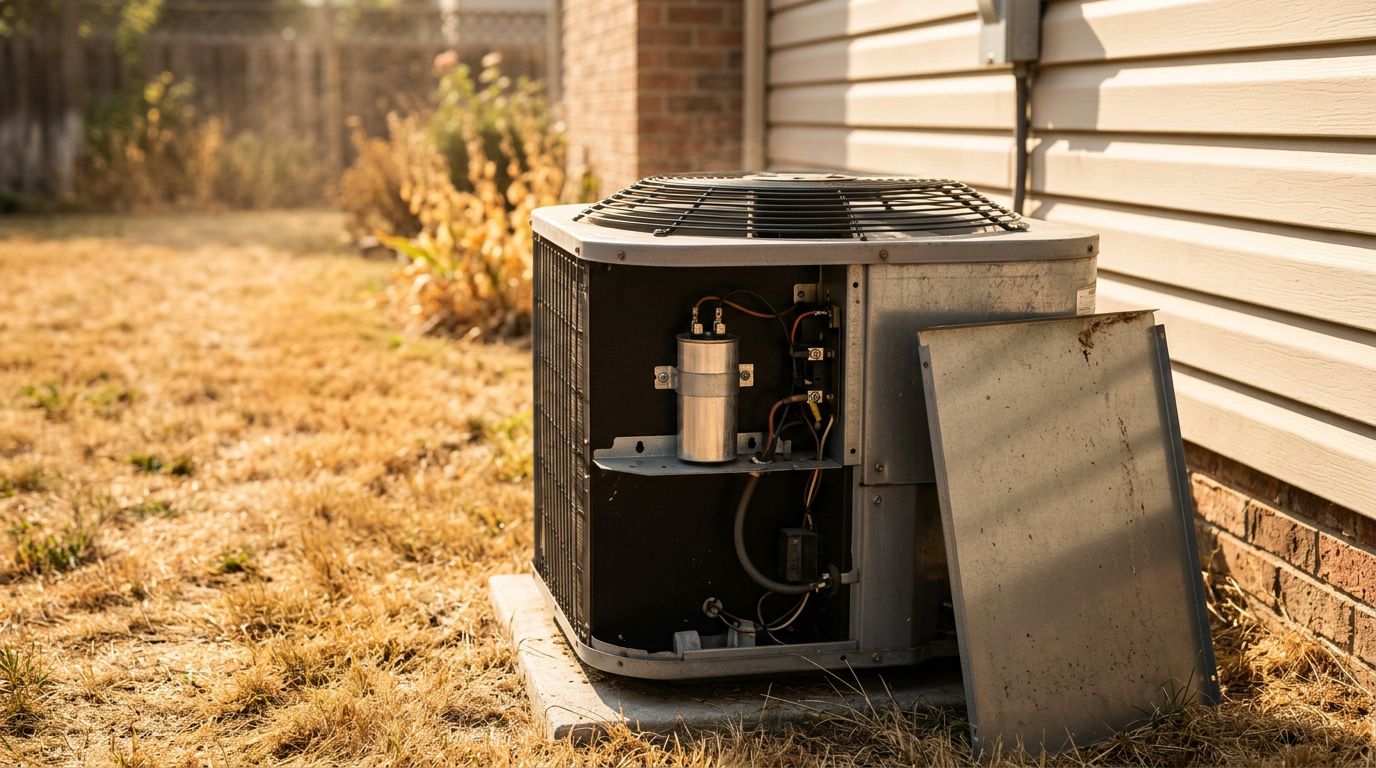
Your HVAC system has picked the worst possible week to act strange. It hums, hesitates, blows warm air, or gives up entirely after a few minutes while the house gets steadily more unbearable.
A failing capacitor is often behind this kind of summer breakdown. It is a small part, but it helps the motors in your outdoor unit start and keep running. When it weakens, you might notice AC capacitor failure signs such as a unit that sounds like it is trying to wake up but cannot quite manage it, or even a situation where your AC won’t start at all.
Knowing these warning signs can help you make the right call before a rough afternoon turns into a full on indoor sauna.
Key Takeaways
- Common AC capacitor failure signs include a persistent humming sound, delayed system starts, blowing warm air, short cycling, and an outdoor fan that will not spin.
- Extreme heat puts significant strain on an already weak component, which is why frequent AC capacitor failure often occurs during long stretches of high temperatures.
- For your safety, do not open the outdoor unit or attempt to touch a capacitor yourself, as these components can hold a dangerous electrical charge even after the power is shut off.
- While an HVAC technician can test the capacitor, they should also perform a thorough inspection of the fan motor, contactor, electrical wiring, and compressor before replacing any parts to ensure the root cause is addressed.
What the Capacitor Does When Your AC Starts
Think of a capacitor as the electrical spark plug that gets your cooling system moving. Within your HVAC system, the capacitor acts as a vital power reservoir. A start capacitor provides the initial high-voltage surge needed to wake up the system, while a run capacitor provides the steady, continuous energy necessary to keep components operating smoothly.
Most central units utilize a dual run capacitor to manage two critical parts of the outdoor unit simultaneously. One side of this component provides the energy required to initiate and maintain the compressor, while the other side supports the fan motor. When the capacitor begins to struggle, these parts lose their rhythm.
If the capacitor starts to fail, the thermostat may call for cooling as usual, and you might hear the indoor blower pushing air through the vents. However, because the outdoor unit fails to engage, your home simply circulates warm, stagnant air. This inefficiency forces your system to labor longer and harder, which frequently leads to a noticeable spike in your energy bills.
Capacitors naturally wear down over time, particularly under the stress of extreme temperatures. Factors such as voltage fluctuations, a struggling motor, or exceeding the specific voltage rating of the component can drastically shorten its lifespan. Because these parts are common failure points, it is helpful to understand the symptoms. For a closer look at the common warning signs, this guide to identifying a failing AC capacitor explores the connection between weak airflow, rising costs, strange noises, and an AC unit that will not start.
AC Capacitor Failure Signs You Shouldn’t Brush Off
The clearest sign of trouble is a system that tries to engage but simply cannot. You might notice your AC won’t start, accompanied by a distinct humming noise from the outdoor unit, even though the fan never begins turning. Sometimes, you may hear a repeated clicking sound as the system attempts to engage its relays. Please do not poke the fan blades with a stick or try to spin them by hand while the unit has power. That outdated trick is not a safe home test, and it can turn a simple component failure into a damaged fan motor or a trip to the emergency room.
A delayed start is another familiar clue. The outdoor unit may sit silent for several seconds after the thermostat clicks on before it finally lurches to life. It might work normally one day and struggle the next. Because extreme heat makes electrical parts less forgiving, intermittent trouble often evolves into a complete failure during a heatwave.
If the indoor blower runs but you feel warm air at the vents, this often indicates the compressor is failing to start. Because the indoor system continues to circulate air without the cooling power of the compressor, the house will quickly become uncomfortable. You may also notice short cycling, where the outdoor unit starts, runs for only a brief period, and then shuts down before the house reaches the temperature set on the thermostat. While a weak capacitor is a common culprit, this behavior can also point to a dirty condenser coil, a refrigerant leak, or a control fault.
Look and listen for these specific patterns:
- The outdoor unit emits a humming noise or clicking sound, but the fan does not start.
- Cooling begins slowly or feels inadequate as the afternoon heat builds.
- The system shuts off repeatedly and the home never reaches the set temperature.
- The condenser fan runs, but the air coming from the indoor vents remains warm.
- A circuit breaker trips immediately after the AC attempts to start.
Physical inspection can also reveal signs of damage. Check the unit for a bulging top, leaking oil, scorch marks, or heavy corrosion around the terminals. However, keep in mind that a normal-looking part can still be internally weak. Appearance alone does not provide a definitive diagnosis.
A humming outdoor unit that will not start is not a reason to wait until evening. Turn the system off and arrange service before the compressor is forced to keep trying.
This overview of capacitor symptoms during peak heat is right about one thing homeowners often learn the hard way: a small electrical problem can leave the whole house without cooling.
Why a Heatwave Pushes Weak Capacitors Over the Edge
On a mild day, your HVAC system enjoys frequent breaks between cooling cycles. During a intense heatwave, however, it may run for hours with very few pauses. Both the compressor and the fan motor must work much harder because they are struggling to release heat into already sweltering outdoor air.
This prolonged workload significantly raises the temperature inside the outdoor unit. While capacitors are built for demanding environments, the combination of age and extreme heat exposure eventually takes its toll. A part that was barely functioning in June may finally quit on a 100-degree afternoon in August. Furthermore, local power grids are often strained during these peaks, leading to frequent power surges that can overwhelm an already weakened electrical component.
Heatwaves make a failing capacitor easier to notice because the system lacks the reserve capacity to compensate. If the unit loses efficiency, your energy bills begin to climb while the house struggles to maintain a comfortable temperature. As the thermostat reading steadily rises, bedrooms become stuffy and uncomfortable.
A failing capacitor is often the culprit when the outdoor unit simply hums without starting, blows warm air, or shuts down completely during the hottest part of the day. These are classic warning signs that your HVAC system is failing under pressure, as explained in this guide on why capacitor failure is such a common AC repair.
What You Can Safely Check Before Calling
Start with the simple things that do not require opening equipment. Check the thermostat mode to ensure it is set to “cool” with a temperature lower than the current room temperature. If your thermostat uses batteries, replace them to ensure your signal is strong.
Next, inspect the air filter. A heavily clogged filter restricts airflow and can make an AC seem weak, though it will not usually cause the outdoor unit to experience starting issues. If the filter is dirty, replace it with the correct size and airflow rating.
Walk outside and listen from a safe distance. Is the condenser completely silent? Do you hear a faint humming noise? Is the fan turning, or is the system blowing warm air indoors? These observations help an HVAC technician narrow down the problem before they arrive.

You can also look around the unit without removing panels. Clear away leaves, grass clippings, and anything leaning against the condenser. Keep shrubs and stored items away from the sides so air can move through the coil effectively.
If the circuit breaker has tripped, you may reset it once, but only if you are comfortable doing so and there is no burning smell or visible damage. If the breaker trips again, leave it off. Repeated resets can put undue stress on a compressor that is already struggling to start.
Do not remove the condenser access panel. Never touch wires, the contactor, or the capacitor. Capacitors can retain a dangerous charge, and handling them poses a significant risk of electrical shock. Furthermore, capacitors must discharge energy safely before being replaced. Always remember that the correct replacement part must match the specific microfarad rating and voltage rating of your system. If you suspect your capacitor is faulty, contact a qualified HVAC technician to handle the repair.
When It Is Time to Stop Troubleshooting
Call a qualified HVAC technician promptly if your outdoor unit hums but fails to run, if the circuit breaker trips repeatedly, or if you notice a burning smell near the equipment. These are not wait and see symptoms, particularly during a heatwave.
A professional HVAC technician will shut off the power to the outdoor unit to safely inspect the hardware. They use a multimeter to measure the current microfarad rating of the capacitor and compare that reading against the factory specifications printed on the label. Beyond just the capacitor, a skilled HVAC technician will perform essential maintenance by checking the contactor, wiring, fan motor, compressor, and various electrical connections. Replacing a component without identifying the root cause of the failure can lead to the same breakdown occurring again next month.
Turn the thermostat off while you wait for service if the unit is buzzing, cycling repeatedly, or struggling to start. Continuing to call for cooling while the system is failing can place excessive strain on the compressor. Since the compressor is far more costly to replace than a simple capacitor, it is best to leave it powered down.
If cooling is weak but the AC still runs, use ceiling fans, close blinds, avoid using the oven, and focus on keeping one or two rooms comfortable. Drink plenty of water, check on older neighbors, and make a plan for your pets. Heat inside a house can become a health risk faster than many people expect.
Frequently Asked Questions
Can I replace an AC capacitor myself to save money?
No, you should never attempt to replace a capacitor yourself. These components store a dangerous electrical charge even after the power is turned off, posing a severe risk of electric shock, and improper installation can cause permanent damage to your HVAC system.
Why does my AC unit make a humming sound when it won’t start?
A humming sound typically indicates that the motor is receiving power but lacks the necessary electrical ‘push’ from the capacitor to start turning. This is a classic sign of a failing capacitor that needs immediate attention to prevent the compressor from overheating.
Does a failing capacitor always cause the AC to stop working entirely?
Not necessarily, as a weakening capacitor can sometimes allow the system to run intermittently or struggle to cool properly before failing completely. If your AC is short cycling, blowing warm air, or taking longer than usual to start, these are early warning signs that the capacitor is losing its ability to function correctly.
How often should I have my AC capacitor tested?
While there is no fixed replacement schedule, it is a good idea to have a professional technician check your electrical components during your routine seasonal maintenance. Regular inspections allow a pro to catch a failing capacitor before it leaves you without cooling during the peak of a heatwave.
Keep a Small Failure From Becoming a Big One
The most effective response to AC capacitor failure signs is quick, calm attention. A humming condenser, a stalled fan, warm vents, or repeated hard starting are your clear cues to stop asking the system to work harder. If you notice these warning signs, turning off your unit prevents the minor electrical issue from damaging the expensive compressor, which significantly lowers your potential replacement cost later on.
A capacitor is a modest part with a massive job. By treating these early symptoms as a priority and scheduling professional HVAC system maintenance, you can protect your investment, restore your cooling, and keep a heatwave from taking over your home. Catching these problems early is the best way to ensure your comfort while avoiding the stress of a total system breakdown.
This post may contain affiliate links. If you make a purchase through these links, I may earn a small commission at no extra cost to you.


