
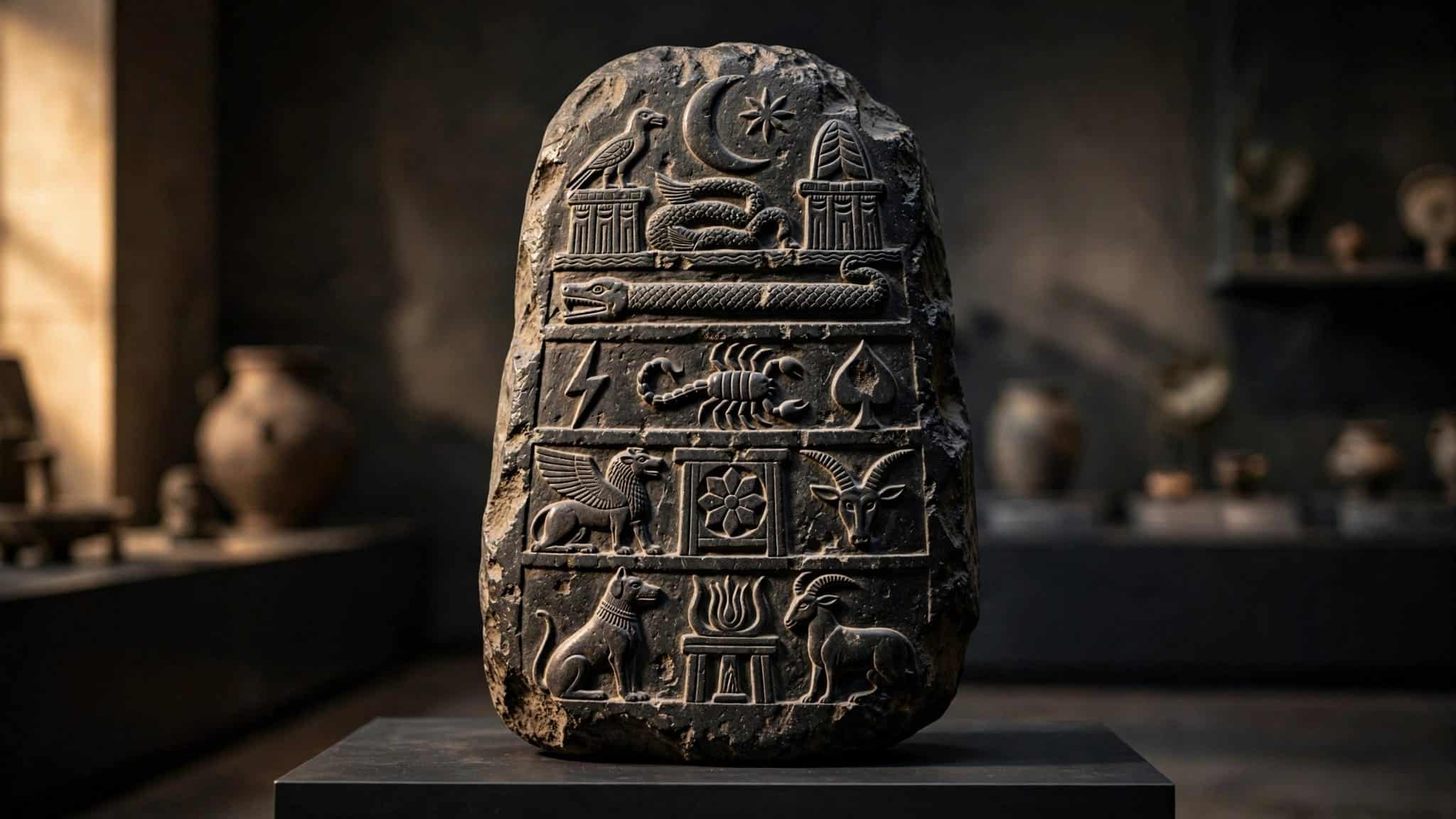
A kudurru can look like a small, solemn slab of stone, the sort of thing you’d walk past in a museum before heading for the enormous winged bulls. That would be a mistake. These objects are full of land, money, family status, royal power, and enough divine threats to make a modern property solicitor blink.
Mesopotamian kudurru stones are often called boundary stones, but many are land-grant monuments. Their inscriptions make them durable legal documents, defining rights and property limits without proving the stone stood in a field.
Once you know where to look, the crowded cuneiform and strange little emblems stop feeling like visual noise. They become a document with its own peculiar, forceful logic.
This post may contain affiliate links. If you make a purchase through these links, I may earn a small commission at no extra cost to you.
Start by dropping the roadside-marker idea
The Akkadian term kudurru is commonly translated as “boundary” or “frontier.” That translation describes a semantic field, not the monument’s proven location or function. A stone can mark the edge of a field, but the word alone doesn’t establish that role.
Yet many surviving kudurrus probably didn’t sit outdoors at the edge of the land they describe. The word has stuck, but some inscriptions describe the object as a narû, meaning a stele or stone monument.
A stone with legal teeth
A kudurru usually records a transaction: a royal grant, a purchase, an inheritance, a tax exemption, or a bundle of privileges tied to land. These legal documents name people, places, measurements, witnesses, and obligations.
Think of it less as one of the boundary markers used in a field. It’s a durable land deed carved into a monument. It was meant to last longer than a papyrus record, a memory, or a convenient lie told after the king died.
A kudurru’s “boundary” may mark the legal limit of a right, not prove that the stone stood in a field.
That small distinction changes how you read the whole thing.
The Kassite period gave kudurrus their familiar form
Most surviving Mesopotamian kudurru stones date to the Kassite dynasty of Babylonia. They belong mainly to the Middle Babylonian period, roughly 1595 to 1155 BCE. The form continued after the dynasty ended, including under Nebuchadnezzar I and later Babylonian rulers.
The Kassites ruled ancient Babylonia, where land could bring grain, labour, tax income, status, and political loyalty. Giving land away was never a casual gesture. A king who granted an estate was also rearranging wealth and loyalty.
Why a royal grant mattered
Royal land grants could reward an official, confirm a family’s property rights, or designate some holdings as tax-exempt land. The recipient received more than soil. They received protection, income, and a public connection to the crown.
That is why the wording tends to be so detailed. A vague document is an invitation to a dispute. Ancient Babylonians knew this perfectly well, perhaps because people have always become surprisingly inventive when acreage is involved.
The British Museum’s Meli-Shipak kudurru records a gift of 50 gur of corn-land to Khasardu, son of Sume. It also records officials involved in the transfer and seven high-ranking witnesses. That is not decoration. It is an administrative paper trail in stone.
Read the stone in layers, not all at once
A first encounter with cuneiform inscriptions can feel like looking at a page written in very tidy bird tracks. On a kudurru, the writing may run across several faces, while reliefs and text often occupy different zones.
There is no need to pretend you can translate it on sight. Begin with the physical order of the monument.
Find the human story in the text
The longest written sections usually establish the basics: who made the grant or sale, who received it, what land or privilege was involved, and where it lay. Later parts can name boundaries, neighbours, officials, witnesses, payments, or exemptions.
Look for repetition in a museum label or scholarly translation. Personal names and royal titles often recur. So do units of land and grain. A museum label usually gives a translation or summary, not the original Akkadian text. Repetition is useful because it tells you which facts the text refuses to leave loose.
One 11th-century BCE kudurru from the reign of Marduk-nadin-ahhe records the purchase of five gur of corn-land. A transliteration such as gur represents a Mesopotamian measure, whose exact modern equivalent can vary. The payment included silver, a chariot, saddles, animals, grain, oil, and garments. A house purchase with an ox and some clothing in the deal is hardly the neat bank transfer we know, but the legal instinct feels familiar.
The writing has a rhythm
The inscription tends to move from authority to transaction, then from transaction to protection. First comes the right to give or sell. Then comes the description of what changed hands. Finally, protective curses warn anyone tempted to reverse it.
That rhythm helps you orient yourself, but it isn’t the same as reading every cuneiform sign. Even without reading Akkadian, you can see that a kudurru is not a random assortment of text and symbols. It is a case built carefully against future interference.
Hidden divine symbols are not random ornaments
On kudurru stones, the upper part often contains rows of divine emblems. You may see a crescent, a solar disk, an eight-pointed star, horned headdresses, weapons, animals, or shrine-like forms.
These aren’t filler added because a bare top looked dull. They bring divine authority into the legal document.

Celestial signs at the top
A crescent is commonly associated with god Sin. A solar disk can point to god Shamash, who was linked with justice. An eight-pointed star is often connected with goddess Ishtar. These are common scholarly and museum associations, not universally certain identifications for every example.
The important thing is the group. A row of emblems gathers several divine powers around the grant. The recipient isn’t merely saying, “The king gave me this land.” The stone says the gods have seen the arrangement too.
Objects can carry divine identities
Other symbols are less obvious to modern eyes. A horned headdress can indicate divinity. A battle-mace may invoke a god’s power. A turtle, bird, serpent-dragon, or shrine may carry a deity’s presence through an emblem rather than a portrait.
Read these forms in relation to the whole iconographic group and the inscription. They aren’t a guaranteed key to one specific deity.
The British Museum’s Marduk-nadin-ahhe monument has a black limestone surface filled with such emblems. Reading the symbols as a group is safer than treating them as an ancient spot-the-god quiz.
The curses are part of the contract
The final section of many kudurru texts is where the mood hardens. Formulaic malediction clauses support the legal claim. They target anyone who alters the inscription, erases it, transfers the grant without authority, or interferes with the arrangement.
This isn’t flowery religious language tacked on at the end. It functions as a ritual, religious, and political sanction. The exact formula varies, and not every stone preserves the same threats. Each curse places violations under divine judgment and royal authority.
What the curse was meant to prevent
A land grant could be challenged years later by an official, an heir, a neighbour, or a new ruler with a selective memory. A curse made that challenge dangerous in legal, political, and religious terms. The stone’s original location isn’t always known, either.
A threat might invoke disease, bodily affliction, infertility, defeat, loss, or the anger of named gods. These punishments reinforced the king’s authority and the enforceability of the recorded arrangement. To damage the stone was to attack the agreement itself. To invalidate the grant was to invite divine punishment.
Modern legal documents rely on courts, registries, signatures, and penalties. A kudurru combined witnesses, royal authority, a durable stone surface, and divine sanctions. The gods named in its curses weren’t decorative witnesses. Their power gave the legal claim religious force. It was not subtle. It was not meant to be.
Boundary stone or land deed? The difference matters
People often ask whether there were private and public boundary stones in ancient Babylonia. The answer is less tidy: a monument could record a royal grant while defining rights over land.
A kudurru is usually best understood as a charter of rights. Its text could record land grants, including acreage, neighboring holdings, duties, exemptions, and the legal limits of a claim.
Land grants had public consequences
A royal grant recorded a relationship between ruler and recipient. It could free land from taxes or labour duties. It could protect a person’s claim against local officials. In that sense, the document had a public dimension even when one family benefited.
The stone makes the grant difficult to dismiss as a private arrangement. It identifies authority, witnesses, and divine protection. It says, in effect, that the matter has been put on record.
Field boundaries were another matter
Physical boundary markers need to be visible where people work the land. A kudurru preserves legal terms and may inform ancient land surveying through its boundary descriptions. It was not necessarily surveying equipment. Those jobs can overlap, but they are not identical.
So avoid the museum shortcut of treating the modern label “property boundary stones” as proof of a field-side function. Some may have been displayed or kept in sacred settings, and for many, the original location is unknown. The safer reading is that these were monuments about boundaries, ownership, and rights.
Stone was chosen because memory is fragile
Surviving kudurru stones are commonly made from limestone, including black limestone and calcareous limestone. They were shaped into blocks or stelae, then smoothed enough for inscriptions and low relief.
A stone record was expensive, heavy, and hard to alter without leaving obvious evidence. As stone documents, kudurrus conveyed durability, visibility, and resistance to alteration. Those qualities were features, not inconveniences.

Do not assume every stone had a clay copy
Clay tablets were central to Mesopotamian record-keeping, so it is easy to assume each kudurru had a matching tablet held by the owner. The archaeological evidence does not support that blanket claim.
What we can say is simpler. Clay documents and stone monuments coexisted within Mesopotamian record-keeping. A kudurru had a distinctive public and commemorative status because its durable material, cuneiform text, royal authority, relief, and curses worked together.

A stone could outlast a family argument. It could also outlast the family.
How to look at a kudurru in a museum
Museum cases can make kudurrus seem remote. The glass is spotless, the label is short, and the object is often placed beside far larger sculptures. Slow down for a minute.
Start at the top. Look at the divine symbols before the text. Then trace the cuneiform inscriptions and notice where the sculptor made room for them.
Ask practical questions
Ask who had the power to make the grant and who gained from it. Ask whether the stone served as one of the region’s boundary markers. Then ask what would happen if someone ignored the document twenty years later.
Those questions turn relief sculpture into evidence. A star isn’t automatically part of a curse. Compare it with the inscription and museum scholarship. A line of text is no longer an abstract pattern. It may record grain land, a payment, or an exemption that changed one household’s fortunes.
The British Museum’s Kassite collection record helps place several examples in the reign of Meli-Shipak, around 1186 to 1172 BCE. Dates matter because they anchor a stone in a particular political moment, not in a vague and dusty “ancient past.” A later example from the reign of Nebuchadnezzar I shows continuity and change without repeating every earlier emblem.
Famous kudurrus are scattered across major collections
Several important Mesopotamian kudurru stones are held in the British Museum, including examples linked to Meli-Shipak, Nabu-mukin-apli, and Marduk-nadin-ahhe.
The Louvre Museum holds the original so-called Michaux stone, an early famous example that reached Europe in the 18th century. It records a property-related grant and became well known partly because it was among the first substantial Babylonian inscriptions studied in Europe.

Photo by Rose TheGuide
Museum labels are a beginning, not the whole answer
A label may call an object one of the standard “boundary stones.” That category is useful, but it doesn’t state the monument’s full legal function. Read one step further. Does its description identify a land grant, title deed, sale, tax exemption, or curse? That is where the object becomes legible.
Its collection also lists a kudurru of Nabu-mukin-apli as a title deed for an estate in the district of Sha-mamitu. That small detail tells you far more than the broad category “boundary stone.”
Why Mesopotamian kudurru stones still feel immediate
These monuments ask a stubborn question: how did Mesopotamian civilization prove ownership when authority shifted, memories faded, and disputes outlasted witnesses?
The answer in Kassite Babylonia was grander than a filing cabinet. Put the agreement into stone. Name the ruler and witnesses, describe the transaction or privilege, and invoke divine sanctions. That compact record brought land, labor, taxation, royal patronage, and social status into Mesopotamia’s economic and religious life.
Frequently Asked Questions
What was a Mesopotamian kudurru?
A kudurru was usually a stone legal monument recording a royal land grant, sale, inheritance, tax exemption, or related privilege. Although often called a boundary stone, it did not necessarily stand beside a field.
How should you read the symbols on a kudurru?
Begin with the divine emblems, then read the inscription as a legal document describing authority, land, recipients, boundaries, witnesses, and obligations. Symbols such as crescents, solar disks, and stars have common divine associations, but their meanings are safest when interpreted as part of the whole group.
Why do kudurrus contain curses?
Curses threatened anyone who altered the inscription, challenged the grant, or interfered with the recorded rights. They placed the agreement under both royal authority and divine judgment, giving the legal claim religious force.
Were kudurrus used as physical field markers?
Some may have marked boundaries, but many surviving examples probably served as legal or commemorative monuments rather than roadside markers. Their original locations are often unknown, so the safer interpretation is that they documented rights over land.
Why were kudurrus made of stone?
Stone was durable, difficult to alter secretly, and capable of preserving the agreement beyond the lives of its witnesses. Its weight and permanence also made the royal grant visible and difficult to dismiss.
Final thoughts
Mesopotamian kudurru stones are not silent lumps of carved rock. They are legal arguments made visible: cuneiform records the transaction and rights, while boundary descriptions define the claim. Divine emblems frame its authority, and curses threaten anyone who interferes.
When you meet one in a museum, begin with the emblems, but remember that their meanings can be uncertain. Then follow the document’s path through land, authority, witnesses, and threats. A kudurru was often a land-grant or legal monument, not a simple field marker. Its stone record reveals ideas about ownership, justice, and fear.


