
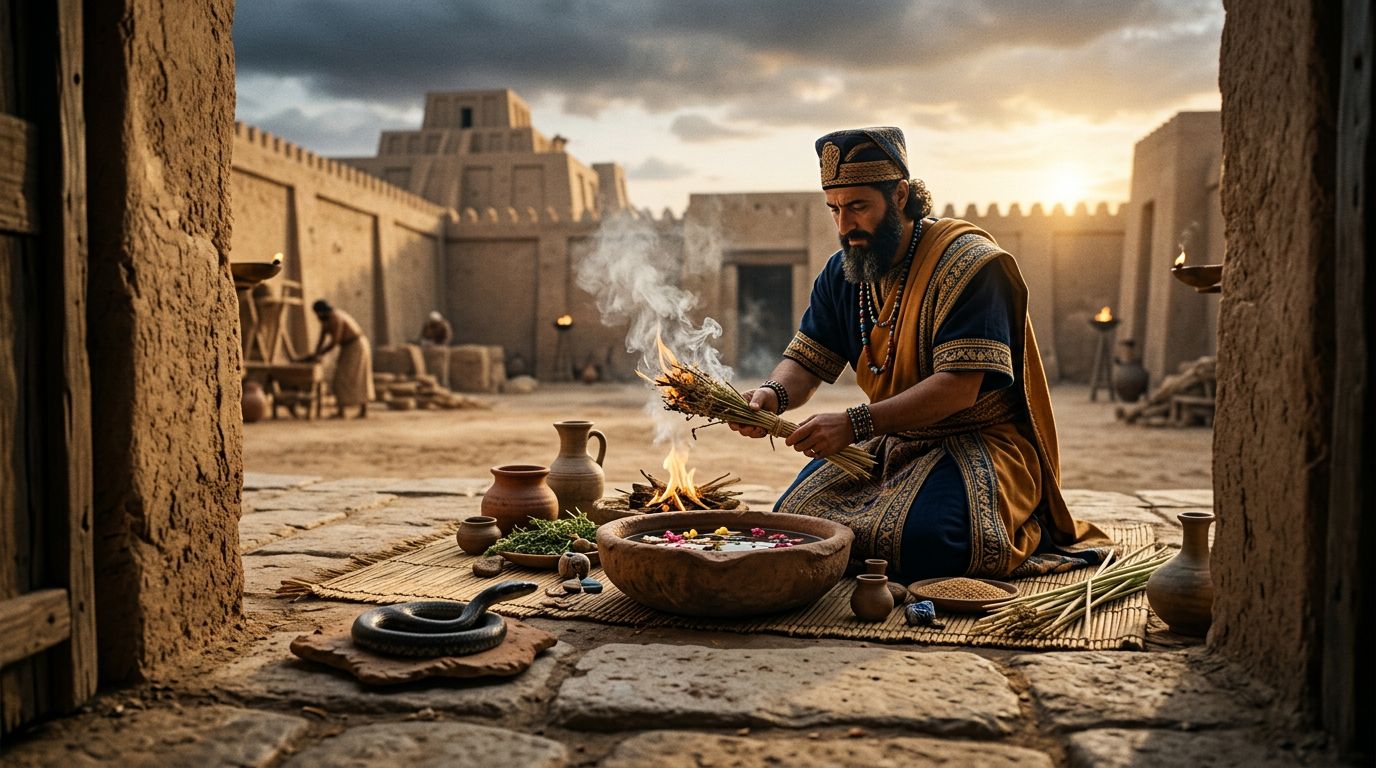
Picture a tense morning in ancient Mesopotamia, part of the wider ancient Near East. A snake crosses a threshold, a troubling dream lingers, or the moon darkens at an ominous hour. You wouldn’t simply shrug and carry on.
For Babylonian and Assyrian communities, Namburbi rituals offered a practical response to a bad omen. This apotropaic ritual aimed to release the harm an omen seemed to predict before it reached the household.
The warning mattered, but it wasn’t the final word. That is where the ritual began.
This post may contain affiliate links. If you make a purchase through these links, I may earn a small commission at no extra cost to you.
Key Takeaways
- Namburbi rituals were apotropaic rites intended to release the harmful consequence predicted by a bad omen before it reached a person or household.
- The rites responded to many kinds of signs, including eclipses, unusual stars, troubling dreams, snakes, and other disturbing events whose meaning depended on context.
- An ashipu, or ritual expert, guided the procedure through purification, incantations, offerings, divine appeals, and carefully ordered actions.
- Water, clay figurines, and changes of location or route helped symbolically separate the afflicted person from danger and carry the harm away.
- The surviving tablets were not merely copied literature; their imperative instructions show that they functioned as scripts for rituals performed in the ancient Near East.
What These Rites Were Meant to Undo
The name namburbi comes from the Sumerian NAM.BUR.BI, usually translated as “its undoing.” The “it” was not the omen itself. Nobody could make an eclipse uneclipse. It was the ugly consequence the sign was thought to announce.
A namburbi was therefore a preventive rite. It addressed danger that had been foretold but had not yet settled into ordinary life as illness, loss, conflict, or death. In the ancient Near East, ritual texts framed this as a formal response, not merely a belief to record. Prescriptive ritual texts set out what had to be done before the predicted consequence arrived.
The omen remained, but its harm could be released
These rites did not try to prove that a troubling sign was imaginary. They accepted that the world could send messages through the sky, animals, dreams, and strange events. Ritual texts focused on the harm that might follow. Prescriptive ritual texts directed the response away from the person who saw it.
A namburbi did not declare an omen false. It treated the omen as a warning whose harmful consequence could still be sent away.
That makes these rites more practical than they first sound. A troubling sign created anxiety, but it also created a course of action. There were words to say, materials to prepare, gods to address, and a place where the ritual had to happen.
An ancient form of protection
The scholarly term for this is apotropaic ritual, meaning a rite intended to turn harm aside. Yet the word can make the whole thing sound like a dusty museum label. Across the ancient Near East, an apotropaic ritual actively turned danger aside, but it offered no modern guarantee of safety.
These rites could be tailored to a particular problem. A frightening dream was not handled in quite the same way as a troubling animal sign, showing ritual innovation within a standardized practice. Still, the pattern stayed familiar. It began by cleansing the person or place through ritual washing and identifying the danger. The rite then transferred or dissolved it before placing the matter before divine powers who could set it right.
Which Bad Omens Needed a Ritual Response?
In ancient Mesopotamia, diviners watched for meaning in places most of us barely notice. Regional divinatory traditions across the ancient Near East read signals in the night sky, household, road, field, body, and animal behavior.
That doesn’t mean every odd event caused panic. A specialist had to judge whether a sign was threatening, unclear, or harmless. Context determined whether specialists classified it among evil portents. A snake sighting became a bad omen only under particular conditions, not simply because it was unusual. Where did it happen? Who saw it? What exactly did the creature do? A snake in the wild was one thing. A snake appearing where people slept was another matter entirely.
Signs in the sky, home, and dream world
Surviving Namburbi texts deal with celestial omens such as lunar and solar eclipses, unusual stars, and wandering planets. These ritual texts also address frightening dreams and terrestrial signs tied to a house, field, or person’s path. In the ancient Near East, celestial and terrestrial categories could overlap, but signs still demanded different responses. Prescriptive ritual texts connected each omen to an action, rather than simply recording a list of dangers.
A universal Namburbi, like other ritual texts, invokes Ea, Shamash, and Asalluhi against a broad range of dangers. It even leaves space for the afflicted person’s name, written as NENNI, meaning “so-and-so.” That small blank reflects ritual innovation, since the rite could be adapted to the person standing there. As prescriptive ritual texts, these works linked danger to action, not merely to a grand speech about evil.
Snake omens were about circumstance, not monsters
A snake omen is easy to sensationalize. It is also easy to miss the point. The snake was not automatically supernatural or malicious. Nor was it a demon in reptile form, waiting to ruin someone’s week. Its appearance could become ominous because of its location, timing, direction, or behavior.
The ritual answered the possible harm attached to the sighting. It did not punish the animal. That distinction matters. Namburbi practice dealt with the link people feared between an event and its future result, not with blame in the modern sense.
The Ashipu Turned Fear Into a Procedure
The person leading the rite was the ashipu, often described as an exorcist. The English label is useful, though it can give the wrong picture if it makes you imagine an entertainer or fortune-teller improvising in candlelight.
The specialist was trained in incantations, purification methods, offerings, divine names, and correct sequences for particular situations. He also studied scribal techniques for preserving those incantations in learned ritual texts across the ancient Near East, including the technical traditions discussed in work on the ashipu in narrative poetry.

A ritual expert, not a lucky charm seller
The ashipu’s role was both religious and practical, and his work constituted a formal apotropaic ritual. He prepared the space, recited the right formulae, handled ritual objects, and made offerings. He also helped determine what needed to be undone, adapting established formulas to each situation through controlled ritual innovation.
That training gave shape to a person’s fear. Instead of being left alone with an eclipse, a dream, or an alarming animal encounter, the client entered a known process. The steps were not casual, and ritual texts organized the work. Prescriptive ritual texts might name the day, location, garment, deity, and exact action required.
Ea, Shamash, and Asalluhi had distinct roles
Several gods appear repeatedly. Ea was associated with wisdom, fresh water, and incantatory power. Shamash, the sun god, was also a divine judge whose light exposed what was hidden. Asalluhi was a divine exorcist, later closely connected with Marduk.
A riverbank rite could begin with ritual washing, as the practitioner swept the ground and sprinkled pure water. Prescriptive ritual texts then direct the practitioner to set up a portable altar before Shamash and make a sacrifice. The ritual’s geography was not an afterthought. Riverbank, threshold, rooftop, and canal edge all marked sacred boundaries in the ancient Near East, between ordinary space and danger being pushed elsewhere.
Why Water and Clay Figurines Appeared So Often
Water is not just background scenery in these rites. It cleanses, carries away, and connects the rite to Ea’s deep freshwater domain, the apsu. Descriptions in ritual texts pair water with clay, which could be shaped into a substitute that took on part of the danger facing the client.
Modern readers sometimes call this sympathetic magic. The phrase is useful as a modern analytical label, if it doesn’t make the practice sound like a magic trick. The substitutions were serious acts, supported by prayer, sacrifice, cleansing, and divine authority.

The figurine gave danger somewhere else to go
Some prescriptive ritual texts call for two small figurines, one male and one female, made from clay. Other prescriptive ritual texts add figures made from dough, wax, or tallow, showing ritual innovation within the tradition. Names could be written on the left shoulder, while arms might be twisted behind their backs and feet bound.
The details are unsettling because they’re meant to be. A clay figurine could stand in for the afflicted person, the evil consequence, or a hostile force within the rite’s own logic. This apotropaic ritual used symbolic transfer, which resembles sympathetic magic. Since each text has its own wording, it’s safer not to force one explanation onto every figure.
Water completed the act of separation
After ritual purification and prayer, ritual washing helped separate the client from danger. The dangerous element could then be released into moving river water. Other ritual texts describe the river as more than a means of disposal. It carried harm from the client’s social and domestic space toward the apsu. That role reflects wider concerns in the ancient Near East about water and boundaries.
Some rites also required a change of route afterward. The client did not simply walk home as though nothing had happened. A different path marked a clean break with the danger. It is a rather human detail. When something has frightened you, doing the same thing in the same way can feel like tempting fate.
Questions about water, bodily cleansing, and formal ritual action also appear in research on Mesopotamian healing rituals. This practice sits within that larger concern for restoring safety through ordered action.
Were Namburbi Texts Used or Just Copied?
The short answer is both. The tablets are written documents, copied and preserved by scribes. They are also ritual texts that assume a ceremony will take place outside the tablet room, with a client, objects, water, offerings, and spoken words.
Around 140 texts are often grouped under the Namburbi label, though the boundaries of any ancient genre can be messy. Many survive in more than one copy. In ancient Mesopotamia, that repetition shows a living scribal tradition, not a single ceremony frozen in time. Copies also circulated across the ancient Near East, linking local traditions without making them identical.
Genre labels also need care. These materials belong among magical texts, but that label should not collapse every Mesopotamian ritual source into one category. Their function is that of an apotropaic ritual, turning predicted harm aside through prescribed actions. Related responses, including the substitute king ritual, show that threatening royal signs could prompt specialized procedures.
Full tablets and shorter working versions
Some tablets preserve extended prescriptive ritual texts, while others are abbreviated, excerpted, or adapted for narrower use. These differences reveal scribal techniques and ritual innovation within an inherited tradition, not a rejection of older forms.
A universal anti-omen text could work as a template. Scribes used scribal techniques to insert the affected person’s name where needed, adapting an inherited procedure through ritual innovation.
Namburbi tablets are well represented in Assyrian collections linked with the Library of Assurbanipal at Nineveh. That does not mean every tablet was copied for a king, or that every copy sat on one royal shelf. It does show that ritual knowledge was important enough to collect, copy, and organize. Assurbanipal’s scholarly program also supported their preservation, even though the collection reflects work by many specialists.
The instructions point to ritual performance
Imperative language is hard to ignore. These prescriptive ritual texts say: sweep the ground and sprinkle pure water. Then build an altar, make figures, and recite the prayer. These are not the habits of a text written only to be admired by later scribes.
Still, a tablet cannot show us every spoken pause, mistaken word, or nervous client. It preserves a formal version of ritual practice. These prescriptive ritual texts are best read as scripts for performance, shaped by generations of scribal copying.
The careful comparison with Torah rituals
Namburbi texts and biblical prescriptive ritual texts share recognizable features: prepared spaces, washing, offerings, specialist mediation, and spoken formulae. A thoughtful comparison of Namburbis and Torah rituals argues that both kinds of text can preserve instructions meant for real practice. Biblical rituals can address ritual impurity, while these rites focus on turning predicted harm aside.
The similarity should not be stretched into a claim of direct borrowing. These anti-omen rites are explicitly designed to counter ominous signs. Torah rituals often focus on purity, holiness, atonement, and covenantal order. The structures sometimes rhyme, but the religious worlds are not identical. This caution matters across the ancient Near East, where neighboring traditions could share forms without sharing theology.
Frequently Asked Questions
What was the purpose of a Namburbi ritual?
A Namburbi ritual was meant to undo the harmful consequence associated with a bad omen. It did not erase the sign itself, but sought to release its danger before it became illness, loss, conflict, or death.
Which omens could lead to a Namburbi ritual?
Ritual texts address celestial signs such as eclipses and unusual stars, as well as frightening dreams, snakes, and other terrestrial events. Whether a sign was dangerous depended on its location, timing, behavior, and the person who encountered it.
Who performed these rituals?
The ashipu, often translated as an exorcist, led the rite. This specialist knew the required incantations, purification methods, offerings, divine names, and ritual sequences.
Why were water and clay figurines used?
Water purified the person and carried danger away, often toward a river or the freshwater realm associated with Ea. Clay figurines could serve as symbolic substitutes for the afflicted person, the predicted harm, or a hostile force, allowing the danger to be separated and released.
Were Namburbi tablets intended for actual rituals?
Many tablets preserve instructions in imperative language, directing a practitioner to sweep, sprinkle water, make figures, build an altar, and recite prayers. Although scribes copied and adapted these texts, they functioned as formal scripts for ritual performance rather than as texts meant only for reading.
The Last Word Did Not Belong to the Omen
The rite did not promise that life would become safe forever. It offered something more immediate: a way to meet dread with trained hands, familiar words, and a belief that danger could be released before it became real.
That is why the tradition still feels close to us. Namburbi rituals turned an alarming sign into a sequence of actions, and action is often where fear begins to loosen its grip.


