
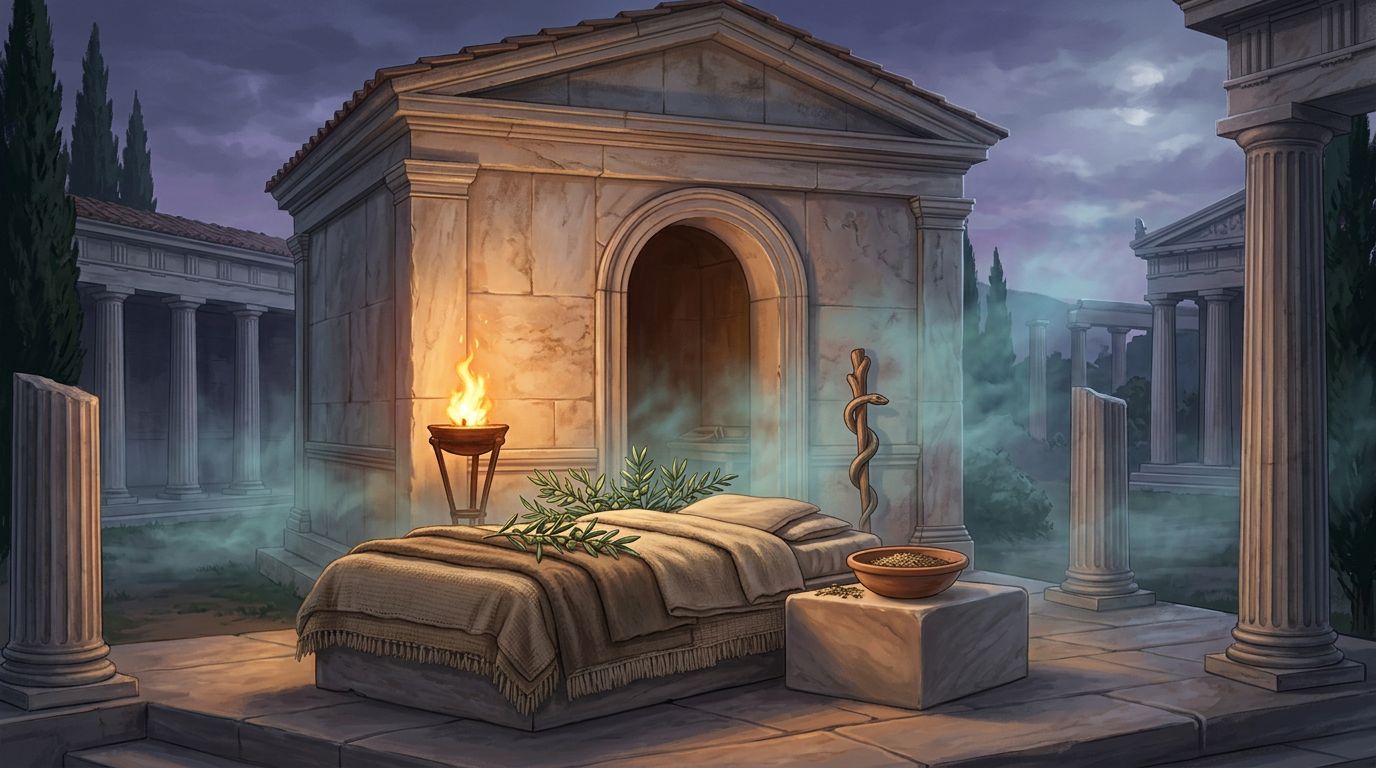
Picture arriving at Epidaurus with an aching leg, a small offering, and no expectation of a doctor’s waiting room. The hoped-for treatment was ancient Greek incubation, a night of ritual sleep in which a healing god might appear in a dream.
For worshippers, this was not a strange bedtime experiment. It was a serious act of hope, prayer, preparation, and public faith, carried out in sanctuaries built for people who were ill, injured, frightened, or simply out of options.
This post may contain affiliate links. If you make a purchase through these links, I may earn a small commission at no extra cost to you.
How Ancient Greek Incubation Turned Sleep Into a Rite
Ancient Greek incubation was called enkoimesis, meaning a ritual sleep undertaken in a sacred place. People usually sought Asclepius, the Greek god of healing, though other healing figures received visitors too, including Amphiaraus and Hygieia.
The point was not merely to have an interesting dream. A visitor hoped for a divine encounter that brought relief, a diagnosis, or clear instructions for what to do next. The National Archaeological Museum’s account of healing sleep describes sleep as central to sanctuaries dedicated to healing gods.
A visit to the god, not a nap
Asclepius was imagined as a healer with divine authority and recognisably human bedside manners. He could appear in a dream, inspect a wound, touch a patient, prescribe a remedy, or arrange a cure through one of his sacred animals.
That closeness mattered. A person did not pray toward a remote force in the sky and hope for the best. They travelled to the god’s own precinct, made an offering, and placed their sleeping body within his care.
The sanctuary was both religious and practical. It gave people a destination, a ritual routine, companions with similar fears, and a language for pain that did not treat illness as a private failure.
Why dreams counted as treatment
Dreams already had weight in Greek religious life. They could be messages, warnings, or glimpses of things that ordinary waking thought could not settle. At an Asclepian sanctuary, the dream had a particular job: it was expected to heal.
Sometimes the god was said to act directly. Other dream accounts gave instructions, such as using a remedy, changing a habit, or returning for another rite. The line between divine vision and practical treatment could be blurry, which is probably why the practice felt so persuasive to visitors.
Preparing for a Night in the Abaton
Temple sleep did not begin when someone closed their eyes. It began with the journey, the arrival, and a set of preparations meant to make the visitor ready for the god.
Details differed between sanctuaries and periods, so there was no single Greek rulebook tucked behind every altar. Still, purification, sacrifice, prayer, and offerings were common parts of the process.
Cleansing the body before seeking a cure
A visitor might bathe, abstain from certain foods or activities, and make an animal sacrifice. These acts were religious, but they also imposed a pause. You left home, stepped out of ordinary habits, and gave the illness a name in a place designed to hear it.
At some sites, the offering was modest. A poor visitor could bring a cake or a small object rather than an expensive animal. The point was participation, not a luxury package with complimentary divine intervention.
A study of Asclepieia as healing destinations describes purification and incubation as parts of a wider pilgrim experience. The sanctuary was not simply a building. It was a carefully staged change of setting.
Sleeping in the sacred hall
The sleeper entered a designated space often called an abaton or enkoimeterion. At Epidaurus, this was a long, covered sleeping hall within the sanctuary complex. It was likely a shared place, not a private consulting room with a curtain and a clipboard.
Visitors lay down and waited. Some sources describe sleeping on the skin of a sacrificed animal. Sacred snakes, linked with Asclepius, may also have moved through the sanctuary. To a modern reader, that last detail may sound like a firm reason to stay awake. For worshippers, it was part of the god’s presence.

The sleep itself was an act of trust. A pilgrim had prepared, offered, waited, and surrendered control for the night. That is a powerful structure for any healing story, even before the dream arrives.
Dreams, Cures, and the Marble Stories of Epidaurus
The strongest evidence for temple sleep at Epidaurus comes from the iamata, inscriptions that recorded cures credited to Asclepius. These were displayed on marble stelae where future visitors could read them.
Six surviving stelae preserve 43 healing stories, mostly dated to the fourth century BCE. They name patients, describe ailments, and explain how the god supposedly cured them.
The cure inscriptions were public testimony
One famous story concerns Ambrosia of Athens, who had blindness in one eye. She was said to have doubted the inscriptions already displayed at the sanctuary. In her dream, Asclepius treated her eye, and she awoke able to see.
The tale has drama, a sceptical patient, and a neat ending. It also has a message for every anxious visitor standing nearby: come in good faith, and the god can help you too.
A recent study of sleep incubation at Asclepieia treats enkoimesis as a ritual practice rather than a modern clinical procedure. That distinction keeps the inscriptions in focus. They are religious narratives, not hospital charts.
The marble cures prove that people sought healing, gave thanks, and remembered recovery. They do not prove that every reported cure happened exactly as the inscription says.
A story could prepare the next sleeper
Ancient Greek incubation depended on expectation. A visitor who read that others had been cured might approach sleep with confidence, fear, awe, or all three at once.
That does not make the experience fake. It makes it human. Hope affects how people endure illness, make decisions, and describe change. The Greeks built those feelings into the architecture, ritual, and stories of healing.
Why Epidaurus Became the Famous Healing Sanctuary
Epidaurus, in the Argolid region of Greece, became the best-known sanctuary of Asclepius. Its surviving buildings, inscriptions, and offerings give historians an unusually full picture of how a healing cult could operate.
The UNESCO overview of the Sanctuary of Asklepios describes a vast site of temples and healing-related buildings that illuminate Greek and Roman healing cults. It was a place of worship, but it was also a destination people travelled to for relief.
A sanctuary built for pilgrims
Visitors did not arrive, sleep, and vanish before breakfast. The wider complex had places for worship, movement, social life, and the practical business of receiving pilgrims. That mattered when illness had already pushed someone far from home.
The sanctuary’s famous theatre often steals the spotlight now, because it is remarkably well preserved. For ancient visitors, though, the sleeping hall and sacred precinct may have carried the sharper emotional charge. The theatre is impressive. A god meeting you in a dream is harder to forget.
Epidaurus was not the only place to sleep for healing
Asclepius had sanctuaries across the Greek-speaking world. Pergamon in Asia Minor became another major healing centre, especially during the Roman imperial period. Trikka, on the Greek mainland, also had a long association with the god.
Practices varied by place and date. Epidaurus has the richest surviving evidence, so it should not be treated as a perfect template for every sanctuary. The University of Warwick’s description of Epidaurus helps show how much of the site still shapes what we can say with confidence.
Snakes, Body Parts, and Thank-You Gifts
A sanctuary told its healing stories in more than words. People left physical reminders of their needs and their gratitude, including small models of body parts, relief sculptures, and inscriptions.
An eye, ear, leg, breast, womb, or hand made a pointed request. It could also mark a cure that the visitor credited to Asclepius.

Votive offerings made suffering visible
These offerings are among the most moving remains from ancient healing cults. A sculpted foot may look simple in a museum case, but it once stood for a person’s pain, mobility, work, and hope of returning to ordinary life.
They also show that temple healing was public. A recovered visitor could leave evidence behind, which encouraged the next person who arrived with the same problem. The sanctuary became a growing archive of illness and survival.
The snake belonged to Asclepius
Snakes were closely tied to Asclepius and appeared in his imagery, often around his staff. Their ability to shed skin encouraged associations with renewal, while their movement between hidden and visible spaces suited a god connected to mystery and recovery.
That symbolism should not be mistaken for a medical claim. A sacred snake was a sign of divine healing within the cult. It was not an ancient version of a prescription bottle.
Temple Sleep Was Religion, Not Modern Medicine
It is tempting to call Epidaurus an ancient hospital. The comparison has limits. Sanctuaries addressed sickness, but they did so through sacrifice, dreams, divine authority, offerings, and stories of intervention.
Greek physicians also existed, and Hippocratic medical writers developed explanations for disease that did not rely on a god appearing at the bedside. Many people could use both worlds without finding the combination odd.
Why reported cures need careful reading
The iamata do not meet modern standards for medical evidence. They do not offer controlled comparisons, diagnostic records, or a way to test whether a cure can be repeated.
Some stories are also wonderfully dramatic. A god may perform a dream operation, restore sight, or solve a problem that has defeated ordinary treatment. Their purpose was to honour Asclepius and encourage trust, not to satisfy a modern research review.
Ancient Greek incubation should never be presented as a replacement for evidence-based care. Serious symptoms deserve qualified medical attention, no matter how compelling an ancient cure story may sound.
What temple sleep can still teach us
The practice shows that healing has never been only about a body part. People need explanation, rest, ritual, community, and room for hope, especially when illness makes life feel chaotic.
That is not a claim that dreams cure disease. It is a reminder that patients have always brought fear, belief, memory, and expectation into places of treatment. The Greeks understood that much, even if they explained it through Asclepius.
The Lasting Meaning of Temple Sleep
Ancient Greek incubation was a night spent waiting for a god, but it was also a carefully organised response to suffering. Pilgrims travelled, purified themselves, offered gifts, slept in sacred space, and carried their dreams into daylight.
The marble inscriptions and votive body parts leave behind something more durable than a miracle claim. They show ordinary people asking to be whole again.
Temple sleep matters because it records that hope, like illness, has a history.


