
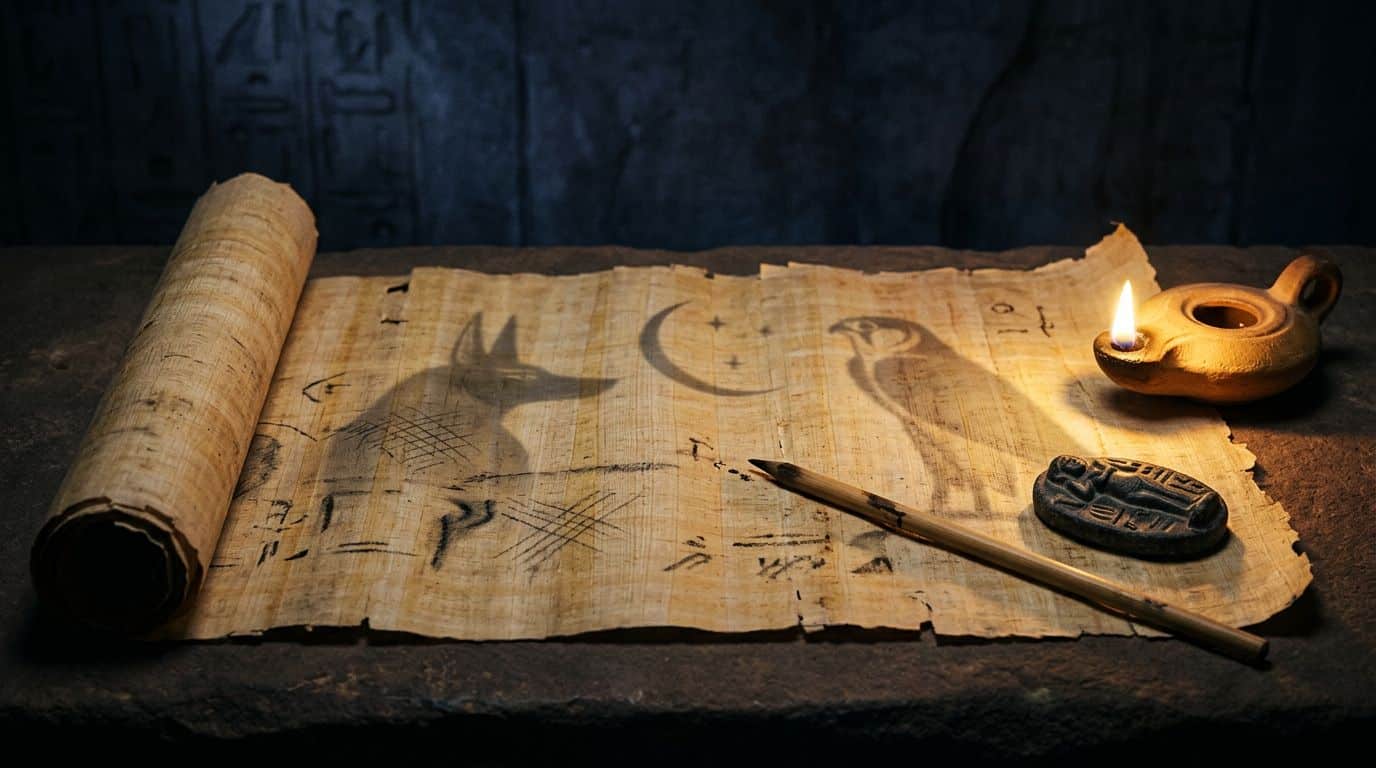
A nightmare can leave you with a strange feeling long after breakfast. For ancient Egyptians, it could also carry a warning, a promise, or an upsetting glimpse of what might lie ahead.
These manuals gave trained readers a way to sort that unease into a practical answer. They did not ask how a dream made you feel. They asked what you saw, what you did, and whether the outcome was good or bad.
The most famous surviving example comes from a scribal community near the Valley of the Kings. It is now held by the British Museum, where it remains a record of how seriously ancient Egyptians approached dreams, letters, rituals, and official records.
This post may contain affiliate links. If you make a purchase through these links, I may earn a small commission at no extra cost to you.
Key Takeaways
- Ancient Egyptian dream books treated dreams as omens, using concrete images and actions to reach a favourable or unfavourable judgment.
- Papyrus Chester Beatty III, found at Deir el-Medina and now held by the British Museum, is the best-known surviving Egyptian dream manual.
- The manuscript used a repeated formula, with bad outcomes marked in red, and sometimes gave frightening images surprisingly positive meanings.
- Dream interpretation belonged to a wider world of scribal learning, religious practice, ritual protection, and household knowledge rather than to priests alone.
- The tradition continued beyond the New Kingdom in later Demotic, Greek, and bilingual dream texts.
The dream book found at Deir el-Medina
The best-known Egyptian dream manual is Papyrus Chester Beatty III, a manuscript written on hieratic papyrus. It was found at Deir el-Medina, the workers’ village on the west bank of Thebes, not far from the royal tombs in the Valley of the Kings.
This was no sleepy little settlement. The community housed skilled workmen, artists, and scribes who built and decorated royal tombs. A household with books, letters, copied literature, and magical works makes far more sense here than it might at first glance.
A workers’ village with a serious library
The papyrus was part of a larger private historical archive. That matters because it changes the usual picture of dream interpretation.
You might imagine a grand temple, a nervous visitor, and a priest speaking in riddles beside a column. That did happen in some religious settings. Yet this particular text also belonged to a literate community where people copied, kept, and passed down written knowledge.
Its dream manual appears on the recto, or front side. The reverse holds other literary works. The British Museum’s record for Papyrus Chester Beatty III identifies the object as a hieratic dream book divided across four frames.
A manuscript from Ramesses II’s reign
Papyrus Chester Beatty III dates to the Nineteenth Dynasty, during the reign of Ramesses II. The British Museum dates it to about 1220 BCE.
It is often described as the oldest surviving fully developed manual of dream interpretation from ancient Egypt. That description needs a little care: it was one of several ancient divinatory manuals, rather than a modern dream dictionary. Dreams were recorded much earlier in several ancient cultures. What makes this papyrus special is its length, its orderly format, and the number of interpretations it preserves.
It was not a diary of one person’s strange nights. It was a reference book. That is the difference between hearing someone tell a dream and finding the shelf where its possible meaning has already been filed.
What Egyptian dream books actually recorded
The writing is in hieratic, a fast cursive script used by Egyptian scribes. It looks nothing like the monumental hieroglyphic text seen on temple walls.
The format is brisk and repetitive. Each entry begins with a version of: “If a man sees himself in a dream…” Then comes the image, the verdict, and the interpretation.
Dreams were sorted by action and image
The book deals with common human experiences, although “common” does some heavy lifting here. A dreamer may see himself eating, drinking, receiving something, making love, travelling, looking into water, or meeting an animal.
Some discussions describe around 108 dream scenes and 78 kinds of activity. Other counts describe the surviving manuscript as preserving about 222 individual entries. These numbers are not a neat disagreement. They measure different parts of a damaged text, whose beginning and ending have not survived.
The important point is that the book is not random. It groups dreams by what the dreamer does or sees. A person was not handed a vague message about “change coming your way.” They were given a judgment tied to a concrete scene.
Bad omens were written in red
Egyptian scribes usually wrote in black ink. In this dream book, the word for a bad outcome appears in red, the colour of danger and ill omen.
That little visual jolt matters. Before you even reached the explanation, the red word told you the dream had taken a turn. The Google Arts & Culture view of the Dream Book shows how the repeated formula, black ink, and red warnings give the papyrus its rhythm.

A nightmare was not always bad, though. An unpleasant image could receive a reassuring interpretation, complicating the modern division between good and bad dreams. That is what makes the book far more interesting than a simple list of symbols.
Why a frightening dream could have a good meaning
Ancient Egyptian dream interpretation was not therapy in the modern sense. The interpreter was not trying to trace a nightmare back to childhood, workload, or an unfortunate late-night meal.
Oneiromancy, the practice of interpreting dreams, was a way to divine the future. Dreams were treated as omens, with meanings shaped by religious ideas, wordplay, opposites, and established associations between images and outcomes.
Death could mean a long life
One striking entry says that seeing oneself dead is good. The interpretation is a long life.
That sounds backwards until you stop treating the book as a modern dream dictionary. A dream image did not always predict itself. It could point to its opposite, use a pun, or draw on a religious association that made sense to the reader.
Other entries are equally blunt. Seeing oneself eating crocodile flesh is good and points toward becoming an official. Looking at one’s face in a mirror is bad and suggests the arrival of another wife. No soft edges. No gentle “perhaps consider your boundaries.”
The verdict came before comfort
For someone frightened by a nightmare, the system offered a clear answer. The dream was either favourable or unfavourable, then the reader explained what it pointed toward.
That certainty may have felt reassuring, even when the verdict was bad. Uncertainty is often the part that lingers. A written diagnosis, however alarming, at least gave the dreamer a name for the trouble.
A red judgment did not explain why a person had a nightmare. It told them that the dream belonged to a category that required attention.
Priests, scribes, and the work of reading nightmares
It is tempting to say priests read every nightmare in Egypt. The truth is more interesting and less tidy.
Priests took part in rituals, healing, divination, and temple life. Scribes copied religious and practical texts. Ritual specialists may have combined learning with religious duties, while some households could consult texts themselves. Papyrus Chester Beatty III does not describe a priest interpreting a named person’s dream at a specific ceremony.
The papyrus is a manual, not a consultation transcript
What it preserves is a tool for an educated reader. A priest, scribe, ritual specialist, or household member with access to the text could match a dream image with its written judgment.
Dreams also mattered in temple settings. People sometimes sought healing or divine guidance through sleep in sacred places, a practice often called dream incubation. That possibility doesn’t prove every nightmare was read by a priest, or that this papyrus guided every temple encounter.
The manual is more practical than theatrical. It offers a pattern for reading, not a dramatic scene.

A bad reading invited a response
A frightening dream could prompt protective action, prayer, ritual speech, or a request for help from someone with religious knowledge. The surviving manual doesn’t provide a tidy response for every troubling sign.
That absence is useful. It keeps us from imagining one standard Egyptian reaction to fear. One person may have sought ritual protection, while another simply worried about the dream all day. Human beings have always been inventive in that department.
The dream book became a family heirloom
The manuscript did not remain untouched after it was copied. It passed through several owners, which is one reason it feels so human.
The book was used, stored, and inherited in a working community, where dream books could circulate within a household. Its preservation resembles that of ancient manuscripts, kept because someone still found them useful.
Qenherkhepshef and the later owners
The dream text itself was copied in a fine literary hand by an unknown scribe. The verso contains texts written by the scribe Qeniherkhepshef, with Qenherkhepshef as a spelling variant.
He was a well-known Deir el-Medina scribe. Later ownership notes connect the papyrus to Khaemnun, sometimes rendered Khaemamen, and then to Amennakht.
The British Museum catalogue records this chain of ownership across generations. These names show a manuscript moving through a household over time.
That small chain of ownership changes how we understand the papyrus as a historical artifact. It was a source of learned knowledge, yes. It was also something someone had to store, protect, inherit, and decide was worth keeping.
The reverse side contains a poem about the Battle of Kadesh and a letter to the vizier. Together, they make the papyrus an ancient literary source as well as a dream text.
Dreams sat beside literature and correspondence. They were not separated into a special drawer marked “mysterious matters.”
Dream books did not end with the New Kingdom
The Ramesside papyrus is famous because it is early and well preserved. It is not the whole story of the tradition’s chronological evolution, which continued through later Demotic and bilingual material.
Dream interpretation continued through later Egyptian history, even as the scripts, languages, and political rulers changed.
Hieratic gave way to Demotic texts
Later dream books were often written in demotic Egyptian, the script used for many everyday and administrative texts in the first millennium BCE. The history of Demotic script helps explain why this writing looked so different from older hieratic manuscripts.
The later books could arrange material by subject rather than by a fixed type of dreamer. They also survive in greater numbers than the early hieratic examples.
Livia Prada’s Oxford study of the tradition follows the tradition from the New Kingdom into the Roman period. The surviving Demotic manuals stretch from the fourth century BCE to the third century CE.
Greek joined the conversation
Egypt under the Ptolemies and Romans was multilingual. Greek dream material circulated beside Egyptian texts, and some papyri used both Greek and Demotic.
A study of bilingual Ptolemaic dream papyri describes one writer switching into Demotic because he believed it allowed him to tell the dream properly. That is a lovely detail. Even in a bilingual society, the language of a dream could feel important.
The tradition was not frozen in the Ramesside age. It changed hands, scripts, and languages while keeping the old question alive: what did that unsettling thing in the night mean?
How to read these texts without forcing modern ideas onto them
These texts can sound familiar because we still search for meaning after strange dreams. Yet the resemblance only goes so far.
A modern reader may use dream analysis to explore anxiety, memory, grief, or stress. A reader in antiquity could see a sign within a moral and religious order shaped by spiritual beliefs.
Read the formula before the image
The repeated wording is the key to the manuscript, turning each personal experience into a category.
Before interpreting individual images, readers should consider the formula, genre, and religious setting within their historical context. That system does not tell us every Egyptian believed the same thing. It tells us that trained readers had a shared framework for discussing dreams. Think of it as a handbook for interpretation, not a census of private belief.
Leave room for what we cannot know
We do not know who first copied the manuscript. We do not know how often its owners consulted it. We cannot recover the voices of worried people who may have brought dreams to a priest or scribe.
Those gaps are part of the story. The papyrus gives us a rare written answer, but it cannot give us every question that brought someone to seek it.
Frequently Asked Questions
What is the oldest surviving Egyptian dream book?
Papyrus Chester Beatty III is often described as the oldest surviving fully developed manual of dream interpretation from ancient Egypt. It dates to around 1220 BCE, during the reign of Ramesses II.
How did ancient Egyptians interpret nightmares?
Readers matched a dream’s image or action with a written judgment about its likely meaning. The result could be favourable or unfavourable, and a frightening image did not always receive a bad interpretation.
Did priests read every Egyptian dream?
Not necessarily. Priests and ritual specialists may have interpreted dreams in religious settings, but scribes or household members with access to a manual could also have used its entries.
Why were some bad dreams considered good omens?
Egyptian dream interpretation could rely on opposites, wordplay, and religious associations rather than taking an image literally. Seeing oneself dead, for example, was associated with a long life in one entry.
What happened to Egyptian dream books after the New Kingdom?
The tradition continued in later Demotic and bilingual Egyptian-Greek texts. Dream manuals survived into the Ptolemaic and Roman periods, changing scripts and languages while preserving the practice of seeking meaning in dreams.
The lasting pull of Egyptian dream books
The red ink, the strict formulas, and the odd reversals make these manuals feel wonderfully close and very far away at once. A frightening dream could still trouble a person, but it did not have to remain shapeless.
Papyrus Chester Beatty III, now held at the British Museum, gave nightmares a place in a written order. Three thousand years later, that urge to turn a bad night into an answer still feels familiar.


