
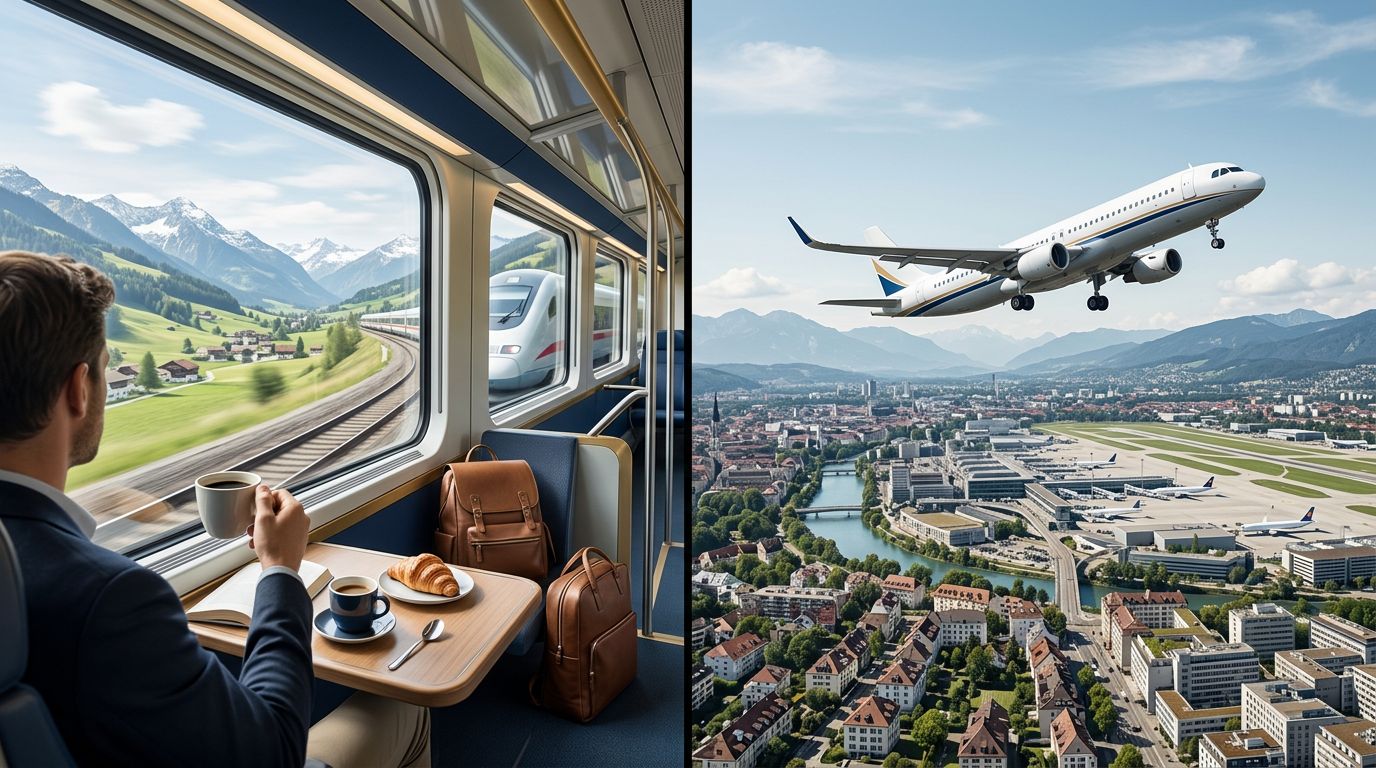
A relaxed holiday can become a small endurance test before you’ve even checked into your hotel. There is the airport bus, airport security, the gate change, and the polite scramble for space in the overhead compartment.
The real question behind train travel vs flying Europe is not which option wins on paper. It is which one lets you arrive with enough energy left to enjoy the place you came to see, rather than letting the journey shape your overall travel experience.
This post may contain affiliate links. If you make a purchase through these links, I may earn a small commission at no extra cost to you.
Key Takeaways
- Compare total door-to-door travel time, not just the time spent in the air or on the rails. For city-center routes of around four or five hours or less, high-speed trains are often faster once airport transfers, security, and boarding are included.
- Trains are usually the calmer and more comfortable choice for medium-distance journeys, with central stations, roomier seating, flexible luggage policies, and the freedom to move around.
- Flying can be better value or more practical for long distances, islands, remote destinations, and routes where several train connections would consume most of the day.
- Compare the complete cost of each journey, including airport transfers, baggage, seat selection, food, rail reservations, and possible Eurail pass costs.
- For routes where both options are practical, trains generally produce fewer carbon emissions, while combining flights and rail can be the most sensible choice for a wider European itinerary.
Train Travel vs Flying Europe: Start With the Kind of Holiday You Want
If your plan involves Paris, Brussels, Amsterdam, Florence, Rome, Madrid, or Munich, the European train system often fits the mood better. Navigating major hubs by rail connects these cities conveniently, with stations that tend to place you near the useful bits of a city, not beside a runway and a motorway.
You can leave a hotel after breakfast, roll a suitcase to one of the central train stations, and be watching fields, villages, and the occasional stubborn goat by mid-morning. There is no need to treat the journey as dead time.
Flying makes more sense when distance is the main problem. A trip from Lisbon to Prague, Dublin to Athens, or Barcelona to Istanbul can swallow most of a day by rail, even when direct flights are available. Even the most charming carriage cannot make a 15-hour routing feel like a casual afternoon.
The useful dividing line is usually about four or five hours of total travel time. On city-center routes below that point, a high-speed train is often ideal for a city center to city center journey once airport transfers and early arrival times are counted. Purchasing fast train tickets can save time over flying, too. London to Paris on Eurostar takes around two hours and 16 minutes on the train, while the airport version can easily take five hours door to door.
The flight time is only the part spent in the air. Your holiday clock starts when you leave the hotel and stops when you reach the next one.
For a relaxed vacation, that difference matters more than people expect. Nobody looks back fondly on the time they saved by eating a sandwich under fluorescent lights at an airport gate.
The Door-to-Door Time Is What You Actually Feel
A flight may appear faster because the timetable says 90 minutes. Then the hidden pieces start piling up, especially when flying into distant secondary airports or choosing cheap flights that land far from downtown.
Most European airports are outside the center. Getting there may mean a taxi, an airport train, or a bus that makes one extra stop because life enjoys a joke. You also need to arrive well before departure, clear airport security, wait to board, collect luggage, and travel into the next city, all of which adds to your total travel time.
Train stations often sit much closer to the center, reducing the door-to-door hassle. They have queues too, especially on Eurostar and international services. Still, they are often gentler. You can usually arrive closer to departure, keep your luggage beside you, and walk straight into the center after arrival.
Take Rome and Florence. A high-speed train covers the route in about 90 minutes, offering a simple city center to city center connection with minimal total travel time. A flight may be short in the air, but reaching both airports, waiting, and travelling back into town turns it into a much longer affair. The train is not merely quicker. It is less fiddly.
The same goes for Amsterdam to Brussels, Paris to Lyon, and Barcelona to Madrid. These are routes where a train carries you between places you actually want to be, without the uncertainty of unexpected flight delays.

Photo by Margis 233
A plane can still be the sensible answer when a direct route saves many hours. There is no medal for taking three regional trains, changing platforms in the rain, and arriving too tired to appreciate your lovely little hotel.
Cost Depends on the Whole Trip, Not the First Fare You See
Budget airlines Europe have trained us to stare at a fare of EUR19 as though it has fallen from heaven. Sometimes cheap flights are a good deal. Other times, that headline price is the beginning of a bill with several small, annoying footnotes.
Add airport transport, seat selection, checked bags, cabin-bag rules, and food. Low cost carriers often charge extra fees for these basics, and a cheap flight can become less cheap with alarming speed, particularly for two people travelling with proper luggage.
Flight baggage limits can be restrictive, while a train operator’s baggage policy is often more flexible. On Eurostar, for example, standard passengers can take two bags plus one piece of hand luggage without the familiar ritual of weighing socks against toiletries. That is useful if you are taking a two-week trip rather than a heroic weekend with one tiny backpack.
Rail is not always cheaper. A Greenpeace price study found flights cheaper on 79 of 112 European routes it examined. Cross-border rail fares can be stubbornly high, especially when booking late or crossing several national networks. The overall travel costs may look very different when you compare advance train tickets with a Eurail pass or separate point-to-point tickets.
There is no tidy rule here. Domestic rail in Italy and Spain can be excellent value when booked early. A last-minute international sleeper berth can cost more than a flight and a decent dinner. Families, travellers with luggage, and anyone staying near a central station often get a better deal from the train once every cost is on the table.
The sensible comparison is simple: price the complete journey. Include the ride to the airport, baggage, and the ride from the arrival airport. Then compare that number with the train fare, rather than searching only for headline cheap flights.
Comfort Is More Than Extra Legroom
The difference becomes obvious about 40 minutes into a journey. On a train, you can stand up, stretch your legs, visit the cafe carriage, or stare out of the window without being told to remain seated.
That freedom improves the overall travel experience. You can move around the carriage when you need to, rather than staying confined near an overhead compartment while waiting for the journey to end. A train feels like part of the holiday. A plane often feels like a chore that must be completed before the holiday is allowed to begin.
Seats are generally roomier, and a table seat gives couples, families, and friends space to play cards, read, or eat a picnic bought five minutes before departure. You can also work if you must, though taking a laptop to Lake Como is a decision between you and your conscience.

Scenic views are not a minor perk. From a high-speed train crossing between scenic regions, you can watch the landscape change through the window, while routes such as the Bernina line through the Swiss Alps, the West Highland route in Scotland, and coastal stretches in Italy offer scenic views that make the geography between destinations part of the journey. Flying turns Europe into a series of airport lounges. Rail lets the countryside remain part of the story.
Of course, not every rail journey is dreamy. A crowded regional train in summer, with broken air conditioning and nowhere for a suitcase, can test anybody’s patience. But it is usually easier to recover from than unexpected flight delays that strand you 45 minutes outside the city, or a difficult arrival at distant train stations.
Flexibility, Night Trains, and the Trouble With Connections
Rail travel rewards a little planning. Train tickets are often cheapest when bought in advance, although flexible point-to-point tickets can be worthwhile when your itinerary may change. A Eurail pass offers broader flexibility, but some routes still require train reservations, and even a Eurail pass may not cover every supplement. Apps from national operators such as SNCF, Trenitalia, Deutsche Bahn, Renfe, and OBB help you check schedules, seat reservations, and disruption notices.
Connections are the chief risk. A 12-minute change might look elegant on a timetable. It looks less elegant when your first train is late and your second platform is at the far end of a station built in 1890. On a slow-paced trip, leave a larger buffer or book fewer stops.
Sleeper trains deserve their own honest mention. Booking a comfortable sleeper train can save a hotel night and carry you across a long distance while you sleep, but comfort depends heavily on the berth you choose. A private compartment is peaceful. A shared six-berth cabin with strangers and a snorer is a social experiment.
Research on overnight train capacity notes that night trains can carry more passengers than the narrow-body aircraft common on short and medium routes. Across the wider European train system, night trains can preserve precious daytime hours, although they don’t always offer the same travel time or convenience as booking multiple direct flights. That does not make every sleeper service cheap or convenient. It does make them worth considering when a daytime rail trip would eat an entire holiday day.
Flying is more forgiving when a single direct flight replaces several trains. It is also handy for islands, remote areas, and destinations where rail connections are sparse. A relaxed traveler does not need to prove loyalty to either mode of transport.
The Environmental Choice Is Usually Clear
For journeys where both options are practical, using the electric infrastructure of the modern European train system generally produces fewer carbon emissions per passenger than flying. That is one reason rail feels especially appealing for short and medium European routes, with a lower overall environmental impact.
Still, guilt is not a useful travel planner. Taking one flight to reach a distant country does not cancel a thoughtful holiday. You can fly when it genuinely saves time, then use trains and local public transport for the middle legs of a multi-stop travel itinerary.
A Paris, Lyon, Avignon, and Nice itinerary works beautifully by rail. A route linking Athens, Sicily, and Portugal may need a flight or two unless you have weeks to spare, although trains and public transport can still shape much of the journey. The goal is not purity. It is choosing the option that suits the distance, your budget, and your patience.
Frequently Asked Questions
Is train travel better than flying in Europe?
For short and medium-distance routes, train travel is often better because stations are central and the journey involves fewer queues and transfers. Flying remains more practical for long distances, islands, and destinations with limited rail connections.
When is it faster to take the train than fly?
A train is often faster door to door when the total journey takes around four or five hours or less. High-speed routes such as London to Paris, Rome to Florence, and Paris to Lyon can save time once airport transfers and early arrival requirements are included.
Is travelling by train in Europe cheaper than flying?
Not always. Budget flights can be cheaper on some European routes, but airport transport, baggage, seat selection, and food can make the final price much higher, so compare the complete cost with train fares or a Eurail pass.
Are trains more comfortable than planes for European travel?
Trains generally offer more space, easier luggage handling, scenic views, and the chance to stand up or walk around. They can still become crowded or uncomfortable, particularly on busy regional routes during summer.
Should I use both trains and flights on a European holiday?
Yes. A combination is often the most practical approach, with trains used for scenic city-to-city routes and flights reserved for long distances, islands, or awkward connections. This lets you save time without turning every journey into an airport day.
The Relaxed Choice Is the One That Leaves You Ready to Arrive
The best answer to train travel vs flying Europe changes with every route. Compare overall travel costs, total door-to-door time from city center to city center, and the generous baggage policy often offered by rail before choosing speed alone. A high-speed train booked through a Eurail pass can make regional hops across the European train system feel simple and comfortable.
Trains are usually the calmer choice for medium distances, city-center stays, scenic routes, and travellers who’d rather sit with a coffee than queue at security. A comfortable sleeper train or one of Europe’s night trains can also turn an overnight journey into useful holiday time.
Flying earns its place when geography gets bossy. Long distances, islands, awkward borders, and limited holiday time can make a plane the kindest option. A relaxed European vacation has room for both, so take the train when the journey can be part of the pleasure, and fly when it gets you to the pleasure without turning travel day into a full-time job.


