
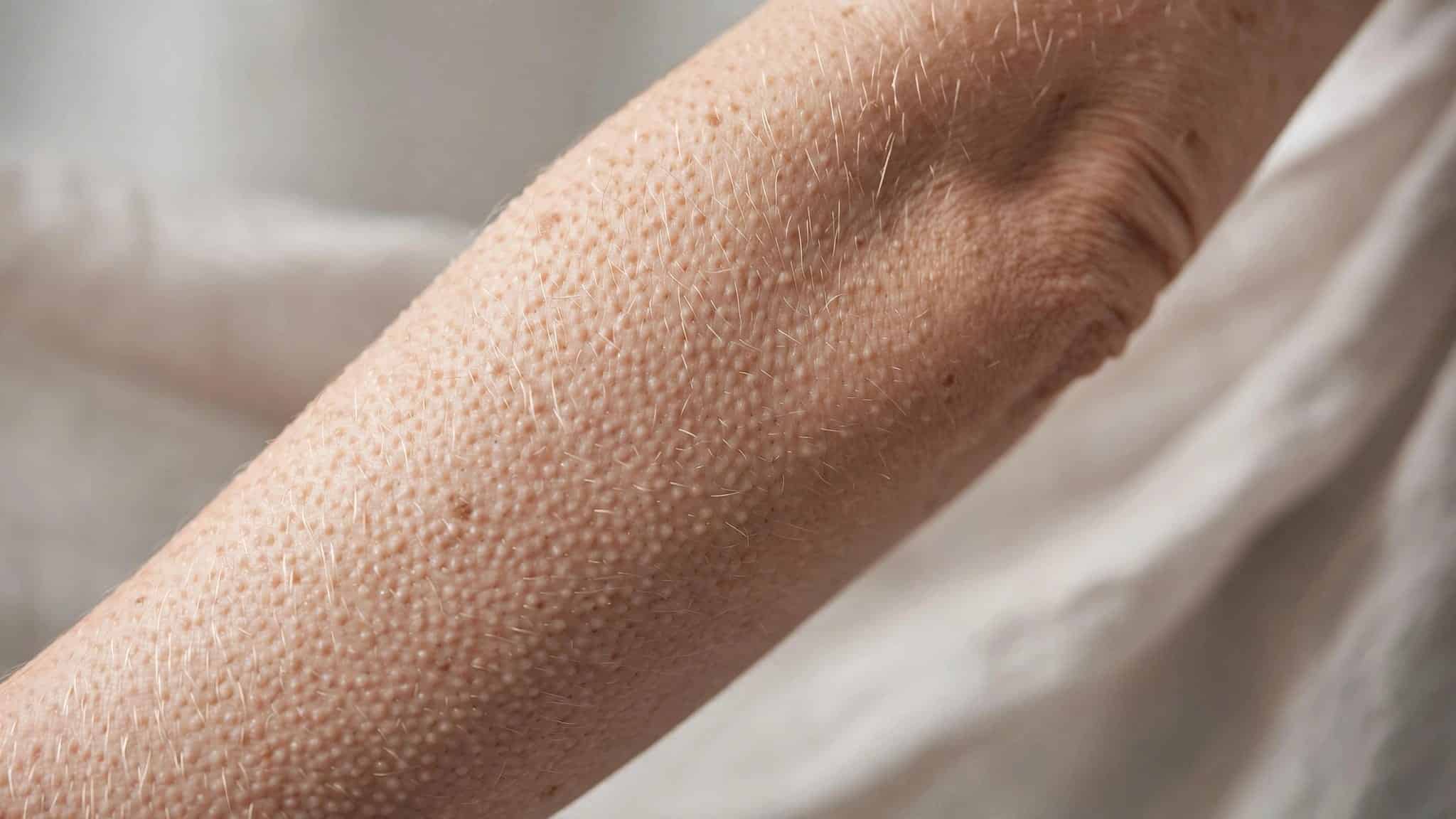
Goosebumps appear when tiny muscles in your skin contract, pulling your hairs upright and creating small bumps around them. The reaction happens automatically, often when you’re cold or feeling a strong emotion.
It’s a curious bit of multitasking. How can a chilly breeze and a moving piece of music produce the same physical response? The answer starts just beneath your skin.
This post may contain affiliate links. If you make a purchase through these links, I may earn a small commission at no extra cost to you.
How goosebumps form on your skin
Each bump begins with a hair follicle, the small structure in your skin where a hair grows. Attached to the follicle is a tiny muscle called the arrector pili. You have many of these muscles across your skin, and they usually go about their business without attracting much attention.

Tiny muscles pull on hair follicles
When an arrector pili muscle contracts, it pulls on its hair follicle and the surrounding skin. The hair stands more upright, and the skin forms a little bump.
This process is called piloerection, a rather grand name for something you might notice while waiting for the bus. Once the muscles relax, the hairs settle and the bumps disappear.
Your nervous system gives the signal
The muscles don’t decide to contract on their own. They respond to signals carried by the sympathetic nervous system, which helps control automatic reactions throughout your body.
You don’t need to ask your skin to raise its hairs, any more than you need to instruct your heart to beat. Your nervous system handles that particular detail for you.
Why does cold give you goosebumps?
When you feel cold, your body responds in several ways to help manage its temperature. Goosebumps can appear alongside shivering and changes in blood flow, although each response works a little differently.
Shivering involves repeated muscle contractions that produce heat. Goosebumps raise your body hair, but they don’t provide much insulation for a person with relatively little body hair.
Your circulation also responds to cold. Blood vessels near the skin can narrow, which helps reduce heat loss but can leave your hands and feet feeling chilly. That’s part of why toes get cold in winter.
A warmer effect for furry animals
Raised hair is more useful when there’s a thick coat to work with. In furry animals, it can help trap a layer of air close to the skin, providing insulation.
A raised coat can also make an animal look bigger when it feels threatened. If you’ve seen a frightened cat puff up, you’ve seen a similar hair-raising response put to work. Humans have inherited the same basic mechanism, even if our arm hair doesn’t make much of a winter coat.
Why can music or fear cause goosebumps?
Cold isn’t the only thing that can activate this response. A frightening scene, a beautiful song, or a moment that leaves you feeling moved can bring on goosebumps too.
Strong feelings can reach the skin
Emotions can set off physical changes without you choosing them. Think of your heart racing when you’re startled or your palms becoming sweaty before a difficult conversation.
Goosebumps are another possible response to emotional arousal. A review of research on emotional piloerection describes goosebumps in connection with experiences that can be positive as well as negative.
Music chills don’t happen to everyone
A singer’s voice or an unexpected change in a piece of music might give you a wave of chills. You may feel it in your arms, your neck, or elsewhere, sometimes with visible goosebumps.
Your friend can listen to the same song and feel nothing unusual on their skin. People differ in their responses, and a particular piece of music won’t affect everyone in the same way. A lack of goosebumps doesn’t mean you aren’t enjoying it.
Could goosebumps have another job?
There’s more to those tiny muscles than a brief reaction to cold. Research in mice suggests that the nerves and muscles involved in goosebumps also have a relationship with the stem cells that help hair grow.
The National Institutes of Health describes research in which sympathetic nerves connected with hair follicle stem cells. In mice exposed to cold for longer periods, nerve activity helped activate those cells and promote hair growth.
That’s an intriguing connection, but it doesn’t mean a few minutes of goosebumps will make your hair grow faster. The work was done in mice, and a visible skin response is only one part of a much more complicated process.
Are goosebumps the same as chills?
People often use the words together, but they describe different things. Goosebumps are the visible bumps on your skin. Chills are a sensation of cold or shivering, and they can happen with or without those bumps.
For example, you might get goosebumps during an emotional moment without feeling cold. You can also have chills when you’re ill, alongside a fever or other symptoms. The sensation and the bumps may overlap, but one doesn’t always tell you the whole story.
When should skin bumps get attention?
Ordinary goosebumps are temporary. They usually disappear once the trigger passes and the little muscles relax.
Bumps that stay around, itch, hurt, or look inflamed may have another cause. Conditions such as keratosis pilaris or folliculitis can also produce bumps around hair follicles, but they aren’t the same short-lived reaction.
If bumps persist, change, or come with symptoms that concern you, a healthcare professional can help identify what’s going on. It’s especially sensible to seek advice when you feel unwell as well as noticing a change in your skin.
A small reaction with a long history
Goosebumps are a visible reminder that your skin is listening to your nervous system. Cold and emotion can both prompt those tiny muscles to pull, even though the situations feel quite different.
For us, the raised hairs offer little warmth. For a moment, though, an ordinary patch of skin reveals an old response shared with many furry animals.


