
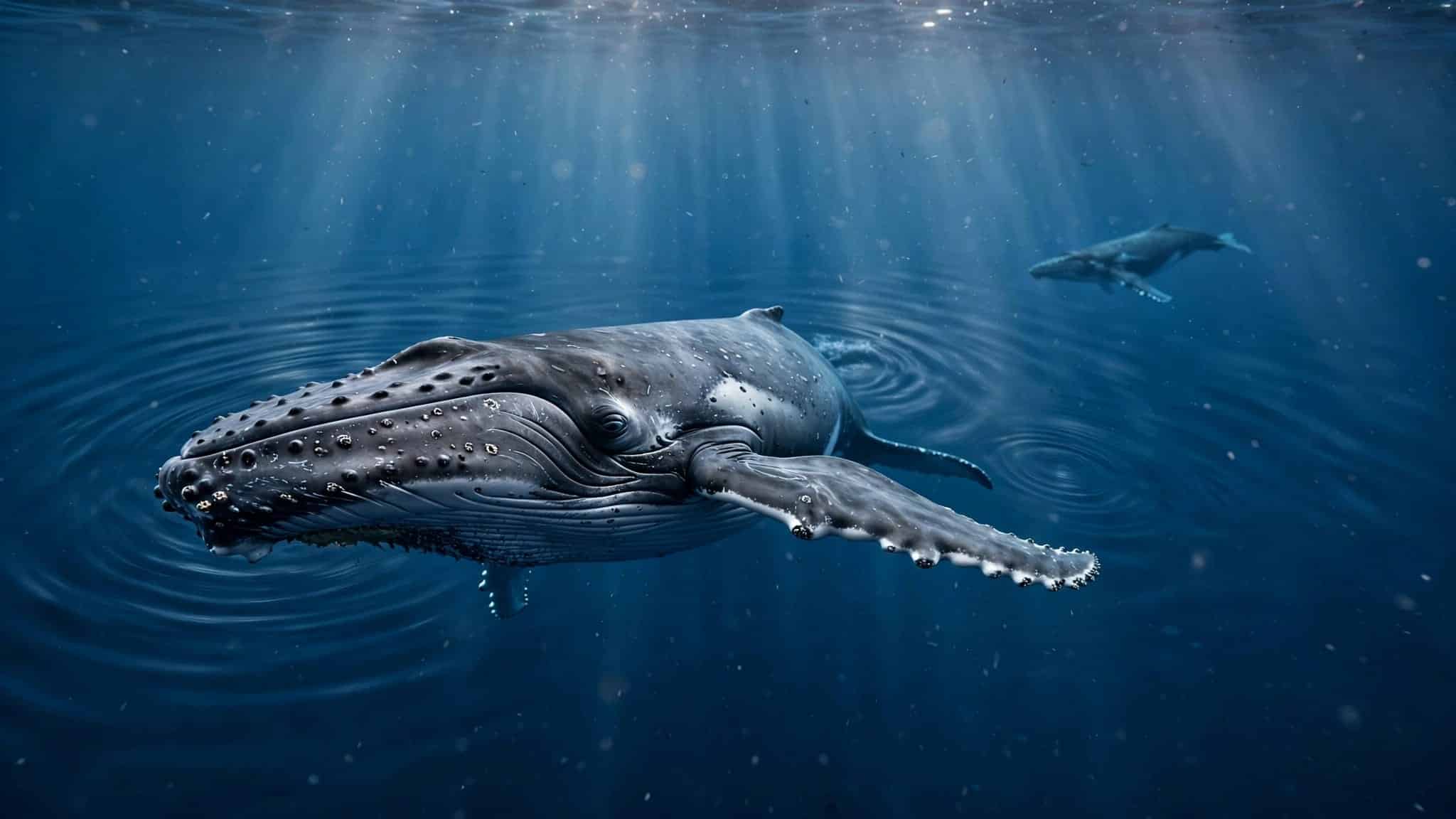
A whale’s call can travel through dark water long before its maker comes into view. To understand what it means, researchers listen for patterns, watch what the whales are doing, and look for responses from other whales.
The answer comes through context, much like understanding a conversation when you can’t make out every word. How does one connect a sound to a possible message? It starts with listening to more than one call.
This post may contain affiliate links. If you make a purchase through these links, I may earn a small commission at no extra cost to you.
Why whales rely on sound
Imagine trying to recognize a friend across a room with the lights off. Their voice would become much more useful than the color of their shirt. For whales, sound can carry information through water where visibility may be limited.
According to NOAA Fisheries on underwater sound, marine mammals use sound to communicate and assess their surroundings. Depending on the species, the sounds researchers hear include clicks, whistles, pulses, and long sequences that we call songs.

Different sounds can do different jobs. Some toothed whales produce clicks for echolocation, sending sounds into the water and listening for echoes that reveal objects or prey. A social call, meanwhile, may affect another animal’s behavior.
That distinction matters when thinking about how vaquitas use clicks to navigate. An echo can tell a porpoise something about its surroundings, even when there isn’t another animal receiving a message.
How researchers study whale calls
A recording is a starting point. To make sense of it, scientists need clues about the whale that made the sound and what happened around it.
Listening beneath the surface
Researchers use underwater microphones called hydrophones to record sounds that people on a boat might never hear. Some remain in one place for long periods. Others are used alongside observations of animals at sea.

A recording can contain several callers, along with waves, boats, and other background sounds. Figuring out which animal produced a call can be difficult, particularly when whales are underwater and out of sight.
Looking at a sound’s shape
Scientists also use spectrograms, visual displays that show how a sound’s frequency and strength change over time. You can think of one as a picture of a recording, although it takes some practice to read.
Pitch and rhythm give researchers something to compare. A short pulse may look different from a rising call, while repeated clicks may form a recognizable sequence. NOAA’s marine mammal acoustics resources show examples of calls represented this way.
Identifying a pattern is useful. Understanding what another whale makes of that pattern takes more evidence.
What gives a whale call its possible meaning?
A sound becomes more informative when researchers can connect it to an interaction. They look at who is present, what the animals are doing, and whether another whale responds.
Behavior adds context
Suppose a particular call often occurs when whales are close together. That pattern may suggest a social role. If another animal regularly changes direction or answers after hearing it, the response gives researchers another clue.
One observation isn’t enough to establish a reliable connection. A whale might call while moving toward a companion because it is keeping contact, because something else nearby caught its attention, or for a reason humans haven’t considered.
Researchers therefore compare many occasions, including times when the call occurs without the expected behavior. Those exceptions help them refine an explanation instead of settling on the first attractive guess.
The same sound may have more than one role
Human voices offer a useful comparison. A person’s name can get their attention, express affection, or warn them that they’re about to sit on a sandwich. Tone and situation matter.
Whale calls deserve the same care. A sound associated with a social encounter may contribute to the interaction without carrying a fixed message that can be written as an English sentence. The listeners’ identities and circumstances may also matter.
What sperm whale clicks reveal
Sperm whales produce short sequences of clicks called codas during social interactions. The timing of those clicks gives researchers a way to compare one sequence with another.
A closer look at codas
A 2024 study involving Project CETI and the Dominica Sperm Whale Project examined nearly 9,000 codas recorded over more than a decade from sperm whale families in the Eastern Caribbean.
The researchers found recurring features in the click patterns, including rhythm and tempo. They also described small timing adjustments and extra clicks that appeared in some contexts. Those features give scientists a more detailed picture of how codas are organized.
This is a little like noticing that people can vary the pace and emphasis of a familiar phrase. The comparison helps us imagine what scientists are measuring, though it doesn’t mean the whales are using human-style phrases.
Patterns are clues, not a dictionary
The study described a possible “phonetic alphabet” of coda features. That phrase refers to building blocks in the sounds, not a set of words researchers can translate.
The findings apply to the codas and population studied. They don’t automatically explain every sound made by sperm whales elsewhere, or tell us what an individual whale intended during a particular exchange.
There is still plenty to learn about how the whales respond to these variations. The click patterns are interesting; the social situations surrounding them may be just as interesting.
What humpback songs tell researchers
Humpback whales are known for long, patterned songs made up of repeated sounds. Researchers can follow changes in those patterns across time and compare what singers in the same area are doing.
Song and social settings
Male humpbacks sing, and song is often heard on breeding grounds. The connection makes mating behavior an important part of the investigation, although the precise role of song is still being studied.
There are several possibilities to consider. A song might influence females, other males, or both. Observing which animals approach a singer, and what happens afterward, can help narrow those possibilities.
Sound is one of many ways animals communicate during reproduction. Our look at animal courtship signals and behavior offers a comparison with displays that rely on movement, color, and other sensory clues.
Songs change over time
In many parts of Hawai’i, male humpback song becomes a dominant source of underwater background sound between December and April, according to the Hawaiian Islands Humpback Whale National Marine Sanctuary.
Researchers have also studied how song patterns change. A 2025 report in Science described work using eight years of recordings from New Caledonia. The study found statistical similarities between the structure of humpback song and patterns found in human language.
That resemblance is a clue about organization. It doesn’t establish that a song contains words with meanings equivalent to ours.
How do scientists test an interpretation?
Listening and watching can reveal a connection, but researchers also need to ask whether their interpretation holds up in other situations.
Compare more than one explanation
If whales frequently gather after a particular call, the call might help coordinate the group. The whales might also be gathering for another reason that happens to coincide with the sound.
Researchers can compare encounters across different times and settings. They can look for occasions when the call is absent, when the animals don’t gather, or when a similar call occurs during a different activity.
This is the patient part of animal communication research. The most appealing explanation has to make room for the awkward observations too.
Observe responses to recordings
In some studies, researchers play a recorded sound and observe how animals respond. A useful experiment compares that response with what happens under suitable control conditions, such as when a different sound or no sound is played.
A whale turning toward a speaker could show that it noticed the recording. Interpreting the turn takes more care. The animal may be curious, cautious, or responding to features of the sound that researchers haven’t identified.
A response can strengthen an idea about a call’s function. It doesn’t automatically reveal the caller’s thoughts.
Can artificial intelligence translate whale calls?
Artificial intelligence can help researchers sort through enormous amounts of underwater audio and find recurring patterns. That matters when recordings run for months and a human listener cannot easily examine every second.
NOAA describes using AI to study humpback whales, including its potential for finding whale sounds in large collections of recordings. A system may learn to recognize a call type or separate it from background noise.
Finding structure and understanding meaning are different tasks. A computer can group similar sounds without knowing what the animals were doing or how a listener responded.
For a more useful interpretation, researchers still need information about behavior, identity, and social context. AI can help them notice patterns worth investigating. The whales provide the evidence about whether those patterns matter.
Why ocean noise is part of the conversation
Understanding calls also means considering what whales can hear around them. Vessel traffic and other human activities add sound to the ocean, sometimes overlapping with animal calls.
Background noise can make a signal harder to detect, much as a conversation becomes difficult beside a busy road. The effect depends on the sound, the distance, and the animals involved.
A 2024 humpback study observed more singing males during periods when nearby seismic air guns were active. The singers were also more likely to be observed joining females during the exposure. Those observations show a behavioral association in the conditions studied, rather than a translation of the songs.
Key takeaways
Researchers work out possible meanings by pairing recordings with observations of behavior and responses. Repeated patterns offer useful clues, while differences between encounters help test an explanation.
Sperm whale codas and humpback songs both have structure worth studying. Their sounds become more informative when scientists can connect that structure to the animals’ lives.
Frequently asked questions
Do all whales make the same sounds?
No. Different species produce different kinds of sounds, and the calls within a species can vary too. A sperm whale’s social clicks, for example, sound quite different from a humpback’s song.
Is every whale sound a message?
A sound can have a purpose without being a message to another whale. Echolocation clicks can help an animal detect objects through their returning echoes. Other sounds may be part of social interactions.
Can humans understand a whale call by listening once?
A single recording may help identify a sound or species, particularly if the call is distinctive. Working out its possible function generally requires repeated observations and information about what happened around it.
Listening for the whole conversation
A whale’s call can tell us more when we know who made it, who was nearby, and what happened next. Even then, the strongest answer may be a careful possibility rather than a tidy translation.
That’s part of what makes the question fascinating. Each recording is a small piece of an underwater social life, and understanding it means paying attention to the whales as well as the sound.


