
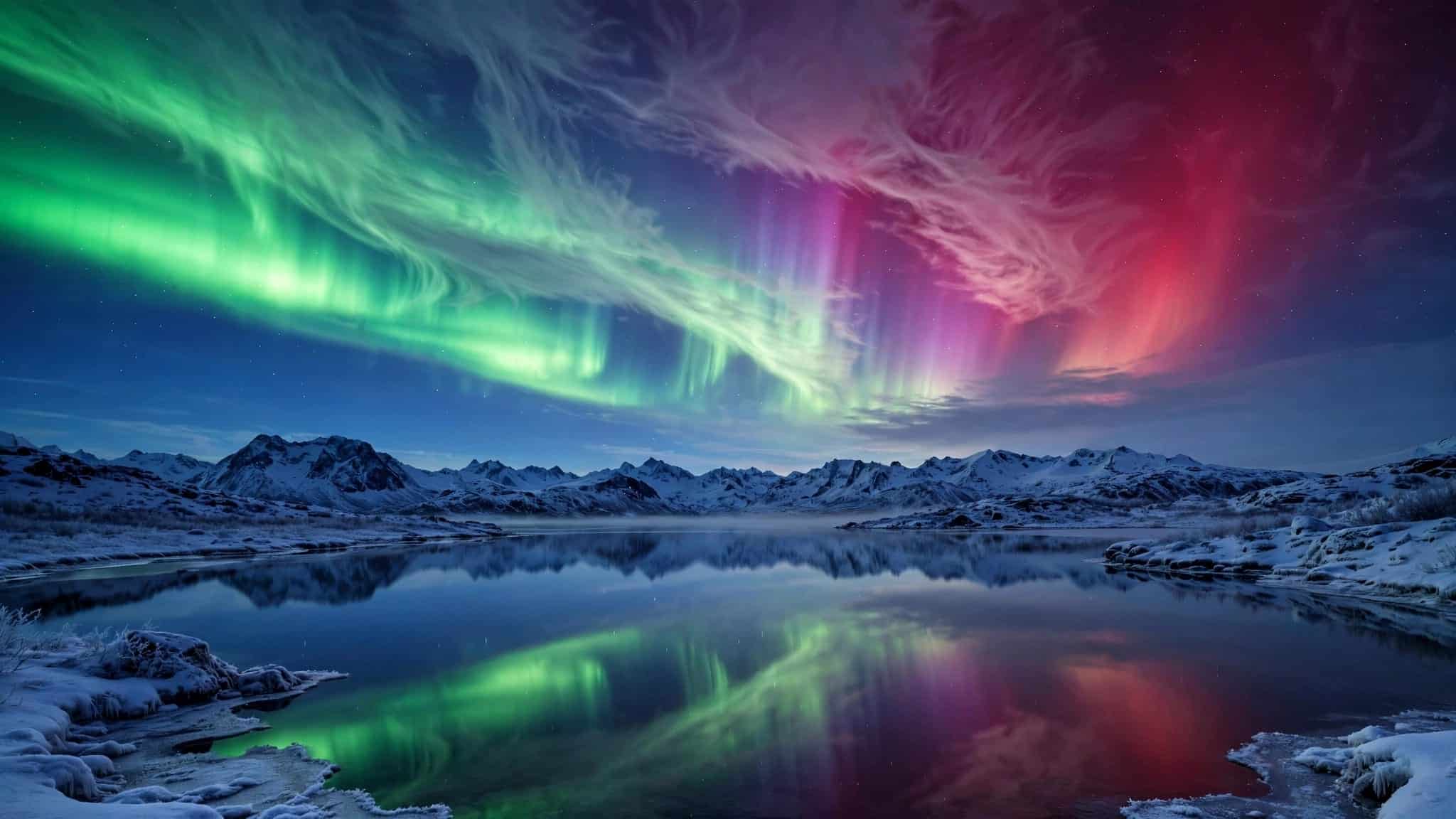
Northern lights colors come from gases in Earth’s upper atmosphere giving off light after encounters with charged particles. Oxygen is responsible for the familiar green and some red glows, while nitrogen can produce blue.
How does one explain a display that seems to change color before your eyes? The answer involves the Sun, Earth’s magnetic field, and a surprisingly colorful layer of air. Let’s start with how that light reaches the sky.
This post may contain affiliate links. If you make a purchase through these links, I may earn a small commission at no extra cost to you.
How the Northern Lights Begin
The northern lights, also called the aurora borealis, begin with a relationship between the Sun and Earth that continues even when the night sky looks ordinary.
Charged Particles Travel Through Space
The Sun releases a steady stream of charged particles called the solar wind. These particles carry electric charges, which makes their behavior sensitive to magnetic fields.
Earth has a magnetic field that extends far into space. When the solar wind interacts with that magnetic environment, particles can be directed toward the atmosphere near the polar regions. Our explanation of how the Sun works gives more context for this constant flow of particles and the Sun’s changing activity.

The Atmosphere Becomes a Light Source
When charged particles encounter gases high above Earth, those interactions can make the gases give off light. The result is an aurora: a glow produced in the atmosphere itself.
Think of the atmosphere as a stage with several performers. Oxygen and nitrogen are among the main participants, and each can contribute different colors under different conditions. The display may look like painted fabric hanging in the sky, but the light comes from countless tiny interactions far overhead.
How Gases Produce Auroral Light
To understand the colors, it helps to look at what happens to an individual atom or molecule. An atom is a basic unit of an element, such as oxygen. A molecule is a group of atoms joined together, such as the nitrogen molecules found in Earth’s atmosphere.
When a charged particle transfers energy during an encounter with an atmospheric atom or molecule, the gas can enter an excited state. That means it temporarily holds more energy than it did before.
As it returns to a lower-energy state, it can release some of that energy as light. A small packet of light is called a photon. Its color depends on the amount of energy carried by that photon.
This doesn’t mean each gas behaves like a paint tube with one fixed shade. Oxygen, for example, can produce both green and red auroral light. Nitrogen can contribute blue. NASA’s guide to aurora colors describes how these gases participate in the display.
The process is happening on an enormous scale. You don’t see one atom flashing. You see light reaching you from a vast region of the upper atmosphere, where many interactions are taking place.
What Produces the Different Northern Lights Colors?
Green may be the color most people picture, but an aurora can also show red, blue, pink, or purple. The gases present and the height of the glowing region help explain the colors.

Green and Red Light From Oxygen
The familiar green glow is associated with oxygen roughly 60 to 120 miles (100 to 200 kilometers) above Earth. Green curtains can stretch across a large part of the sky, sometimes appearing as a soft arc before becoming more detailed.
Red auroral light can also come from oxygen, but it is associated with higher altitudes, above roughly 120 miles (200 kilometers). In some displays, red appears above green, giving the curtains a reddish crown.
NASA’s aurora guide gives these altitude ranges as a way to connect the observed colors with the gases involved. They’re useful guidelines, although a real display doesn’t arrive with neat boundary lines.
Blue and Other Colors in the Display
Nitrogen can produce blue auroral light in the region roughly 60 to 120 miles above Earth. Blue may be less obvious to a viewer than green, especially when the display is faint.
Pink and purple shades can also appear in auroras. A photograph may show delicate colored edges that are difficult to distinguish with the unaided eye. Different amounts of colored light can overlap in the view, so the final appearance isn’t always one gas producing one perfectly isolated stripe.
Why Altitude Matters to What You See
The atmosphere doesn’t end at a sharp line above the clouds. It becomes thinner with height, and an aurora can occupy a substantial vertical region within it. When you look up, you’re seeing light that has traveled to you from that region.
Looking Up Through Layers
Imagine looking at a tall curtain from below. Your view includes its lower edge and its upper reaches, even though those parts are at different heights. An aurora can give you a similar impression, with green lower down and red higher above.
The analogy has limits: auroral curtains aren’t solid sheets. Their colored regions can overlap, and the display’s shape changes. Still, thinking in three dimensions helps explain why several colors can appear together rather than taking turns across a flat sky.
Seeing a Distant Red Glow
Your position also changes which parts of a display are visible. A distant aurora may sit low on your horizon, where its lower portions are hidden from view while higher regions remain visible.
That helps explain why red can be seen during some displays at lower latitudes. NASA’s guide to finding auroras notes that the oxygen responsible for red light is found high in the atmosphere, where it can be visible over greater distances.
A red glow near the horizon can therefore be part of a much larger display, even when you can’t see everything happening above it.
Why the Colors Seem to Shift
Watching an aurora can feel different from looking at a photograph. A picture preserves one view, while the sky may brighten, fade, and change shape during the time you watch.

A green arc might develop brighter folds, or a red area might become easier to notice above it. At other moments, the whole display may look pale. What you describe as a color shift can include a change in which glowing areas are most visible to you.
This is where the curtain comparison becomes useful again. If one section of a large, colored curtain catches your attention while another fades into the background, the overall scene looks different. With an aurora, the light itself can brighten or dim across different areas.
The important distinction is between the color a region produces and the color you perceive across the whole sky. Your view gathers light from a large area, and your eyes respond to the brightness available at that moment.
Why Photos Can Look More Colorful Than the Sky
You may see a pale glow, take a photograph, and discover a vivid green or red display on the screen. That can be surprising, especially if the photograph looks like it was taken during an entirely different evening.
Your Eyes Need Light to See Color
Your eyes use different kinds of light-sensitive cells. Cone cells help you distinguish colors, but they work best when enough light is available. Rod cells are more useful in dim conditions and don’t distinguish colors in the same way.
A faint aurora may therefore look grayish or only slightly green, even when it contains colored light. As it brightens, those colors can become easier to see. Surrounding lights and how well your eyes have adjusted to darkness also affect your view.
A Camera Collects Light Differently
A camera can gather light over an exposure, and its settings affect the resulting image. A longer exposure can reveal colors that were subtle to your eyes, although it can also blur details in a changing display.
Image processing matters too. Adjustments to brightness, contrast, and color can make a photograph look more vivid. That doesn’t automatically make the image dishonest, but it does mean a photograph and a person’s immediate view aren’t identical records.
Give yourself a moment to look at the sky before looking at the screen. The camera may show more color; your eyes can follow how the display changes.
Is an Aurora Like a Rainbow?
Auroras and rainbows both make the sky colorful, but they produce that color in different ways.
A rainbow begins with sunlight entering water droplets. The light bends, reflects inside the droplets, and bends again as it leaves. Different wavelengths bend by different amounts, separating the light into a spectrum.
An aurora comes from atmospheric gases emitting light after interactions with charged particles. The colors originate in those emissions rather than in droplets separating a beam of sunlight.
Other atmospheric glows can look similar to an aurora, too. NASA describes airglow and aurora appearing together in a view from the International Space Station. Similar-looking colors don’t necessarily mean the sky is producing them through the same process.
Where Can You See the Northern Lights?
Auroras are most often associated with regions near Earth’s magnetic poles. In the Northern Hemisphere, that includes places such as northern Norway, Iceland, Alaska, and northern Canada.
You don’t need to be at the geographic North Pole to see them. Auroral displays can cover a broad area, and some extend farther toward lower latitudes during stronger disturbances in Earth’s magnetic environment.
Darkness and a clear view matter. Clouds can hide the display, while nearby artificial light can make faint colors harder to distinguish. A view toward the northern horizon can be helpful when an aurora is occurring farther north.
The southern hemisphere has its own counterpart, the aurora australis. It arises through the same general interaction between charged particles and atmospheric gases. Different name, different part of the globe, and the same colorful conversation between Earth and space.
A Sky With More Than One Color Story
The northern lights change our view of the night sky because many glowing regions can be visible at once. Oxygen can contribute green and red, nitrogen can contribute blue, and your position and eyesight influence what you notice.
The next time an aurora appears to shift, look for the height and brightness of its different areas. What seems like one ribbon of color may be a much larger display, with light reaching you from different parts of the atmosphere.


