
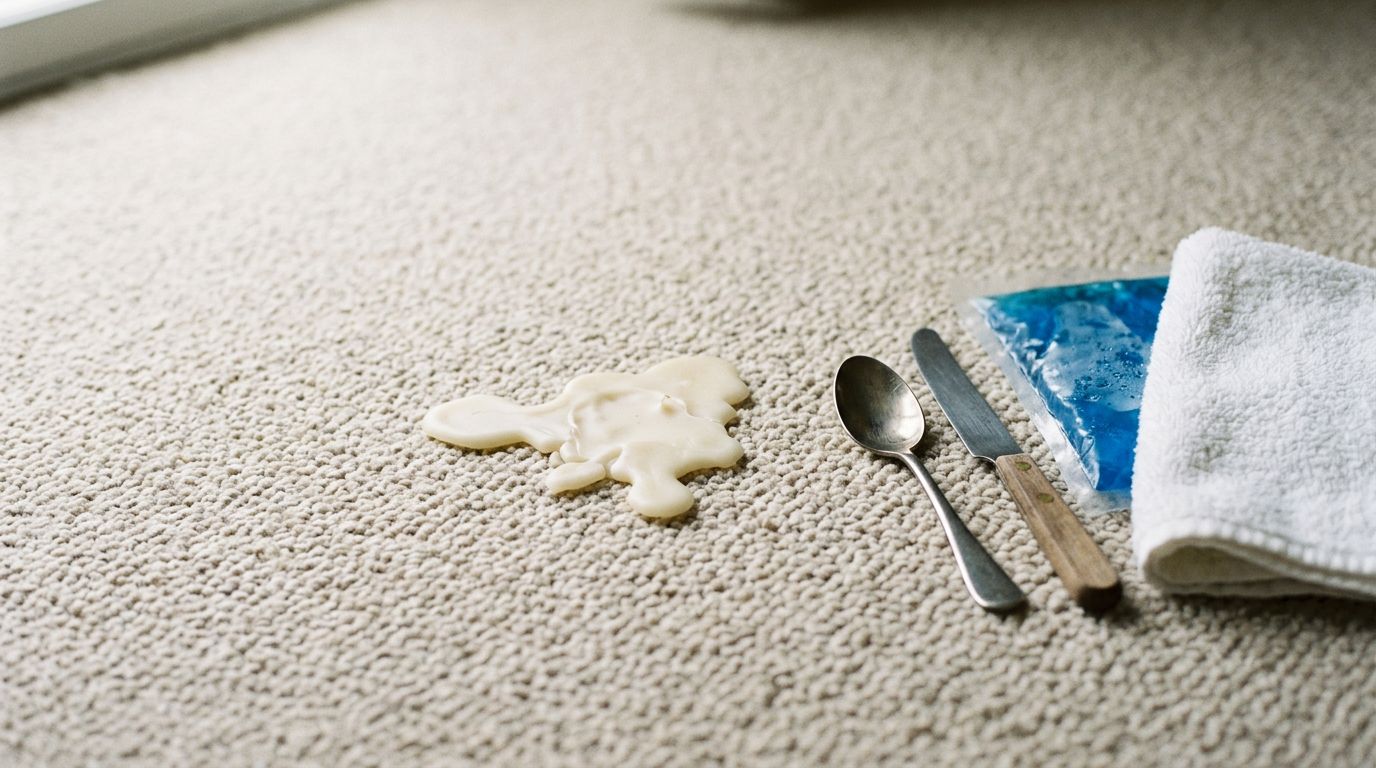
A dropped candle can turn a quiet evening into a small domestic crime scene, especially when a wax spill settles into the carpet and somebody eyes a kitchen knife.
Don’t scrub. To remove candle wax carpet spills safely, harden the wax first, then lift and blot it away in stages. Heat has a place, but only after most of the wax is gone.
Your carpet’s fiber changes the details, so look closely before anything warm touches it.
This post may contain affiliate links. If you make a purchase through these links, I may earn a small commission at no extra cost to you.
Candles belong on stable, hard surfaces. Carpet is not their friend.
Key Takeaways
- Freeze the wax first, then gently lift it with a spoon or dull butter knife instead of scrubbing or digging into the carpet.
- Use low heat only for the thin residue left behind, with a clean white towel between the iron and the carpet.
- Treat dye or oily residue after the solid wax is gone, testing dish soap or isopropyl alcohol in an inconspicuous area first.
- Match the method to the carpet fiber, and use extra caution with wool, Berber, silk, viscose, antique, or hand-knotted rugs.
- Call a professional for large spills, deeply colored wax, wax that reaches the backing, valuable rugs, or unidentified fibers.
Check the carpet before you start cleaning
Fresh wax looks like an emergency, but touching it while soft only pushes it deeper. Let it lose its shine and begin to firm up. For a larger wax spill, use cold to speed things along instead of blotting frantically.
Find the carpet’s care label if possible. Nylon and polyester handle cautious low heat better than delicate wool, silk, viscose, or unknown rug materials. Berber needs extra patience because its loops can snag, pull, and leave a visible run.
Gather an ice pack or a sealed plastic bag of ice, a dull butter knife or spoon, a clean white cotton towel, plain white paper towel, and clear dish soap. A low-heat iron can help with residue. A brown paper bag can work too, if it’s plain, unprinted, and neither wax-coated nor plastic-coated.
Skip dark towels, newspaper, patterned napkins, and anything that could transfer its own dye. Candle wax is enough trouble without adding a newspaper print tattoo to the carpet.
Use a two-stage wax removal method
Freeze the wax, then lift it gently
Put ice cubes in a zip-top bag, or wrap an ice pack in a thin cloth. Hold it over the wax for several minutes until the spill feels brittle. The goal is not to soak the carpet. When you freeze the wax, it becomes brittle instead of smearing across the pile.
Use the rounded edge of a spoon or a dull butter knife to scrape the wax away. Work slowly, keeping the tool nearly flat against the pile. Digging downward can damage carpet fibers or drive wax deeper toward the backing.
Pick up the loose pieces as you go. Then vacuum the area, using a hand vacuum for looped Berber carpet instead of a beater bar.
If you are dealing with a thick lump, repeat the ice treatment rather than forcing it. Work in layers instead of trying to melt the wax before most of it has been lifted. Wax comes away gradually, and that is normal.
Transfer the last wax with low heat
After scraping, the carpet may feel clean but still look dull or stiff. That usually means a thin film of wax remains around the fibers. This is where a warm iron and absorbent cloth can help.
Lay a clean white towel over the spot. Set the iron to its lowest heat setting and turn off the steam. Place it on the towel for two or three seconds, then lift it straight up. Check the towel for wax, move to a clean area, and repeat.
Do not press hard. Do not rub in circles. A hot iron should never touch the carpet directly, even for a second.
Direct heat can flatten, scorch, or melt synthetic fibers long before the wax has finished transferring.
If the towel stops absorbing wax, replace it. The safest way to clear the remaining residue is short contact, a clean section of towel, and a quick inspection after every pass. Slow is not glamorous, but neither is a melted patch of polyester.
Treat a candle wax stain after the wax is gone
Colored wax does not automatically leave a permanent colored stain. Dye and oily residue can remain after the solid wax has been removed, especially with red, blue, purple, or heavily scented candles. The carpet may also show a faint ring where melted wax traveled through the pile.
Start with a mild cleaning solution. Mix a small amount of clear, dye-free dish soap into cool water. Test it on an inconspicuous area first. Dampen a white cloth, then blot the affected area from the outside toward the center. Don’t pour the solution onto the carpet. Wet backing takes ages to dry and can leave an odor behind.
For a residual stain, oily line, or dye haze, isopropyl alcohol can help. After testing isopropyl alcohol in an unseen area, put a little on a clean white cloth, not directly on the carpet. Change to a fresh portion of cloth as color lifts.
Isopropyl alcohol is useful for residue and some dyes. It is not a substitute for removing solid wax first. Pouring alcohol over a waxy patch usually creates a damp, unpleasant mystery rather than solving one.
Finish by blotting the area with a cloth lightly dampened with plain water, then press it dry with a towel. If color remains, use a carpet cleaner, such as a carpet spot cleaner approved for your carpet type, and follow its label. Don’t combine cleaners, alcohol, and dish soap into one homemade potion.
Match the heat method to the carpet fibers
A hair dryer can replace an iron, with limits
A hair dryer on low heat can soften leftover wax if an iron makes you nervous. Hold it several inches away, warm a small section for a few seconds, and blot immediately with a white towel. Keep the airflow moving, using only enough heat to melt the wax.
This creates a controlled transfer, not permission to heat the carpet until the wax or fibers deform. It takes longer than an iron and spreads heat over a wider area. That makes it easier to lose track of the temperature, so a hair dryer is not automatically harmless.
| Carpet type | Safer approach | What to avoid |
|---|---|---|
| Nylon or polyester | Use brief, low-heat towel transfers after a hidden test. | Direct iron contact or prolonged heat. |
| Olefin or polypropylene | Favor freezing first and use the gentlest heat possible. | High heat, which can distort fibers. |
| Wool | Use minimal moisture and heat, then blot carefully. | Strong alkaline cleaners and aggressive rubbing. |
| Berber loop carpet | Lift wax with a spoon and work around loops. | Pulling, digging, or using a sharp blade. |
Silk, viscose, antique rugs, and hand-knotted wool rugs deserve a professional cleaner from the start. Don’t experiment with a spot cleaner on these materials, since they can change texture or bleed color with surprisingly little moisture.
If the brown paper bag gets stuck
A brown paper bag can cling to wax if the iron was too warm or stayed in place too long. Don’t yank it off. Let the area cool, place ice over the bag for a few minutes, then peel it back slowly.
If the paper still resists, cover it with a white towel and apply low heat for a couple of seconds. The goal is to release the wax into the towel, not tear at the carpet loops underneath. Once the paper is gone, continue with a fresh white cloth.
Know when to call a carpet cleaner
A small wax spill is usually manageable at home. On ordinary, colorfast carpet, a small remaining mark may respond to a carpet spot cleaner. A wide puddle, deeply colored wax, wax reaching the backing, a valuable rug, or unidentified fibers calls for professional care.
Look for a cleaner certified by the Institute of Inspection, Cleaning and Restoration Certification, often called IICRC. A professional has extraction tools and spot treatments that are less risky than repeating home remedies until the carpet gives up. If you try a spot cleaner on a minor mark, follow the product label and test it in an inconspicuous area.
Future spills are easier to prevent than repair. Keep candles in stable holders on a hard tray or table, away from carpeted floors and loose rugs. Let a candle cool completely before moving it. Wax has a talent for choosing the worst possible moment to escape.
Frequently Asked Questions
Can I scrape candle wax out of carpet while it is still warm?
No. Warm wax can spread deeper into the pile and make the spill larger. Let it harden naturally or chill it with an ice pack before lifting it gently.
Can I use an iron to remove candle wax from carpet?
Yes, but only after most of the wax has been removed and with a clean white towel between the iron and the carpet. Use the lowest heat, turn off the steam, and apply it for only two or three seconds at a time.
What should I do if colored candle wax leaves a stain?
First remove all solid wax, then test a mild solution of clear dish soap and cool water on an inconspicuous area. For stubborn dye or oily residue, tested isopropyl alcohol on a clean white cloth may help, but do not pour it directly onto the carpet.
Is a hair dryer safer than an iron for removing wax?
A hair dryer on low heat can soften the remaining wax, but it still needs careful control. Hold it several inches away, keep the airflow moving, and blot immediately with a white towel.
When should I call a professional carpet cleaner?
Contact a professional for large spills, wax that has reached the backing, strongly colored wax, valuable rugs, or unknown fibers. Silk, viscose, antique, and hand-knotted wool rugs are especially poor candidates for home experimentation.
A Clean Carpet Is Mostly About Patience
Wax can feel permanent when it lands in carpet, but usually it isn’t. Freeze it, lift it gently without digging, and use only the heat needed to transfer the residue.
The real danger isn’t the wax itself. It’s rushing with sharp tools, soaking cleaners, or placing a hot iron directly on the pile.


